- Research and Breakthroughs
University of Guelph Tests AI-Powered AgriScout Robot for Early Crop Disease Detection
University of Guelph researchers are testing AgriScout, an autonomous AI-powered robot that uses computer vision to detect crop diseases, pests, and plant stress early, supporting smarter and more efficient farming.
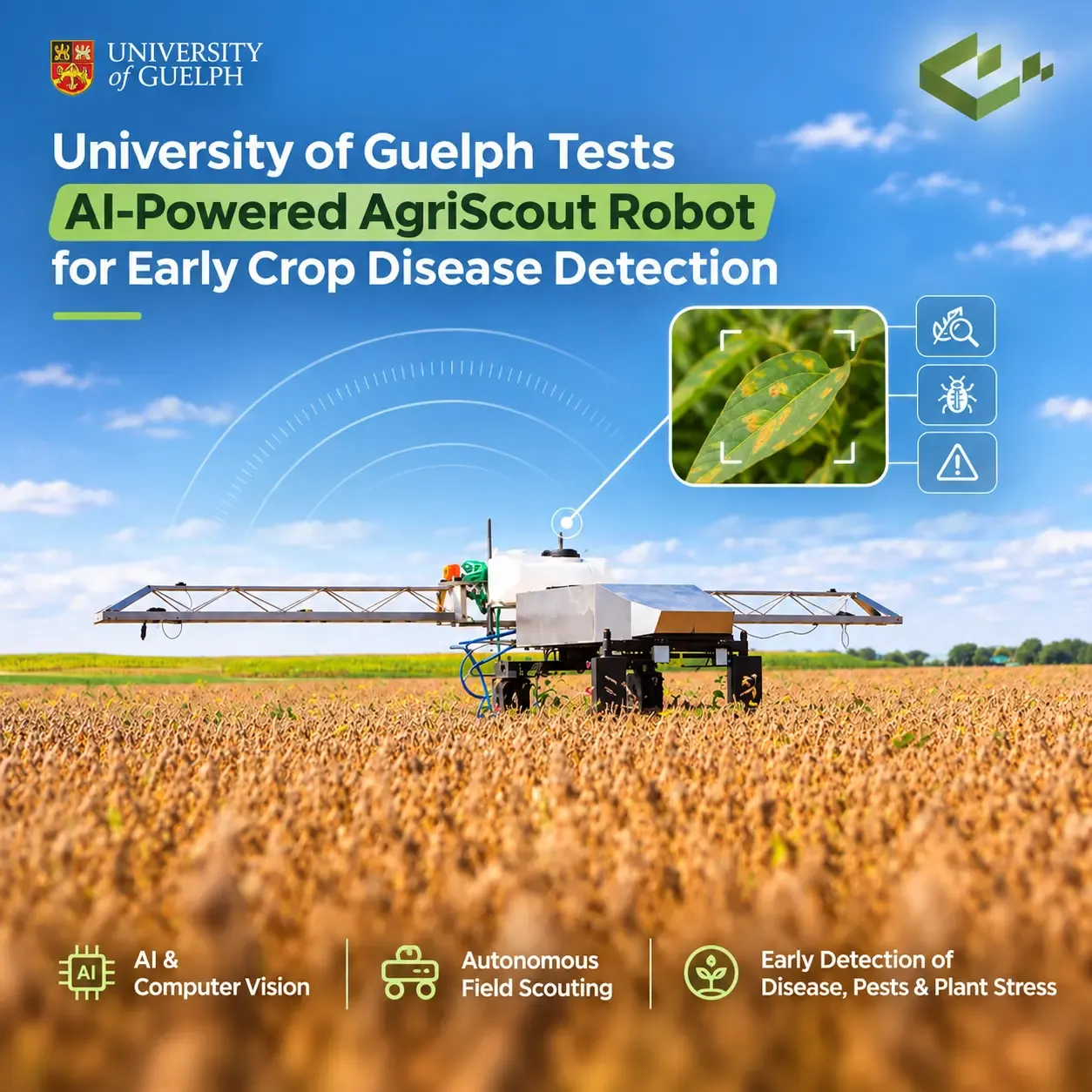
Researchers at the University of Guelph in Ontario, Canada, are testing AgriScout, an autonomous agricultural robot designed to help farmers detect crop diseases, pest damage, and plant stress earlier through artificial intelligence and computer vision.
Developed by a research team involving computer science master's student Jacob Serafin and researcher Dr. Gurjit Randhawa, AgriScout moves autonomously through agricultural fields, capturing crop images using onboard cameras and sensors. AI models then analyze these images to identify visual signs of potential crop health problems.
From Manual Scouting to Intelligent Field Monitoring
Traditional crop scouting often requires farmers or agricultural specialists to walk through fields and manually inspect plants. This process can be time-consuming, particularly across large farming operations, and early symptoms of disease may be difficult to identify.
AgriScout aims to automate part of this process by continuously collecting field-level visual data and using computer vision to identify potential problem areas.
Early disease detection could allow farmers to target specific affected areas rather than applying treatments uniformly across entire fields. This approach has the potential to reduce crop losses, optimize the use of agricultural inputs, and support more efficient crop management.
Taking AI Beyond the Laboratory
One of the project's important aspects is its focus on real-world agricultural conditions.
Operating in an actual field presents challenges that go beyond developing accurate AI models. Changing lighting conditions, uneven terrain, dust, rain, battery limitations, and unreliable connectivity can all affect system performance.
The development team has therefore had to address mechanical engineering, camera integration, electronics, power management, and data collection alongside computer vision.
The project highlights an important principle in agricultural AI: successful field applications require more than accurate models. Reliable hardware, consistent data collection, and practical deployment are equally essential.
The Future of AI-Powered Crop Monitoring
AgriScout reflects a broader shift toward intelligent agricultural monitoring systems that combine robotics, computer vision, and AI to provide more timely and actionable insights.
As these technologies mature, autonomous scouting platforms could become valuable tools for precision agriculture, helping farmers monitor crop health, identify emerging problems, and make more informed field management decisions.
The project is supported by Canada's Natural Sciences and Engineering Research Council (NSERC) and the Ontario Ministry of Agriculture, Food and Agribusiness.
Share this news
Help others discover this content
Comments
Be the first to share your thoughts
No comments yet
Start the conversation by sharing your thoughts