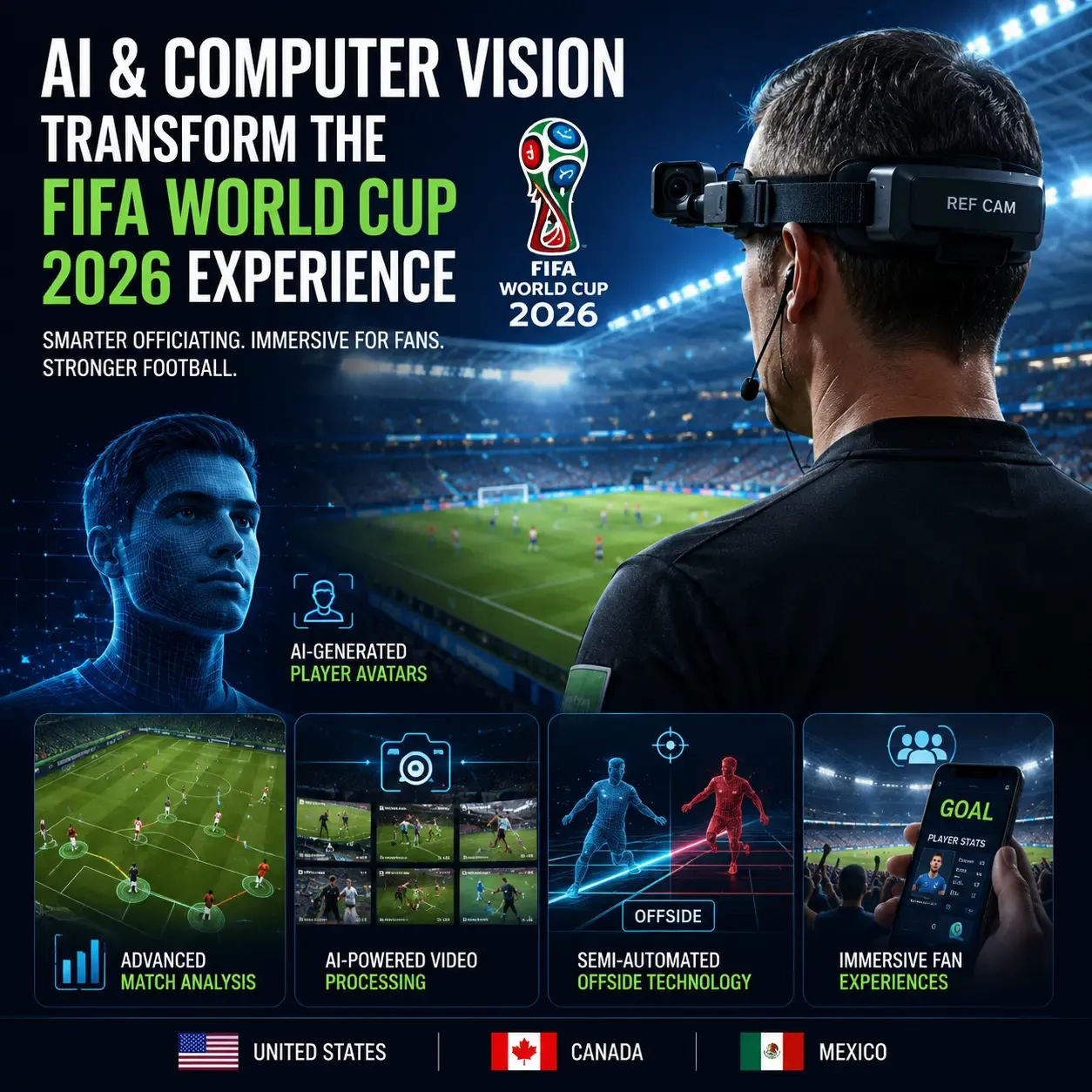
The FIFA World Cup 2026 is making history not only as the first tournament to feature 48 teams across three host nations—the United States, Canada, and Mexico—but also as a major milestone in the adoption of artificial intelligence and computer vision technologies in professional sports. In collaboration with Lenovo, FIFA has introduced a range of AI-powered innovations designed to improve officiating, enhance fan engagement, and provide richer match analysis. One of the tournament's most notable additions is the Referee View, a head-mounted camera system that gives fans the opportunity to experience the game from the referee's perspective. The footage offers a unique view of the pace, positioning, and decision-making involved in officiating at the highest level of football, creating a more immersive experience for viewers while also serving as a valuable resource for referee education and performance analysis. FIFA has also introduced AI-generated player avatars, enabling fans to interact with realistic digital representations of players. These avatars are created using advanced computer vision and artificial intelligence technologies that reconstruct players in three dimensions, opening the door to new forms of digital storytelling and interactive fan experiences. Artificial intelligence also plays an increasingly important role behind the scenes. AI systems help process and organize large volumes of video footage captured during matches, making it easier for broadcasters and production teams to identify significant moments and generate highlights more efficiently. These technologies reduce manual effort while enabling faster content delivery across television and digital platforms. Another key innovation is the continued evolution of semi-automated offside technology, which combines computer vision, multiple synchronized cameras, and sensor data to assist match officials in making faster and more accurate offside decisions. Rather than replacing referees, the system is designed to provide reliable decision support, improving both consistency and efficiency during critical moments of the game. Beyond officiating, the tournament demonstrates how AI is becoming an essential component of modern sports operations. Technologies such as real-time video analysis, automated content generation, player tracking, and immersive viewing experiences illustrate the growing convergence of artificial intelligence, computer vision, and sports entertainment. According to FIFA, these innovations represent part of a broader strategy to leverage emerging technologies in ways that benefit players, officials, broadcasters, and fans alike. As AI continues to evolve, major sporting events such as the FIFA World Cup are becoming important platforms for showcasing how intelligent vision systems can enhance both operational performance and audience engagement.
Source:
FIFA Innovation – Lenovo brings AI, Ref Cam and Player Avatars to the FIFA World Cup 2026