Oct 12, 2026
WeedNet AI Identifies More Than 1,500 Weed Species with High Accuracy
A new AI framework called WeedNet can identify over 1,500 weed species with 91% accuracy—and up to 97% when adapted to local regions. Published in Nature Communications, the model could power precision spraying, robotic weed removal, and smarter farm monitoring.
- Agriculture
- AI in Business
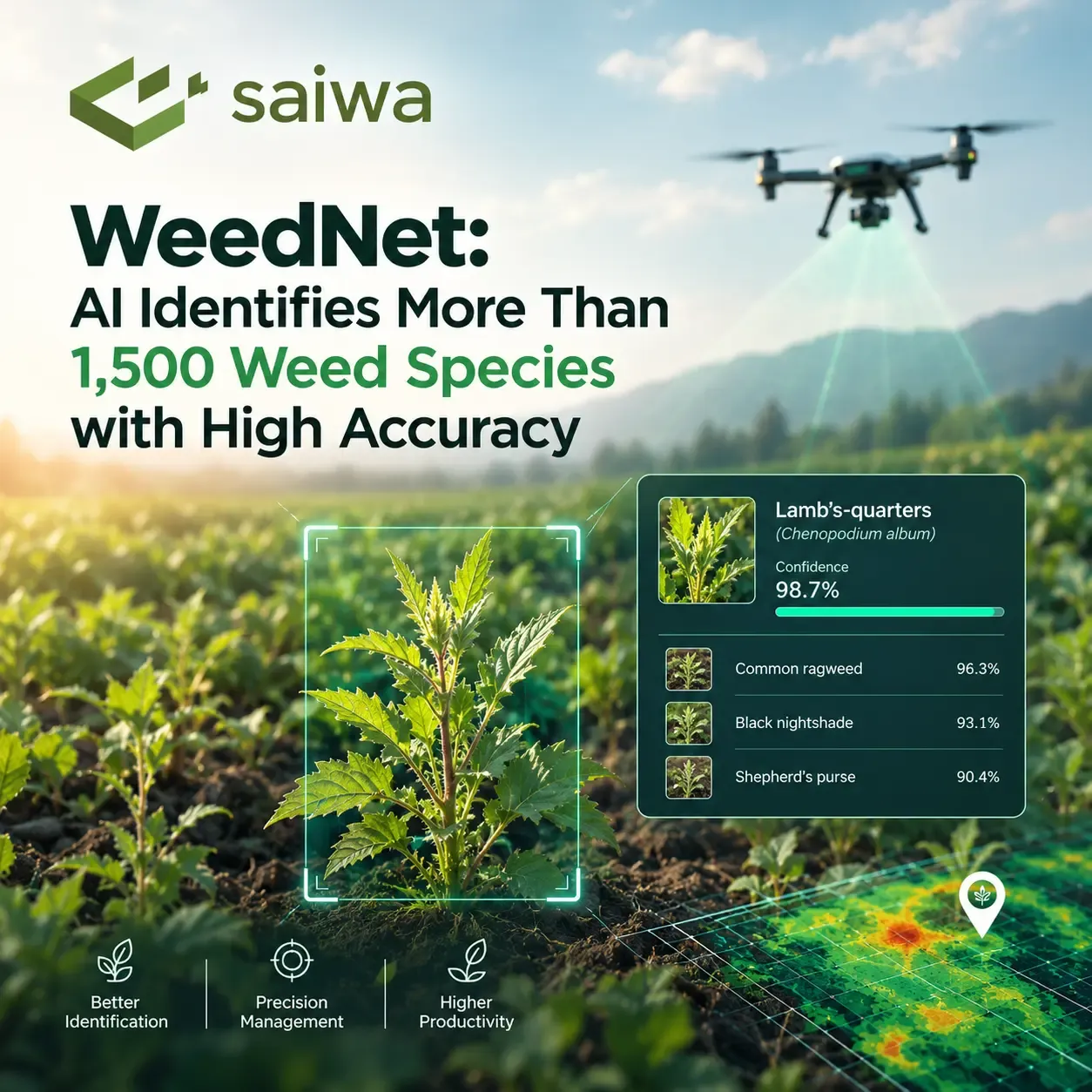
A new study published in Nature Communications introduces WeedNet, an artificial intelligence framework designed to improve weed species identification and support precision agriculture.
Accurately identifying weeds is a persistent challenge in agriculture. Many species have similar visual characteristics, and their appearance changes throughout the growing season. These challenges make reliable automated identification difficult, particularly across different geographic regions and environmental conditions.
A Global-to-Local Approach to Weed Identification
WeedNet combines large-scale visual learning with regional model adaptation, enabling AI to recognize a wide range of weed species while adapting to local conditions.
In evaluations covering 1,593 weed species, the model achieved an overall identification accuracy of 91.02%. The researchers also reported 100% accuracy for 41% of the evaluated species.
To assess regional adaptation, the team fine-tuned the model for Iowa’s weed communities. The resulting regional model achieved 97.38% accuracy across 84 weed species.
These findings highlight the potential of combining general visual knowledge with region-specific data to improve plant identification. This is particularly valuable in agriculture, where weed populations and growing conditions vary significantly between regions.
Applications in Precision Agriculture
The researchers also evaluated WeedNet using images captured by drones and ground-based robotic platforms, demonstrating its potential for integration into automated agricultural workflows.
Accurate weed identification could help farmers distinguish unwanted plants from crops and support targeted weed management. Combined with geospatial information, this capability could contribute to precision spraying, robotic weed removal, and detailed mapping of weed populations.
The study also explored integrating WeedNet with conversational AI to make identification results and related guidance more accessible to farmers, researchers, and government agencies.
Implications for Agricultural AI
WeedNet represents a promising direction for computer vision in agriculture: developing models that can recognize many species while remaining adaptable to local environments.
However, successful real-world deployment still requires validation under field conditions, including different lighting, growth stages, and image quality. Representative training data and regional fine-tuning remain important for reliable performance.
By combining broad species recognition with local adaptation, WeedNet could contribute to more precise, data-driven weed management and more efficient agricultural monitoring.
Reference