AI-powered Vision Metrics
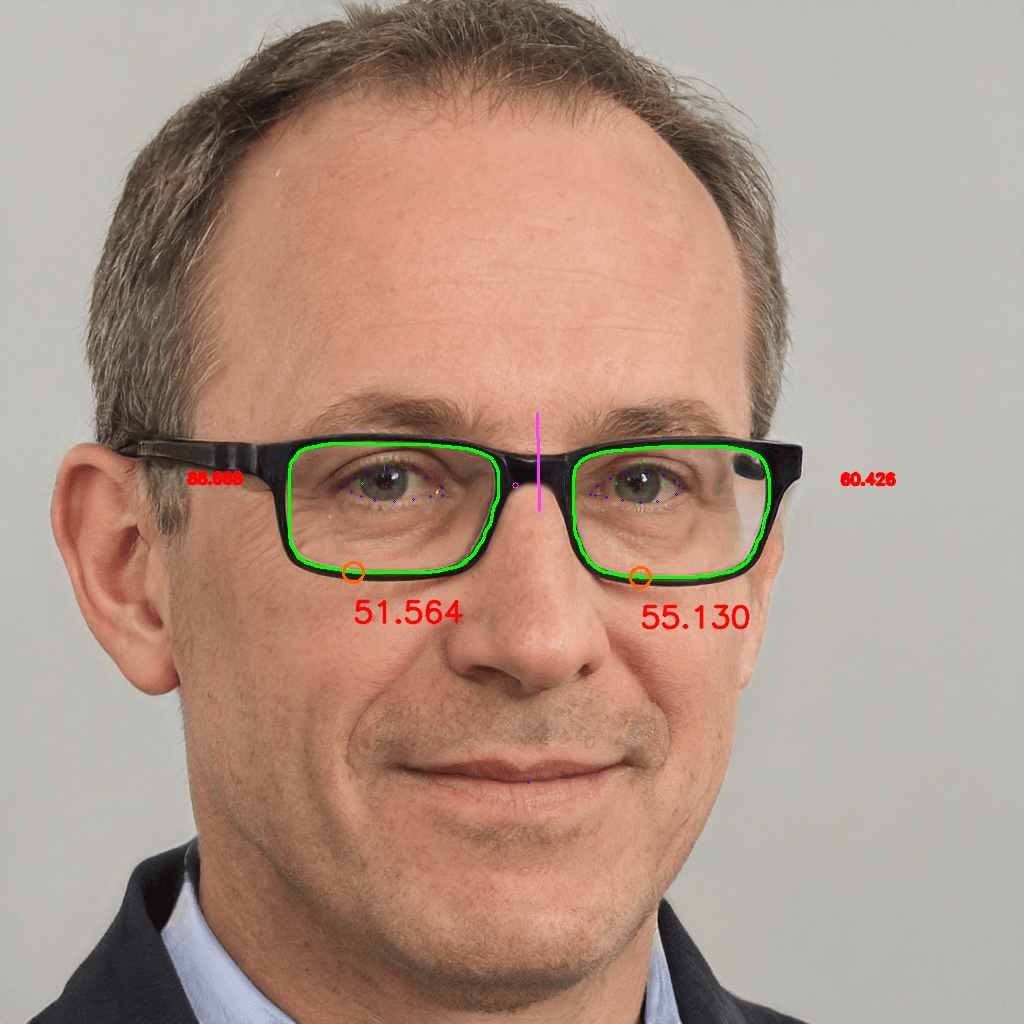
We at Saiwa Inc. are thrilled to announce the successful completion of an innovative project focused on the measurement of interpupillary distance (IPD) and pupil height. This groundbreaking solution was developed in collaboration with Innovation Venture Farm to address the growing need for precision in optical device fitting and design. By leveraging cutting-edge AI techniques and the Mediapipe framework, our solution detects and calculates critical parameters such as the center of the pupil and the lowest point of glasses lenses. These measurements are crucial for applications in eyeglasses, VR/AR headsets, and other optical technologies. The results are delivered with unmatched accuracy and efficiency, empowering manufacturers to deliver tailored products to their users. This project also integrates Saiwa’s Annotation Services, which ensure data labeling precision and scalability, making it easier for users to achieve reliable outcomes.
- Timeline
- Mar 2024 – May 2024
- Solution
- Platform
- Country
- Technology
Measurement Method of Interpupillary Distance and Pupil Height
Overview
Saiwa introduces an innovative approach to measuring interpupillary distance (IPD) and pupil height, leveraging state-of-the-art AI technologies. These measurements are critical for ensuring the comfort and effectiveness of optical devices such as eyeglasses, virtual reality (VR) headsets, and augmented reality (AR) wearables. Saiwa’s solution redefines precision in this domain, offering a reliable method that can revolutionize how optical measurements are performed globally.
Our goal is to empower manufacturers and designers with tools that optimize product fit, enhance user experience, and meet the increasing demands of modern optical technology. By combining cutting-edge algorithms with a robust dataset, Saiwa ensures unparalleled accuracy and scalability.

Challenges and Our Solution
Accurate IPD and pupil height measurements have traditionally been complex and prone to error, especially when reliant on manual methods or inconsistent data. Saiwa’s solution addresses these challenges by:
Using Advanced Deep Learning Models: Incorporating the Mask R-CNN framework and BlendMask algorithm, our method ensures precise detection of key features in facial images, such as eyeglasses and pupil centers.
Utilizing Custom-Labeled Data: Through Saiwa Annotation Services, every image in the dataset is meticulously labeled, capturing the nuances needed for precise calculations.
Enabling Seamless Scalability: Designed with adaptability in mind, this method supports diverse datasets and hardware setups, making it suitable for a wide range of applications.

Data Preparation and Tools
Saiwa’s approach begins with a meticulously curated dataset derived from a Kaggle competition. The dataset features images of synthetic individuals generated by a Generative Adversarial Neural Network (GAN), ensuring diversity and coverage. Key steps include:
Data Segmentation: Images containing eyeglasses were isolated and segmented to focus on relevant features.
Annotation: Saiwa’s proprietary annotation tools were employed to label images with high precision, ensuring the coordinates of critical features, such as the lowest point of the glasses lenses, were accurately captured.

Methodology
Saiwa’s workflow integrates AI-powered algorithms and user-centric processes to ensure efficiency and reliability. The main steps include:
Detection of Glasses Lenses: The BlendMask deep learning algorithm identifies the lenses and marks their lowest points (“x_low”, “y_low”).
Identification of Pupil Centers: Mediapipe’s advanced AI-powered detection precisely locates the center of the pupil (“x_c”, “y_c”).
Pupil Height Calculation: Pupil height (PH) is computed as the vertical distance between the pupil center and the lowest lens point:
Pixel-to-Millimeter Conversion: Measurements are standardized by using a reference object at a fixed camera distance of 30 cm, ensuring reliable real-world scaling.

Key Results
Saiwa’s measurement method has demonstrated:

Trusted by Our Customers
Innovation Venture Farm has already adopted Saiwa’s solution for their advanced optical measurement needs, showcasing its versatility and reliability in real-world applications.
Unmatched Precision: High accuracy in detecting and measuring features essential for IPD and pupil height calculations.
Improved Efficiency: A streamlined process that minimizes manual intervention and reduces errors.
Versatility: Applications extend beyond eyeglasses to VR/AR headsets, industrial goggles, and medical diagnostic tools.
Why Choose Saiwa’s Solution?
Saiwa’s expertise in leveraging AI for optical measurements offers clients a competitive edge:
Precision That Matters: Accurate measurements directly translate to enhanced user satisfaction and reduced returns for ill-fitting optical devices.
Scalability for Growth: Whether you’re a boutique eyewear brand or a global AR/VR provider, Saiwa’s solution scales to your needs.
Future-Ready Innovation: As technology evolves, Saiwa’s commitment to integrating advanced AI models like BlendMask and Cascade Mask R-CNN ensures you stay ahead of the curve.
Looking Ahead
Saiwa continues to push boundaries in optical measurement by:
Exploring New Algorithms: Transitioning to advanced models for even greater accuracy and efficiency.
Enhancing Datasets: Expanding training data to improve robustness and reliability across diverse scenarios.
Refining Parameters: Optimizing learning rates, batch sizes, and other model configurations for peak performance.
Get Started
Ready to revolutionize your optical measurement processes? Discover how Saiwa can elevate your product design and user experience. Visit our projects page to learn more and join the future of optical innovation.
Share this project
Help others discover this work