Sep 23, 2026
OpenCV 5 Brings Modern AI Inference to Computer Vision
OpenCV 5 brings modern deep learning inference directly into its DNN module, making it easier to deploy ONNX models for fast, lightweight computer vision applications.
- Computer Vision
- Artificial Intelligence
- Developer Tools
- Image Processing
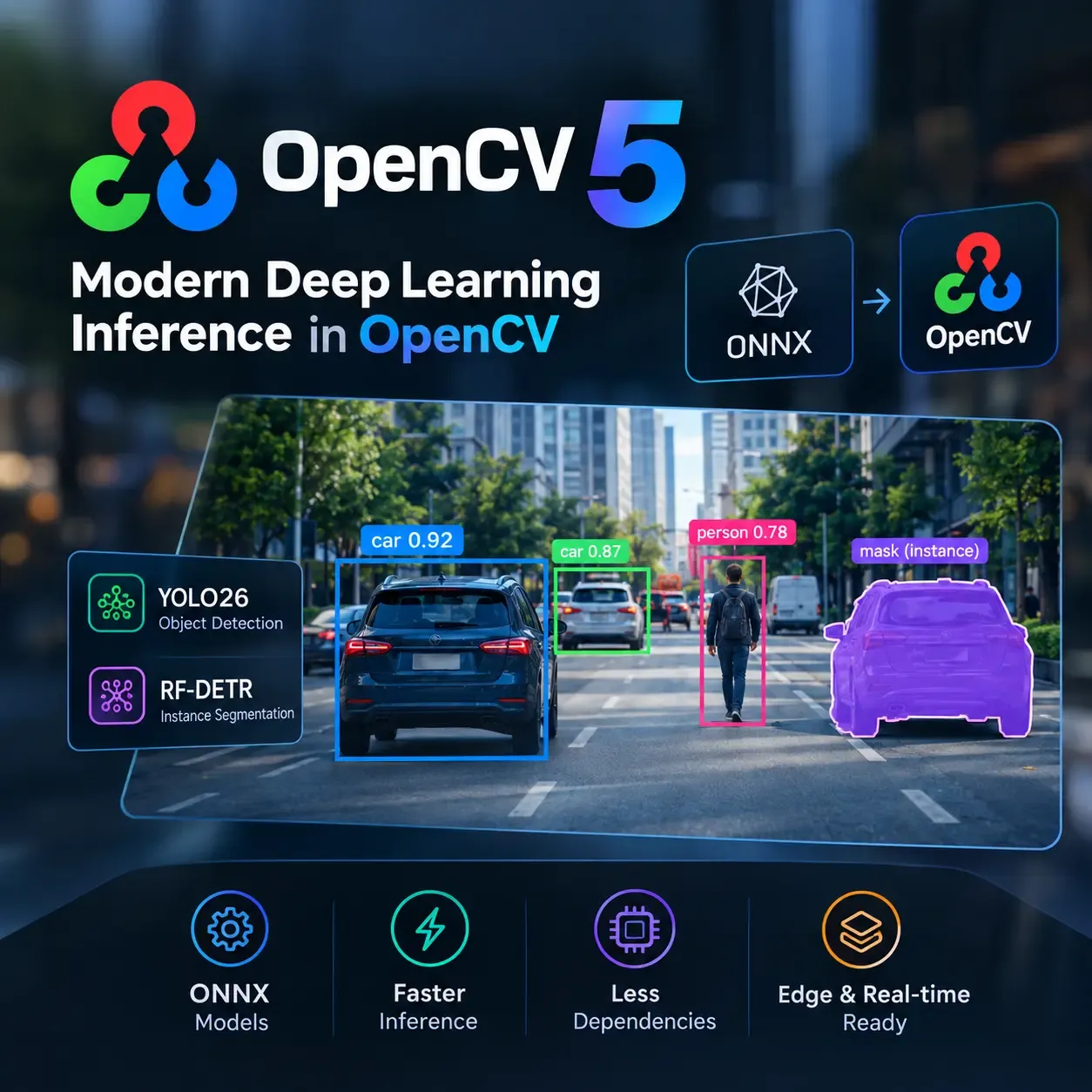
OpenCV has introduced a major update to its Deep Neural Network (DNN) module with OpenCV 5, expanding its ability to run modern deep learning models directly within computer vision applications.
The updated DNN engine is designed to simplify the deployment of neural networks by allowing developers to export trained models to the ONNX format and run inference through OpenCV—without requiring the original training framework in the deployment environment.
The new workflow has already been demonstrated with two modern computer vision models: YOLO26 for object detection and RF-DETR for instance segmentation. While YOLO26 produces bounding boxes around detected objects, RF-DETR can additionally generate pixel-level masks for individual instances.
One of the key advantages of this approach is the separation between model development and deployment. Models can be trained using dedicated deep learning frameworks, exported to ONNX, and then integrated into applications using OpenCV's existing image and video processing capabilities. This can reduce the number of dependencies required in production environments and make deployment pipelines easier to manage.
OpenCV 5 introduces a redesigned DNN inference engine with improved support for dynamic shapes, subgraphs, and modern ONNX features. The release also provides optional integration with ONNX Runtime and extends support for a broader range of neural network architectures.
The examples published by OpenCV demonstrate inference in both Python and C++, with the models running on CPU. According to OpenCV's testing, the Python inference environment for these examples required only OpenCV, NumPy, and the Python standard library; frameworks such as PyTorch, Ultralytics, and ONNX Runtime were not required at inference time.
Performance is another important aspect of the update. OpenCV's published benchmarks compare its new DNN engine with ONNX Runtime across a range of models. In several tested cases, OpenCV 5 achieved lower CPU inference latency, including results for models such as YOLOv8n, DINOv2, RF-DETR, and OWLv2.
These results highlight the potential of OpenCV 5 as a lightweight inference option for applications where deployment efficiency and dependency management are important.
For computer vision applications, this development is particularly relevant to edge AI, real-time image processing, robotics, and industrial vision, where inference needs to be integrated tightly with image acquisition, preprocessing, visualization, and downstream processing.
More broadly, the update reflects an important direction in computer vision: increasingly sophisticated deep learning models are becoming easier to move from research and training environments into practical production systems. With ONNX serving as an interoperability layer and OpenCV providing image processing and inference capabilities in the same ecosystem, developers can build more streamlined computer vision pipelines without necessarily carrying the full training stack into deployment.
OpenCV 5.0.0 was released in August 2026, and the updated DNN capabilities provide another step toward making modern deep learning inference more accessible across a wide range of computer vision applications.
Reference:
OpenCV. OpenCV DNN Module: Deep Learning Inference in OpenCV 5. September 19, 2026.