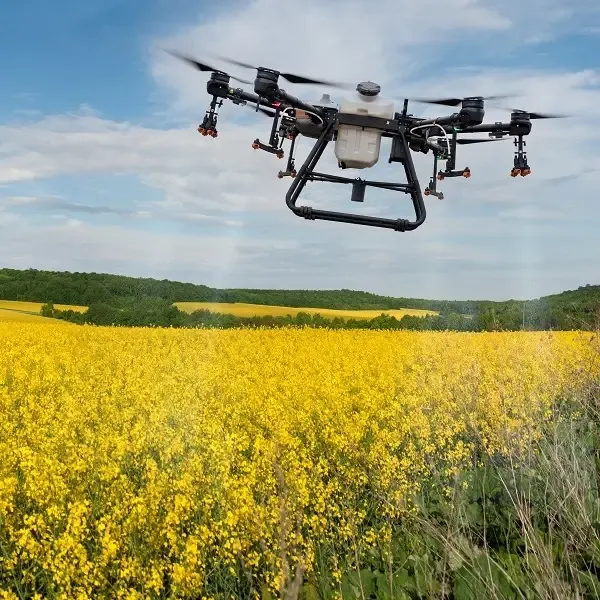
Volunteer Canola After Harvest: When Is Spraying Worth the Cost?
Oct 11, 2026
Written by: Amirhossein Komeili
Reviewed by: Boshra Rajaei, PhD
Written by: Amirhossein Komeili
Reviewed by: Boshra Rajaei, PhD
Volunteer canola is a post-harvest management issue with both immediate and multi-season consequences. Seed lost during combining can germinate after harvest or in the following crop, where it competes for resources, complicates herbicide selection, and replenishes the seedbank if allowed to set seed. Whether a spray application is justified depends on more than seeing green plants in a stubble field. It requires a decision based on emergence timing, crop sequence, herbicide-tolerance history, weed density, expected yield loss, and the cost of control.
This article explains how volunteer canola enters and persists in a field, why it matters in subsequent crops, and how to assess the economics of treatment. It also examines the role of spatial weed detection and the field workflows available through Sairone for converting imagery into maps and treatment zones. The objective is not blanket spraying. It is a defensible, field-specific decision about where intervention protects crop value and where it does not.
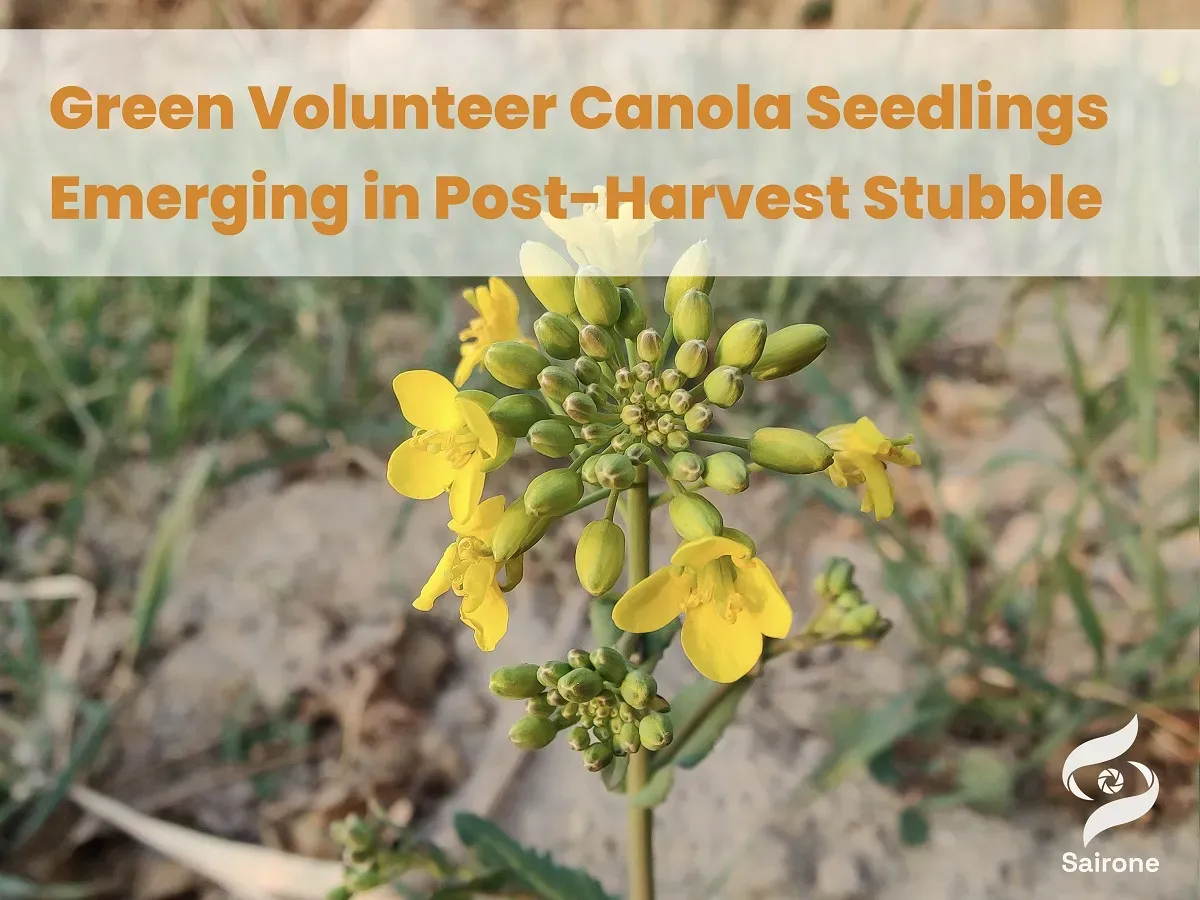
Volunteer canola is canola that grows from seed shed by a previous crop rather than from the seed intentionally planted in the current season. It may emerge soon after harvest, in the crop planted the next year, or over several seasons where viable seed remains in the soil. The issue becomes more difficult in short canola rotations because the same field can contain seed from more than one cultivar and herbicide-tolerance system.
Seed loss at harvest is the starting point for most volunteer populations. The CFIA biology document reports average losses of about 5.5% in spring canola harvest, equivalent to approximately 2,000 to 3,600 seeds per square metre remaining in the field. Even where only a portion of this seed becomes established, that loss creates a sizeable potential source of future volunteers.
Harvest conditions can make the problem more pronounced. Canola pods are susceptible to shattering, and a delayed harvest can increase seed return to the field. In Manitoba, delayed combining during a wet season was associated with pod shatter and pod drop, setting up substantial volunteer pressure in the following crop. Combine adjustment and timely harvest therefore influence more than immediate harvest efficiency; they also determine the starting size of the post-harvest seedbank.
Freshly shed canola seed has no primary dormancy, so it can germinate when conditions are suitable. However, canola can develop secondary dormancy under conditions such as fluctuating temperature, extended darkness, osmotic stress, or limited oxygen. Secondary dormancy helps explain why a field may not express its entire volunteer problem in one emergence event.
Viable canola seed has persisted in soil for four to five years in studies summarized by the CFIA. Soil texture matters: sandy soils may retain more dormant seed than clay soils because reduced moisture can slow seed degradation. Dormancy also differs among genotypes. In a study of 16 Canadian canola genotypes, genotype accounted for 44% to 82% of the variation in secondary dormancy. Most seedlings emerge in the year after canola, but deeply buried seed may remain viable for three years or longer.
The practical risk from volunteer canola changes with the crop that follows. In a cereal, there may be selective herbicide options available. In a broadleaf crop, such as a pulse, soybean, or sugar beet crop, control choices can be narrower. A spray decision must therefore be considered within the next crop's herbicide program rather than treated as an isolated post-harvest task.
Volunteer canola competes with the crop for water, nutrients, and light, and this competition can reduce yield. In newly planted canola, volunteer plants can leave the desired crop thin and spindly, with less opportunity to branch. That means volunteers can reduce performance even when the plants are visually similar to the seeded crop.
The timing of emergence is central to economic damage. Weed plants emerging with the crop have the greatest opportunity to compete, while weeds that emerge after canopy closure have much less economic effect. This is why early scouting is more useful for a spray decision than a late-season count alone. The field question is not simply how many volunteer plants are present; it is whether their timing and density allow them to take meaningful crop yield before control occurs.
Volunteer plants are second-generation plants. They do not retain the blackleg tolerance built into the hybrid seed planted commercially, and they may be more susceptible to disease. Allowing volunteers to persist can therefore add a disease-management concern to the direct cost of crop competition.
Herbicide tolerance requires equally close attention. Researchers in Alberta documented multiple herbicide tolerance in volunteer canola from fields with glufosinate-ammonium- and imidazolinone-tolerant varieties adjacent to glyphosate-tolerant canola. Surveys in southern Manitoba found glyphosate tolerance in 88% of sampled B. napus populations, glufosinate-ammonium tolerance in 81%, and imidazolinone tolerance in 31%. The management implication is straightforward: crop and herbicide records are needed before selecting an in-crop or post-harvest treatment.
Volunteer pressure does not arise evenly across farms or fields. Weather at harvest, pod shatter, the depth at which seed is left, and the field's rotation all influence how much seed enters the soil and when it returns as emerged plants. These factors are useful for prioritizing scouting before committing to a field-wide treatment.
Canola left standing during wet weather is exposed to more opportunity for pod shatter and seed drop. Wind, hail, lodging, and rainfall can also contribute to seed shedding before or during harvest. A field with difficult harvest conditions should be treated as a higher-priority scouting candidate after harvest and during establishment of the next crop.
Field history also affects the herbicide question. Repeated canola production, particularly where different herbicide-tolerance technologies have been used, increases the relevance of checking volunteer traits before spraying. The most reliable choice is not a default active ingredient; it is an option compatible with the volunteer's likely tolerance profile and the crop that follows.
Tillage changes the environment in which lost seed persists. Conventional tillage can bury seed and promote secondary dormancy, while seed remaining near the soil surface under zero-till conditions may avoid secondary dormancy in some circumstances. Heavy residue can still provide shaded conditions that induce secondary dormancy. The effect is not a universal prescription for one tillage system. It is a reason to consider seed position and emergence pattern in each field.
Integrated management reduces reliance on one control point. Practices identified in the CFIA document include limiting harvest seed loss, removing escaped volunteers before flowering, using diverse rotations that include cereals, and keeping records of herbicide-tolerance systems. Mechanical options can also lower future pressure. Seed impact mills process chaff leaving the combine and can destroy volunteer crop seed along with weed seed. Volunteer canola retains seed until harvest, making it a suitable target for this approach, and research cited by GROW IWM indicates seedbank reductions can accumulate over multiple years.
A justified spray pass starts with economic injury, not visual annoyance. The economic threshold is the weed density at which the cost of control equals the crop value saved by preventing yield loss. It is a decision framework that forces the manager to bring together herbicide and application costs, expected crop price, weed density, and the anticipated yield effect of the particular weed population.
Farm Calculators expresses the basic calculation as control cost divided by crop price multiplied by yield loss per weed. Its worked example uses a $25-per-acre treatment cost, a crop price of $4.50 per bushel, and a 0.5-bushel-per-acre loss per weed, producing an economic threshold of about 11 weeds per acre. The value of the example lies in the logic rather than the exact number: any change in treatment cost, crop value, or competitive effect changes the threshold.
Scouting supplies the data that makes this calculation credible. The recommended approach is systematic field walking with at least 10 sample points, counts taken in a square-foot frame, and records of species and growth stage. For volunteer canola, these observations should be read beside the field's canola and herbicide history. A density number alone does not identify whether the plants are susceptible to the herbicide being considered.
When volunteer density is below the threshold, a spray may not recover its cost from protected yield. That conclusion should not be mistaken for a rule to ignore every low-density population. A manager may still intervene where plants will interfere with harvesting, affect equipment, or contribute seed to future seasons. The decision should state which objective is being protected: current-crop margin, operational efficiency, or longer-term seedbank reduction.
The threshold method can reduce unnecessary applications. The source cited by Farm Calculators reports 20% to 40% fewer herbicide applications under threshold-based programs than calendar-based spraying, with reported herbicide-cost savings of 15% to 30% while yields remained steady. Alternative controls also belong in the comparison. Mechanical cultivation may cost $12 to $18 per acre, compared with a potential $20 to $35 per acre for a second herbicide pass in the cited example.
Post-harvest volunteer-canola management benefits from information that is both spatially precise and operationally usable. Sairone is Saiwa’s B2B SaaS platform for agricultural service providers, agronomists, cooperatives, and related field professionals who need to convert imagery and georeferenced data into decision-ready outputs. It applies AI, computer vision, machine learning, and geospatial analysis to workflows that include weed and invasive-plant control, crop monitoring, yield estimation, plant counting, and environmental applications. Its relevance to volunteer-canola management lies in the ability to move from a field image or orthomosaic to mapped detections, reviewed results, and treatment-oriented spatial information.
Rather than treating field observations as a single whole-field judgement, Sairone supports a sequence of image upload, cloud-based processing, validation, spatial visualization, and GIS-ready export. Its Weed Control service is designed to identify and map weeds and invasive plants from drone imagery, orthophotos, GeoTIFFs, and other supported imagery formats. Users can review AI detections before final use, analyse validated results in the Atlas geospatial environment, and export data for downstream GIS or precision-spraying workflows. For a post-harvest volunteer-canola program, that approach can support more targeted scouting and treatment-zone planning instead of relying only on uniform field-wide decisions.
Sairone is a B2B SaaS platform for agronomy, agricultural service, cooperative, ecology, and related workflows. It uses computer vision and AI to process images, videos, and orthomosaics, and it can create orthomosaics from video inputs. Saiwa also provides tagging and annotation tools that allow users to label data and identify objects for detection or counting.
For weed-control work, Sairone supports high-resolution drone imagery, orthophotos, georeferenced datasets, and file types including GeoTIFF, TIFF, JPEG, and PNG. Its file-management environment stores imagery, input data, and processed outputs, supports folders and multiple file types, and permits large-file uploads for large datasets. The cloud delivery model allows users to upload data and create reports without building or maintaining dedicated infrastructure.
Sairone's Weed Control service is designed to detect, map, and analyse weeds and invasive plant species in agricultural fields and natural environments. The documented current species include Taraxacum, Amaranthus tuberculatus, Amaranthus palmeri, European Water Chestnut, Water Soldier, Fleabane, and Thistle. The platform also identifies further species in a planned expansion list, but those species should not be treated as current detection coverage.
Detection results include confidence scores and precise geographic coordinates, creating a spatial record for field validation and targeted treatment planning. Before final use, users can review, correct, and approve AI-generated detections through a validation workflow. This human-in-the-loop step is material in an agronomic setting: it makes it possible to examine the detection layer before it is turned into a treatment map or used as the basis for operational action.
Validated detections can be transferred to Atlas, Sairone's geospatial environment for interactive visualization and spatial analysis. Atlas supports visualization of weed distributions, infestation-pattern analysis, treatment-map generation, and spatial analytics. It can overlay detections on high-resolution aerial and satellite imagery, and includes tools for custom region definition and hierarchical management of field subdivisions.
Sairone can produce GIS-ready exports in GeoJSON, Shapefile, KML, and CSV formats. These outputs can be incorporated into GIS analysis and precision-spraying workflows. Atlas also includes detection-clustering functions that group identified weeds into manageable treatment zones, helping translate discrete geolocated detections into field sections that can be assessed and managed as operational units.
Saiwa describes Sairone as a specialized platform rather than a one-size-fits-all software service. It develops or customizes AI models according to the user's needs and the nature of the available data. Annotation functionality supports polygons, bounding boxes, class definitions, customizable colours, and multi-class labelling, providing a structured route for preparing datasets and refining detection models.
Sairone is available through a cloud platform, customized API integration, and fully customized White Label delivery. The API option is intended to connect Sairone services with a customer's existing infrastructure, while White Label deployment can be developed around the customer's brand, needs, and workflow. Saiwa also describes BaaS and a multi-tenant structure for agritech organizations seeking outsourced product-development capabilities.
Spraying volunteer canola is worth the cost when the expected value of avoided crop loss and other defined management benefits exceeds the cost of control. That assessment depends on the post-harvest seedbank, emergence timing, crop competition, crop and herbicide history, weed density, crop value, and treatment cost. Early scouting and control while plants are small improve the reliability of the decision, but a blanket application is not automatically the economic answer.
A durable program limits seed return at harvest, uses rotation and mechanical options where appropriate, and selects herbicides that match both the volunteer trait and the following crop. Spatial detection and decision-support systems add another layer: they can show where volunteer pressure is concentrated, support review of mapped detections, and help convert field observations into targeted management zones.
