

- Precision Agriculture
Weed Detection: Methods, Technologies, and Applications
Discover efficient weed detection methods, from manual to technological solutions, optimizing agriculture practices for higher yields and sustainability


Weeds are among the most persistent challenges in agriculture. They compete with crops for sunlight, water, nutrients, and growing space, potentially reducing productivity and increasing management costs. Detecting unwanted plants early helps farmers understand where weed pressure is developing and choose appropriate management strategies.
Traditional weed detection relies heavily on visual field scouting. Today, artificial intelligence (AI), computer vision, drones, and ground-based imaging systems offer additional ways to identify and map weeds across agricultural fields.
These technologies can turn field images into useful information about weed presence, location, and distribution. When combined with appropriate agricultural practices, they support more targeted and informed weed management.
This guide explains what weed detection is, how AI weed detection works, which technologies and machines are used, and how to choose an approach for different agricultural applications.
What Is Weed Detection?
Weed detection is the process of finding unwanted plants in agricultural fields or other managed environments. It may involve identifying the presence of weeds, locating individual plants, distinguishing weeds from crops, or estimating the extent of an infestation.
Although the terms are sometimes used interchangeably, weed detection, weed identification, and weed control describe different activities.
- Weed detection determines whether weeds are present and where they are located.
- Weed identification determines the type or species of a detected weed.
- Weed control involves managing or suppressing unwanted plants through mechanical, chemical, cultural, biological, or other methods.
For example, an AI-based weed detector may analyze a photograph of a cornfield and highlight plants that appear to be weeds. The resulting information can help farmers decide where additional scouting or treatment may be necessary.
The detection system provides information; physical weed removal requires a separate management action or integrated treatment system.

Why Early Weed Detection Matters
Weeds can interfere with crop development by competing for essential resources. Their impact depends on several factors, including weed species, infestation density, emergence timing, crop type, and environmental conditions.
Early detection helps farmers identify potential problems before weed populations become more established.
Protecting Crop Growth and Productivity
Weed competition can affect crop performance, especially when unwanted plants emerge during sensitive growth stages.
Timely detection allows farmers to investigate infestations and consider appropriate management measures before competition becomes more severe.
However, detection alone does not improve crop yield. Its value depends on how the information is used.
Supporting More Targeted Weed Management
Weed infestations are not always evenly distributed across a field.
Some areas may contain dense weed patches, while others have relatively little unwanted vegetation. Mapping these differences can help farmers prioritize scouting and consider location-specific management.
When combined with compatible treatment equipment, weed detection information may support targeted interventions rather than uniform treatment across an entire field.
Improving Long-Term Field Monitoring
Repeated weed observations can reveal how infestations change over time.
Farmers and agronomists can use these records to identify recurring problem areas, evaluate previous management decisions, and plan future field operations.
Early detection is therefore valuable not only for immediate decisions but also for long-term weed monitoring.
Weed Detection Methods Compared
Weed detection methods range from manual observation to advanced AI-powered imaging systems.
Each approach has different requirements, advantages, and limitations.
| Weed Detection Method | How It Works | Main Advantages | Main Limitations |
|---|---|---|---|
| Manual field scouting | Farmers or agronomists visually inspect crops | Direct observation and expert judgment | Labor-intensive across large fields |
| Traditional image processing | Uses color, shape, texture, and vegetation patterns | Can be relatively simple and computationally efficient | Sensitive to changing field conditions |
| AI object detection | Locates weeds using trained computer vision models | Can identify and locate individual plants | Requires representative training data |
| AI image segmentation | Classifies image pixels or plant instances | Supports detailed vegetation boundaries and coverage estimates | May require detailed annotation and computing resources |
| Drone-based weed detection | Analyzes aerial field imagery | Useful for monitoring large areas | Small weeds may be difficult to resolve |
| Ground-based weed detection | Uses cameras mounted near crops | Provides detailed close-range imagery | Field coverage and equipment integration can be challenging |
The most appropriate method depends on the size of the area, target weed species, required accuracy, available equipment, and intended management decisions.
Traditional Weed Detection
Manual scouting remains important because trained observers can inspect plants directly, assess field conditions, and investigate uncertain cases.
Traditional computer vision methods can also detect vegetation using predefined visual features.
For example, in row-planted crops, software may identify expected crop-row positions and flag vegetation appearing between rows.
These techniques can be useful under suitable conditions, although overlapping plants, irregular crop spacing, and variable lighting may reduce reliability.
Weed Detection Based on Position and Edge Features
Some traditional image-processing systems distinguish crops from weeds by examining their positions and visual boundaries.
Common techniques include:
- Crop-row detection: Identifying regularly spaced crop patterns.
- Edge detection: Finding plant boundaries and changes in image intensity.
- Pixel histogram analysis: Examining color or brightness distributions.
- Vegetation segmentation: Separating vegetation from soil and other backgrounds.
These methods can provide a practical starting point, but they may struggle when weeds grow within crop rows or resemble crop seedlings.
AI-based systems offer an alternative by learning visual patterns from training examples rather than relying entirely on predefined rules.
How AI Weed Detection Works
AI weed detection uses machine learning and computer vision to analyze agricultural images and distinguish weeds from crops and other objects.
A typical workflow includes image acquisition, data preparation, model development, prediction, mapping, and validation.
1. Image Acquisition
The first step is collecting images of agricultural fields.
Images may come from drones, tractor-mounted cameras, agricultural robots, handheld devices, or other imaging systems.
Image quality is important because lighting, resolution, viewing angle, and plant visibility influence what a model can detect.
2. Dataset Preparation and Annotation
AI models trained through supervised learning require labeled examples.
Agricultural images may be annotated with plant categories, bounding boxes, or segmentation masks.
For reliable development, datasets should represent relevant crops, weed species, growth stages, lighting conditions, and field backgrounds.
Annotation quality matters because inaccurate or inconsistent labels can affect model performance.
3. Model Training and Prediction
During model development, a machine learning algorithm learns patterns from annotated images.
Once trained, the model can analyze new images and generate predictions.
Depending on the technique, predictions may include image-level labels, weed locations, or detailed vegetation masks.
Model training is generally a preparatory activity. A deployed system does not need to retrain its model for every new image.
4. Weed Mapping and Reporting
When predictions are linked to reliable location information, they can be used to create weed distribution maps.
These maps may indicate areas containing unwanted vegetation, estimated weed coverage, or locations requiring further inspection.
5. Field Validation
AI predictions should be evaluated using independent test data or field observations.
Validation helps determine whether the model performs reliably under the conditions in which it will be used.
Common evaluation metrics include precision, recall, F1 score, and mean average precision (mAP), depending on the detection task.
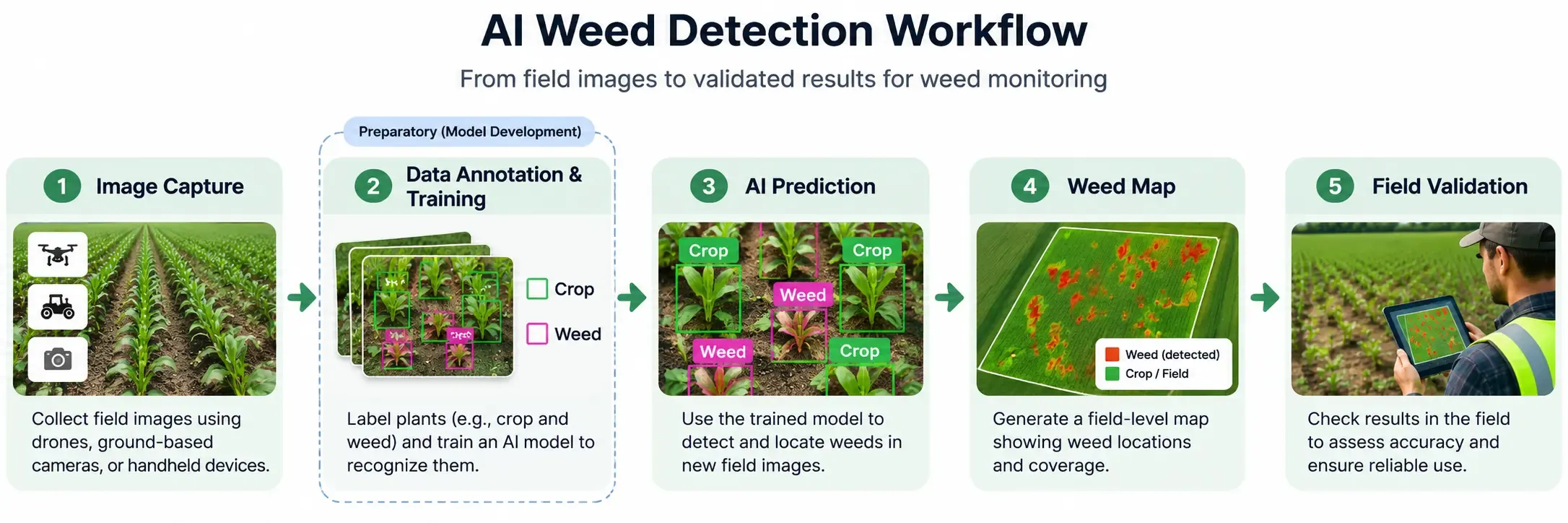
Demonstration of an AI-based weed detection workflow, from field imagery to detection results:
For a deeper technical explanation, read Weed Detection Using Machine Learning.
AI Techniques Used in Weed Detection
AI weed detection includes several machine learning and computer vision approaches.
The appropriate technique depends on whether the goal is to determine weed presence, locate individual plants, or estimate vegetation coverage.
Machine Learning and Deep Learning
Traditional machine learning models may use selected visual features, such as color, texture, and shape, to classify vegetation.
Deep learning models can learn more complex features directly from training images.
Convolutional neural networks (CNNs) are widely used in image recognition and have been studied for agricultural applications.
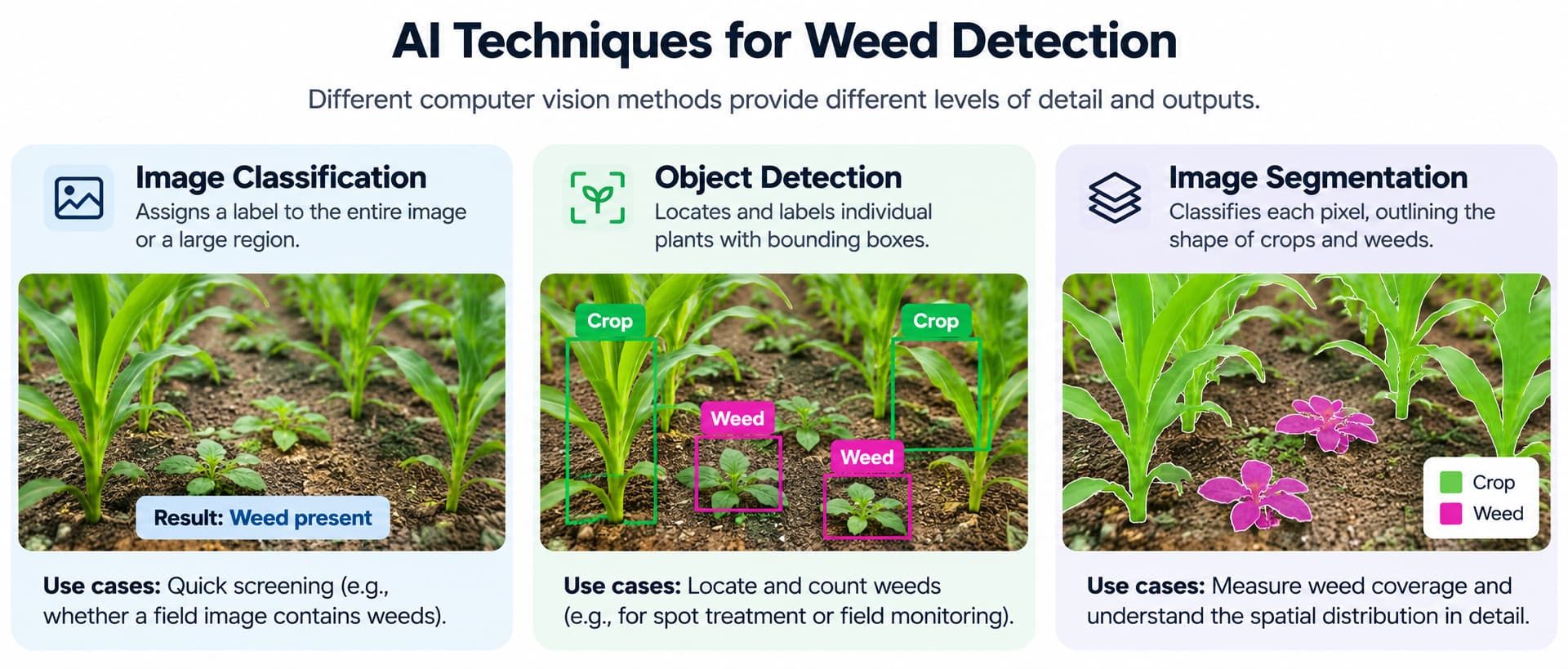
Image Classification
Image classification assigns a label to an image or selected image region.
For example, a classifier may determine whether an image contains weeds.
This approach can support preliminary screening, but image-level classification does not necessarily identify the exact location of each unwanted plant.
Object Detection
Object detection identifies the locations of objects within an image.
In weed detection, object detection models can place bounding boxes around suspected weeds and, when trained appropriately, assign category labels.
The YOLO family of models is frequently studied for applications where inference speed is important.
Region-based approaches, including Faster R-CNN, are also used for object detection.
The best-performing model depends on the dataset, target plants, image resolution, hardware, and evaluation conditions.
Image Segmentation
Image segmentation provides more detailed spatial information than image-level classification.
Semantic segmentation assigns category labels to pixels, such as crop, weed, or background.
Instance segmentation can distinguish separate plant instances.
Segmentation can be useful when estimating vegetation coverage, analyzing plant boundaries, or producing detailed spatial outputs.
Transfer Learning
Transfer learning adapts a previously trained model to a new application.
Instead of developing every model from the beginning, researchers may fine-tune an existing network using agricultural images.
This can reduce some training requirements, but the adapted model still needs suitable data and independent validation.
Which AI Technique Should You Choose?
| Technique | Typical Output | Suitable Application |
|---|---|---|
| Classification | Image-level label | Preliminary weed-presence screening |
| Object detection | Bounding boxes and categories | Locating and counting visible weeds |
| Semantic segmentation | Pixel-level category masks | Estimating crop and weed coverage |
| Instance segmentation | Separate object masks | Analyzing individual plant regions |
No single technique is universally best. The choice should reflect the information needed and the system's operating conditions.
Weed Detection Machines and Equipment
A weed detection machine uses imaging equipment, sensors, or computer vision to identify unwanted vegetation.
These systems vary in their level of automation and the perspective from which they observe plants.
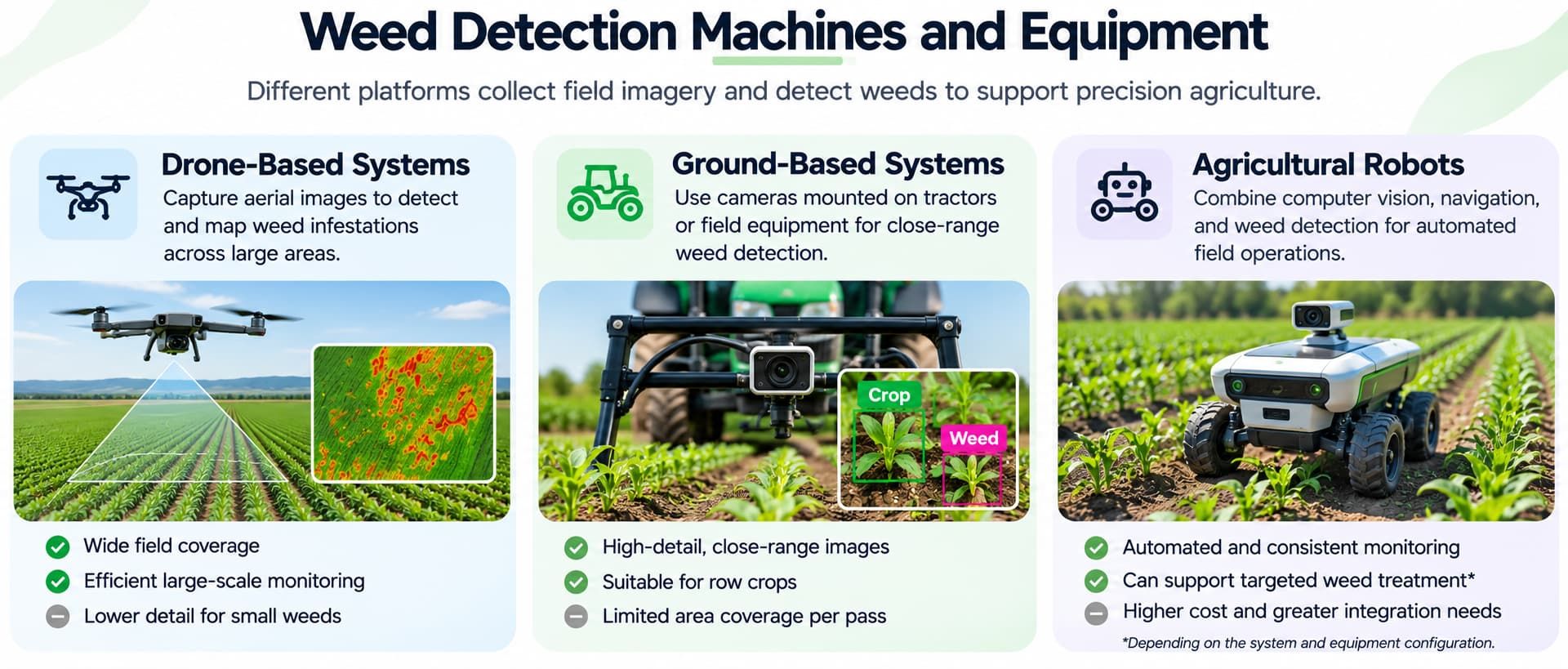
Drone-Based Weed Detection Systems
Drones equipped with suitable cameras can capture aerial imagery of agricultural fields.
The images can then be analyzed to identify weed patches, estimate vegetation distribution, or support field-scale monitoring.
Drone systems are particularly useful for observing large areas, although their ability to identify small plants depends on image resolution and field conditions.
Ground-Based Weed Detection Systems
Ground-based systems use cameras mounted on tractors, agricultural implements, handheld devices, or mobile platforms.
Because cameras can operate close to plants, these systems may capture detailed images suitable for identifying individual weeds.
Their practical performance depends on camera placement, lighting, movement, and processing capabilities.
Robotic Weed Detection Systems
Agricultural robots may combine computer vision, navigation, and weed detection models.
Some robotic systems use the detection results to guide compatible mechanical removal or localized spraying equipment.
However, weed detection and physical weed removal are separate functions. A system capable of detecting weeds does not necessarily perform treatment.
Drone Weed Detection and Mapping
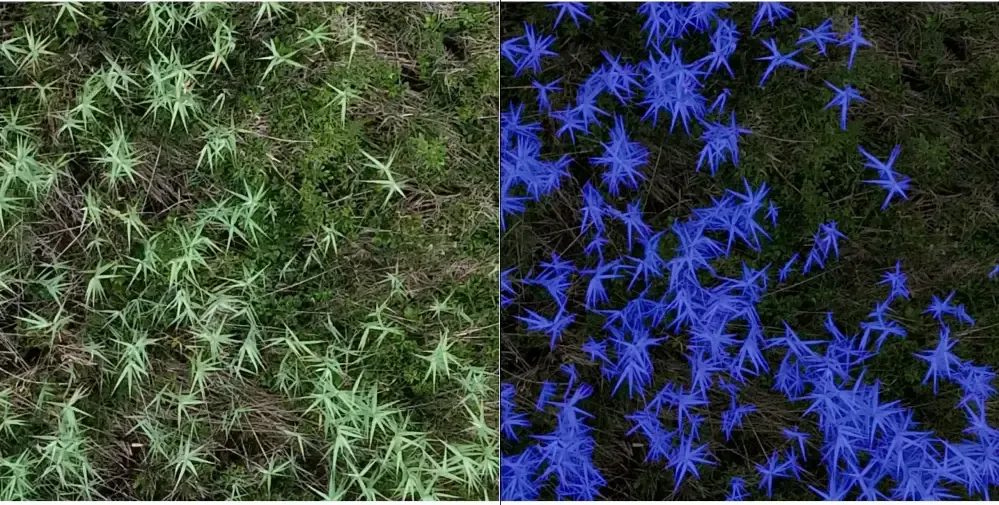
Drone weed detection combines aerial imagery, computer vision, and spatial analysis to identify unwanted vegetation across agricultural fields.
Images may be processed into an orthomosaic, which combines multiple photographs into a georeferenced representation of the field.
AI models can then analyze suitable imagery to identify potential weed patches.
Important Factors in Drone Weed Detection
Ground Sample Distance (GSD)
GSD describes the ground area represented by an image pixel.
Smaller GSD values generally provide more spatial detail, which may be necessary when detecting small plants.
However, the required GSD depends on the target weed, crop growth stage, and detection method.
Flight Altitude
Flight altitude influences image resolution and field coverage.
Lower flights may capture greater detail but require more images to cover the same area.
Image Overlap
Appropriate image overlap supports photogrammetric processing and orthomosaic generation.
The required overlap depends on the camera, terrain, vegetation, and processing workflow.
RGB and Multispectral Sensors
RGB cameras capture visible-light imagery and are commonly used in agricultural computer vision.
Multispectral sensors collect additional spectral information that may support vegetation analysis in suitable applications.
Neither sensor type guarantees accurate weed identification without appropriate models and validation.
Lighting and Environmental Conditions
Shadows, wind, changing sunlight, and plant movement can affect image quality.
Consistent acquisition procedures can help reduce unwanted variation.
From Drone Images to Weed Maps
A typical drone mapping workflow involves collecting imagery, preparing spatial data, applying detection models, and reviewing the resulting map.
When predictions are properly georeferenced, weed maps can support targeted scouting and help identify areas requiring management attention.
Learn more about this workflow in Aerial Image Analysis for AI-Based Weed Identification and Drone Weed Mapping.
Applications of Weed Detection in Precision Agriculture
Weed detection technologies support several agricultural monitoring and management activities.
Monitoring and Mapping Weed Infestations
AI-based systems can help identify where unwanted vegetation occurs and how its distribution changes over time.
Repeated mapping may support field scouting, management planning, and the evaluation of previous interventions.
Site-Specific Weed Management
Knowing the locations of weed infestations can help farmers decide where additional attention is needed.
When integrated with suitable equipment, detection information may support localized treatment.
Potential benefits depend on the accuracy of detection, weed distribution, treatment technology, and agronomic decisions.
Early Detection of Invasive Plants
Some invasive plants can spread rapidly and affect agricultural or natural ecosystems.
AI systems trained to recognize selected species may support early monitoring and help prioritize field verification.
However, unfamiliar species and visually similar vegetation can produce incorrect predictions, making expert confirmation important.
Weed Detection in Soybean Crops
Soybean fields present challenges because weeds and crop plants may overlap or appear visually similar at certain growth stages.
Computer vision models trained on representative soybean-field imagery can help identify unwanted plants.
The usefulness of the results depends on image quality, model performance, and the management decisions supported by the detection.
Weed Detection in Corn Fields
Corn fields may contain weeds such as foxtails, pigweeds, and lambsquarters.
Early-season detection can help locate unwanted plants before crop canopies become dense.
As corn grows, overlapping leaves and shadows may make image-based weed detection more challenging.
For detailed crop management strategies, read Weed Control in Corn Fields.
Weed Detection in Organic Farming
Organic farming frequently uses cultural practices and mechanical weed management.
AI-based weed detection can support scouting or provide information to compatible mechanical systems.
This may help growers make more targeted decisions while maintaining their chosen production practices.
Weed Detection Using the Sairone Platform
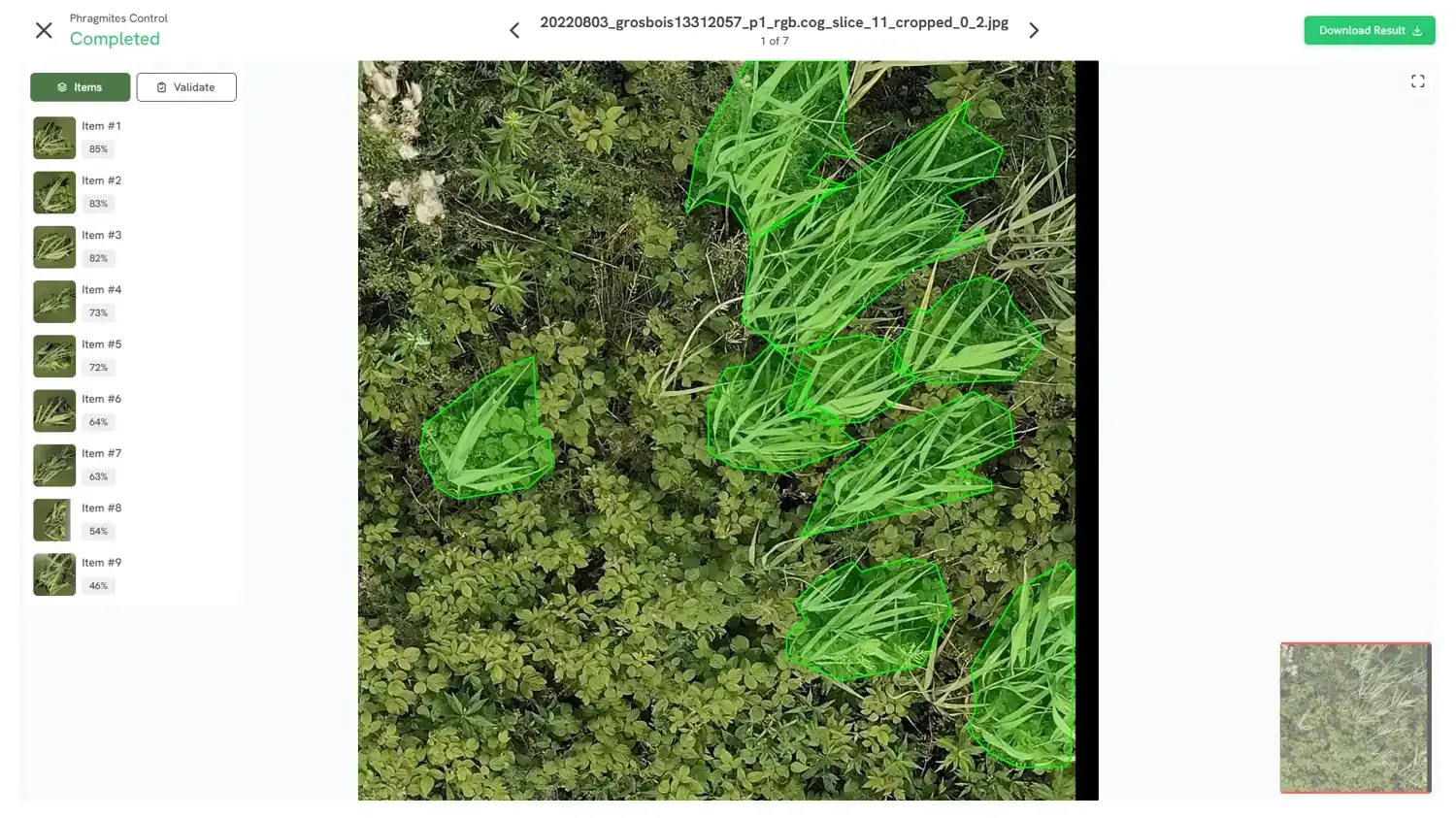
Sairone, developed by Saiwa, provides AI-based image analysis capabilities relevant to weed and invasive plant detection.
Computer vision can help transform agricultural imagery into information about unwanted vegetation, supporting monitoring and field assessment workflows.
When evaluating a platform such as Sairone, important considerations include the supported input data, available detection outputs, target vegetation, and model performance on representative images.
Organizations should also assess how the resulting information fits into their existing agricultural operations.
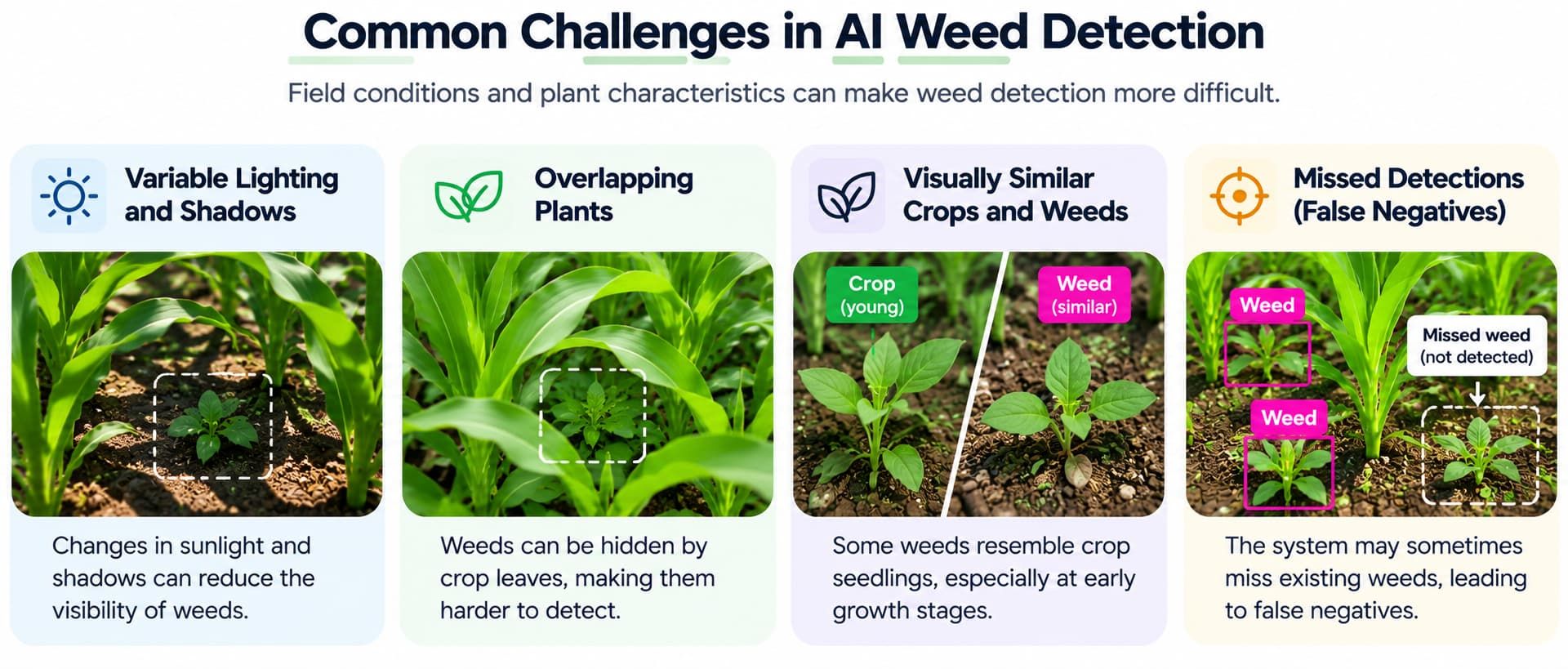
Challenges and Accuracy Limitations of AI Weed Detection
Although AI weed detection offers useful capabilities, reliable performance remains challenging in real agricultural environments.
Similar Appearance of Crops and Weeds
Some weeds resemble crop seedlings, especially during early growth stages.
This can make visual classification difficult and increase the likelihood of incorrect predictions.
Changing Lighting and Field Conditions
Sunlight, shadows, soil appearance, moisture, dust, and camera settings can influence image quality.
A model trained under one set of conditions may not perform equally well in another.
Overlapping Plants
As vegetation becomes denser, leaves may overlap and obscure individual plants.
This can reduce the visibility of weeds and complicate object detection or segmentation.
Dataset Quality and Model Generalization
AI models depend on representative training data.
Changes in crop varieties, weed species, seasons, camera systems, or geographic conditions may reduce performance.
This problem is commonly called domain shift.
It should not be confused with herbicide resistance: weeds do not biologically develop resistance to image recognition algorithms.
False Positives and False Negatives
A false positive occurs when a system incorrectly identifies a weed.
A false negative occurs when an existing weed is missed.
Both errors matter because they can influence field monitoring and treatment decisions.
Computational Requirements
Real-time weed detection may require optimized models, suitable processors, and reliable communication between sensors and agricultural equipment.
Systems intended for deployment should be tested under realistic operating conditions.
How Is Weed Detection Accuracy Evaluated?
Accuracy evaluation helps determine whether a weed detection model is suitable for a particular agricultural application.
Different metrics measure different aspects of performance.
| Metric | What It Measures | Why It Matters |
|---|---|---|
| Precision | Proportion of predicted weed detections that are correct | Helps assess false-positive detections |
| Recall | Proportion of actual weeds successfully detected | Helps assess missed weeds |
| F1 score | Balance between precision and recall | Useful when both error types matter |
| Mean Average Precision (mAP) | Detection performance across defined matching criteria | Common for evaluating object detection |
| Intersection over Union (IoU) | Overlap between predicted and reference regions | Useful for detection and segmentation evaluation |
| Inference time | Time required to process an image or frame | Important for real-time applications |
A model's reported performance should always be interpreted alongside its dataset and testing conditions.
For example, high performance on carefully collected research images does not necessarily mean the same results will be achieved in a different field.
What Performance Data Should Be Reported?
A credible weed detection study or product evaluation should ideally identify:
- The target crop and weed species.
- The source and size of the evaluation dataset.
- Image resolution and acquisition conditions.
- The AI model or detection method.
- Relevant evaluation metrics.
- Whether testing used independent data.
- Important limitations or failure cases.
Weed Detection and Herbicide Resistance Management
Herbicide resistance is a major challenge in agricultural weed management.
Repeated use of the same herbicide mode of action can select for resistant weed populations.
AI-based detection may support monitoring by locating surviving weeds, identifying recurring infestation patches, and helping farmers prioritize further investigation.
However, visual weed identification does not generally confirm herbicide resistance.
Resistance confirmation may require suitable herbicide-response testing or other validated diagnostic methods.
AI weed detection should therefore be used as part of a broader management strategy rather than as a substitute for resistance diagnosis.
For further discussion, see AI Weed Detection to Reduce Herbicide Resistance Pressure.
Weed Detection and Integrated Weed Management
Integrated weed management combines different practices to manage weed populations over time.
These may include:
Cultural Control: Crop rotation, cover crops, and planting practices that influence weed establishment.
Mechanical Control: Cultivation, mowing, and other physical methods of removing or suppressing weeds.
Chemical Control: Appropriate herbicide use based on crop requirements, label instructions, and resistance-management practices.
Biological Control: Suitable biological methods used in specific weed management contexts.
Mulching and Solarization: Methods that suppress weed establishment in appropriate production systems.
Weed detection supports integrated management by providing information about where weeds occur and how their populations change.
For example, a weed distribution map may help identify areas requiring additional scouting or a suitable targeted intervention.
The best response depends on the weed species, crop, growth stage, field conditions, and available management options.
Weed Detection and Precision Irrigation
Weed detection can also provide useful information for broader agricultural resource management.
Because weeds compete with crops for water, information about their distribution may complement irrigation planning.
In an integrated system, weed observations can be considered alongside soil moisture, crop requirements, weather conditions, and irrigation infrastructure.
However, detecting weeds does not automatically enable an irrigation system to direct water only toward crops.
Such applications require appropriate equipment, data integration, and agronomic validation.
Explainable AI in Weed Detection
Explainable artificial intelligence (XAI) aims to make aspects of AI predictions easier to inspect and interpret.
Some techniques highlight image regions that influence a model's classification or detection result.
These visualizations may help researchers investigate incorrect predictions, identify dataset problems, and understand model behavior.
For example, an explanation tool might reveal that a model is relying heavily on background soil patterns rather than plant characteristics.
This can provide useful information for improving the training process.
However, an explanation visualization does not prove that a prediction is correct. Independent evaluation remains essential.
Practical Applications of AI Weed Detection
AI weed detection can be incorporated into different agricultural workflows.
Drone-Based Field Monitoring
A farm may collect aerial images, process them using a detection model, and review a map showing potential weed patches.
The map can help guide additional field scouting.
Ground-Based Robotic Monitoring
An agricultural robot may capture close-range images and detect unwanted vegetation while moving through crop rows.
When integrated with compatible treatment equipment, the results may support localized mechanical or chemical interventions.
Mobile Weed Identification
A mobile application may analyze plant photographs and provide preliminary identification information.
Such predictions should be checked when species identification is uncertain or management decisions carry significant consequences.
These examples illustrate possible applications rather than documented customer results.
Return on Investment of Weed Detection
The return on investment of a weed detection system depends on implementation costs and the value of the information it provides.
Potential expenses include:
- Cameras, drones, and other sensors.
- Software and computing infrastructure.
- Model development or customization.
- Equipment integration.
- Training and maintenance.
- Field verification and ongoing monitoring.
Potential benefits may include reduced scouting effort, improved field monitoring, more targeted interventions, and better allocation of management resources.
These benefits are not guaranteed and should be evaluated using actual field outcomes.
How to Estimate Weed Detection ROI
A practical assessment can compare the total cost of an existing weed monitoring workflow with the cost of a proposed technology-based workflow.
It should also consider whether improved detection changes management decisions or treatment outcomes.
A simplified calculation is:
ROI (%) = [(Measured financial benefits − Total implementation costs) ÷ Total implementation costs] × 100
For a meaningful comparison, use the same evaluation period and include relevant operating costs.
Avoid assuming that every reduction in detected weed coverage automatically produces equivalent financial savings.
How to Choose a Weed Detection Approach
Selecting a weed detection system begins with understanding the agricultural problem.
A farmer monitoring a large field may need different technology from a researcher identifying small weeds in close-range images.
The following questions can help guide the decision.
What Area Needs to Be Monitored?
Large fields may benefit from aerial monitoring, while small plots or detailed plant inspections may be better suited to ground-based imaging.
What Plants Must Be Detected?
The target crop and weed species influence dataset requirements, camera resolution, and model selection.
What Information Is Needed?
If the goal is simply to determine whether weeds are present, image classification may be sufficient.
If individual weed locations are required, object detection may be more appropriate.
If detailed vegetation coverage is needed, segmentation may provide additional information.
How Quickly Are Results Required?
Real-time agricultural equipment may require efficient models and suitable onboard computing hardware.
Offline mapping workflows can allow more time for image processing.
How Will the Results Be Used?
Detection outputs should support a clear decision, such as additional scouting, infestation mapping, or compatible targeted treatment.
| Agricultural Need | Approach to Consider |
|---|---|
| Small-scale visual inspection | Manual scouting or handheld imaging |
| Large-area weed distribution mapping | Drone imagery with spatial analysis |
| Close-range plant detection | Ground-based cameras |
| Real-time equipment integration | Optimized computer vision models |
| Detailed vegetation coverage estimates | Image segmentation |
| Monitoring changing field conditions | Repeated imaging with field validation |
The most effective approach is the one that provides reliable information for the intended management task.
Future Trends in AI Weed Detection
AI weed detection continues to develop as computer vision, sensing technology, and agricultural automation improve.
More Adaptable Deep Learning Models
Researchers are working to improve model performance across different crops, weed species, and environmental conditions.
Reducing the need for extensive retraining is an important research direction.
Multispectral and Hyperspectral Imaging
Sensors that capture information beyond visible RGB imagery may support more detailed vegetation analysis.
Their usefulness depends on the target species, spectral characteristics, acquisition conditions, and processing methods.
Foundation Models and Open-Vocabulary Detection
Foundation models are being investigated for more flexible image recognition tasks.
Open-vocabulary detection approaches can attempt to locate objects based on text descriptions or other prompts.
These methods may help researchers explore unfamiliar targets, but reliable weed identification still requires evaluation, particularly for visually similar plants and early growth stages.
Synthetic Data and Efficient Model Training
Synthetic images, transfer learning, and other data-efficient techniques may help reduce some annotation and training requirements.
However, synthetic training data must represent real agricultural conditions sufficiently well to be useful.
Integration with Agricultural Robotics and IoT
Future systems may combine imaging, environmental sensors, robotics, and AI-based monitoring.
Such integration could support more coordinated agricultural decision-making, provided the systems are reliable, safe, and compatible with field operations.
Frequently Asked Questions About Weed Detection
What is weed detection in agriculture?
Weed detection is the process of finding unwanted plants in agricultural fields. It can involve manual scouting, image processing, computer vision, or AI-based systems.
How does AI weed detection work?
AI weed detection analyzes agricultural images using trained machine learning models. Depending on the model, it can identify weed presence, locate individual plants, or produce detailed vegetation masks.
What is a weed detection machine?
A weed detection machine uses cameras, sensors, or image analysis software to identify unwanted vegetation. Examples include drone-based systems, tractor-mounted cameras, and agricultural robots.
Can drones detect weeds in crop fields?
Yes. Drones can capture aerial imagery for weed detection and mapping. Their effectiveness depends on image resolution, weed size, crop conditions, and model performance.
Which AI model is best for weed detection?
There is no universally best model. YOLO-based object detectors, segmentation networks, and other approaches may be suitable depending on the target plants, dataset, hardware, and required output.
Can AI distinguish weeds from crops?
AI models can learn visual differences between crops and weeds, but accuracy varies with plant growth stage, training data, lighting, and field conditions.
Can weed detection reduce herbicide use?
Weed detection may support more targeted herbicide application when combined with appropriate treatment equipment and management practices. Actual reductions depend on field conditions and treatment decisions.
What is the difference between weed detection and weed control?
Weed detection locates unwanted plants, while weed control involves managing or removing them. Detection can support weed control decisions but does not necessarily perform treatment.
Conclusion: Using Weed Detection for Smarter Agricultural Decisions
Weed detection has evolved from manual field scouting into a range of technologies that include computer vision, machine learning, drones, and agricultural robots.
These approaches provide different ways to identify unwanted vegetation, locate infestations, and understand weed distribution.
AI-based systems can support image classification, object detection, and segmentation, while drone and ground-based platforms provide different perspectives on agricultural fields.
However, reliable results depend on image quality, representative training data, suitable evaluation methods, and field validation.
The greatest value of weed detection comes from connecting accurate observations to practical management decisions.
For organizations exploring AI-powered agricultural image analysis, Sairone offers an opportunity to investigate weed and invasive plant detection workflows.
References (5)
About the team
Amirhossein Komeili
I’m an AI Developer specializing in Computer Vision and deep learning. At Saiwa, I work on developing and optimizing intelligent systems that apply advanced image analysis to address real-world challenges, particularly in agriculture. My focus is on creating practical, high-impact AI solutions that enhance efficiency, accuracy, and decision-making across diverse applications.
Share this article
Help others discover this content
Comments
Be the first to share your thoughts
No comments yet
Start the conversation by sharing your thoughts