



- Internet of Things
- Precision Agriculture
- Agriculture
IoT in Agriculture: How It Works, 10 Applications & Benefits
Discover how IoT in agriculture works, including smart sensors, irrigation, and crop monitoring. Explore 10 applications, benefits, and challenges.
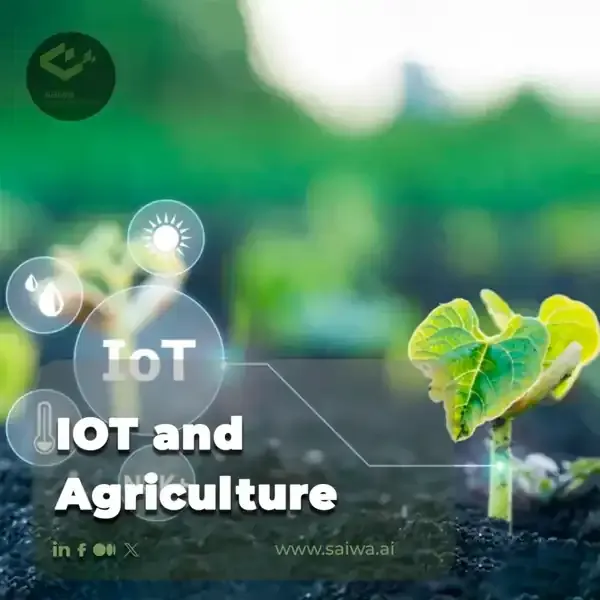
The Internet of Things (IoT) is changing how farms monitor crops, manage irrigation, track equipment, and respond to changing field conditions. Instead of relying entirely on manual inspections or fixed schedules, farmers can use connected sensors and software to collect field data and make more informed decisions.
IoT in agriculture refers to the use of internet-connected sensors, devices, machines, and control systems to monitor and manage agricultural operations. These technologies help farmers measure soil moisture, weather conditions, equipment performance, and livestock activity, often without being physically present at every location.
For farmers in the United States and Canada, agricultural IoT can be particularly useful for managing large fields, variable weather, irrigation demands, and remote operations.
This guide explains how agricultural IoT works, its most important applications, common sensor technologies, benefits, challenges, and practical steps for implementation.
What Is IoT in Agriculture?
IoT in agriculture, sometimes called Agriculture IoT or Agri-IoT, is a network of connected devices that collect, transmit, and sometimes act on agricultural data.
An agricultural IoT system may include soil moisture sensors, weather stations, GPS trackers, livestock monitoring devices, irrigation controllers, and cloud-based farm management platforms.
For example, a soil moisture sensor can measure conditions at different depths and send readings to a farmer's phone. The farmer can then review the information and decide whether irrigation is necessary.
More advanced systems can automatically operate pumps or irrigation valves when predefined conditions are met, provided appropriate safeguards are in place.
Agricultural IoT is one of the technologies supporting smart farming, alongside artificial intelligence, robotics, GPS, and remote sensing.
The U.S. National Institute of Standards and Technology identifies IoT as a technology with significant agricultural potential, particularly for improving efficiency and resource management.
Source: NIST — Internet of Things Advisory Board Report
How Does IoT Work in Agriculture?
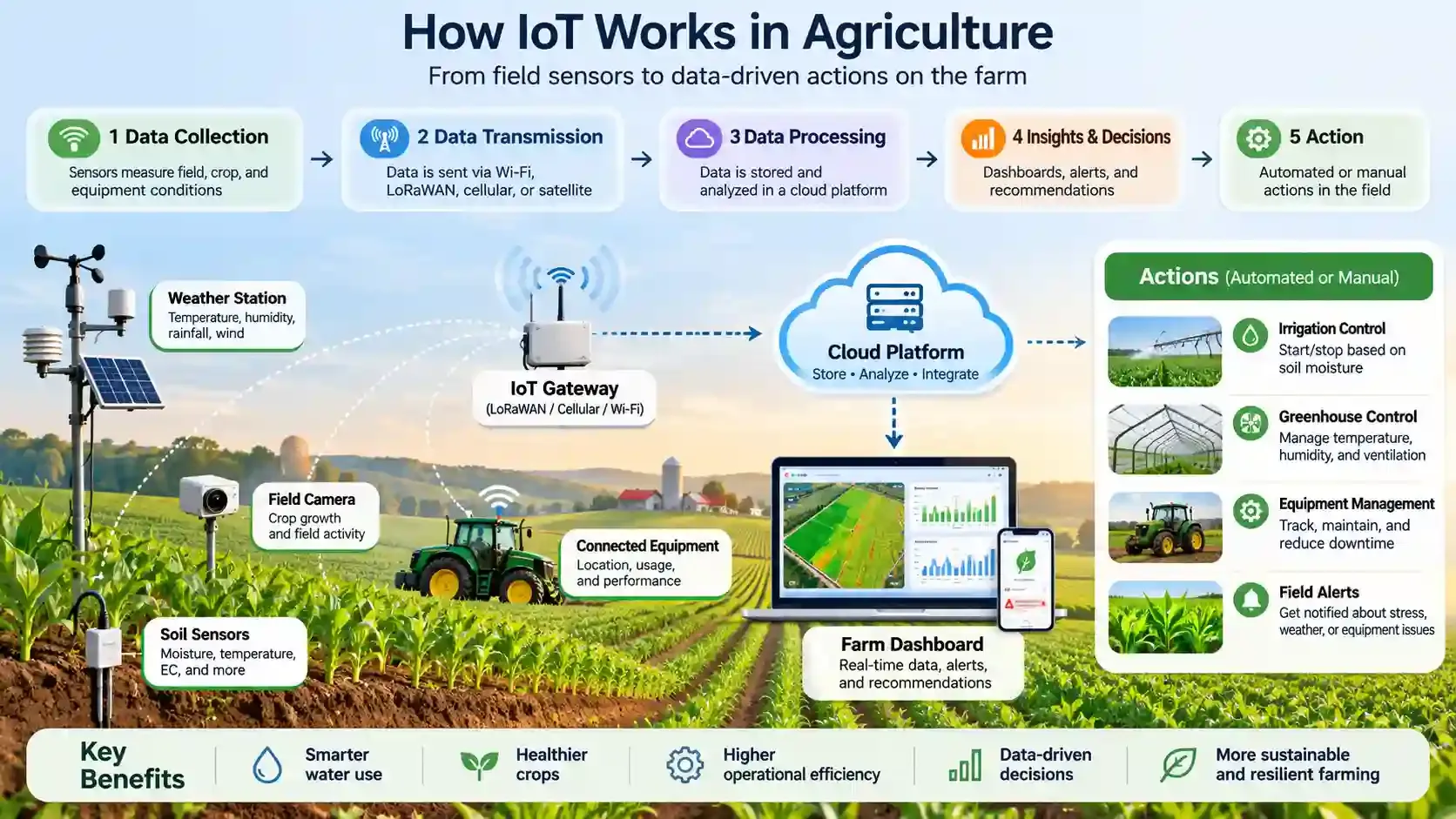
Most IoT farming systems follow a five-stage process.
1. Data Collection Through Agricultural Sensors
Sensors installed in fields, greenhouses, machinery, or livestock facilities collect measurements such as soil moisture, temperature, humidity, water flow, equipment location, and animal activity.
The type and placement of sensors depend on the agricultural problem being addressed.
2. Data Transmission Through IoT Networks
The collected information travels through communication technologies such as Wi-Fi, cellular networks, LoRaWAN, or other low-power wireless systems.
Some sensors connect directly to the internet, while others communicate through a nearby gateway.
3. Data Storage and Processing
Sensor readings are transmitted to a local computer, edge device, or cloud platform.
The platform organizes the measurements, stores historical records, and may combine sensor information with weather forecasts or other agricultural datasets.
Learn more about the role of cloud computing in agriculture.
4. Analysis and Decision-Making
Farmers use dashboards, alerts, and analytical models to interpret the information.
For example, an irrigation dashboard might show declining soil moisture alongside an upcoming rainfall forecast. The farmer can use both sources to decide when to irrigate.
5. Automated or Manual Action
The final step converts data into an agricultural action.
A system may send an alert, recommend an inspection, adjust greenhouse ventilation, or control irrigation equipment.
The basic IoT agriculture workflow is:
Sensors → Wireless Network → Data Platform → Analysis → Farmer Decision or Automated Action
Not every system requires automation. Many farms gain value simply by receiving reliable measurements and timely alerts.
10 Applications of IoT in Agriculture
Agricultural IoT applications range from simple environmental monitoring to integrated farm management systems.
The most useful application depends on crop type, farm size, available connectivity, and the decisions that farmers need to improve.
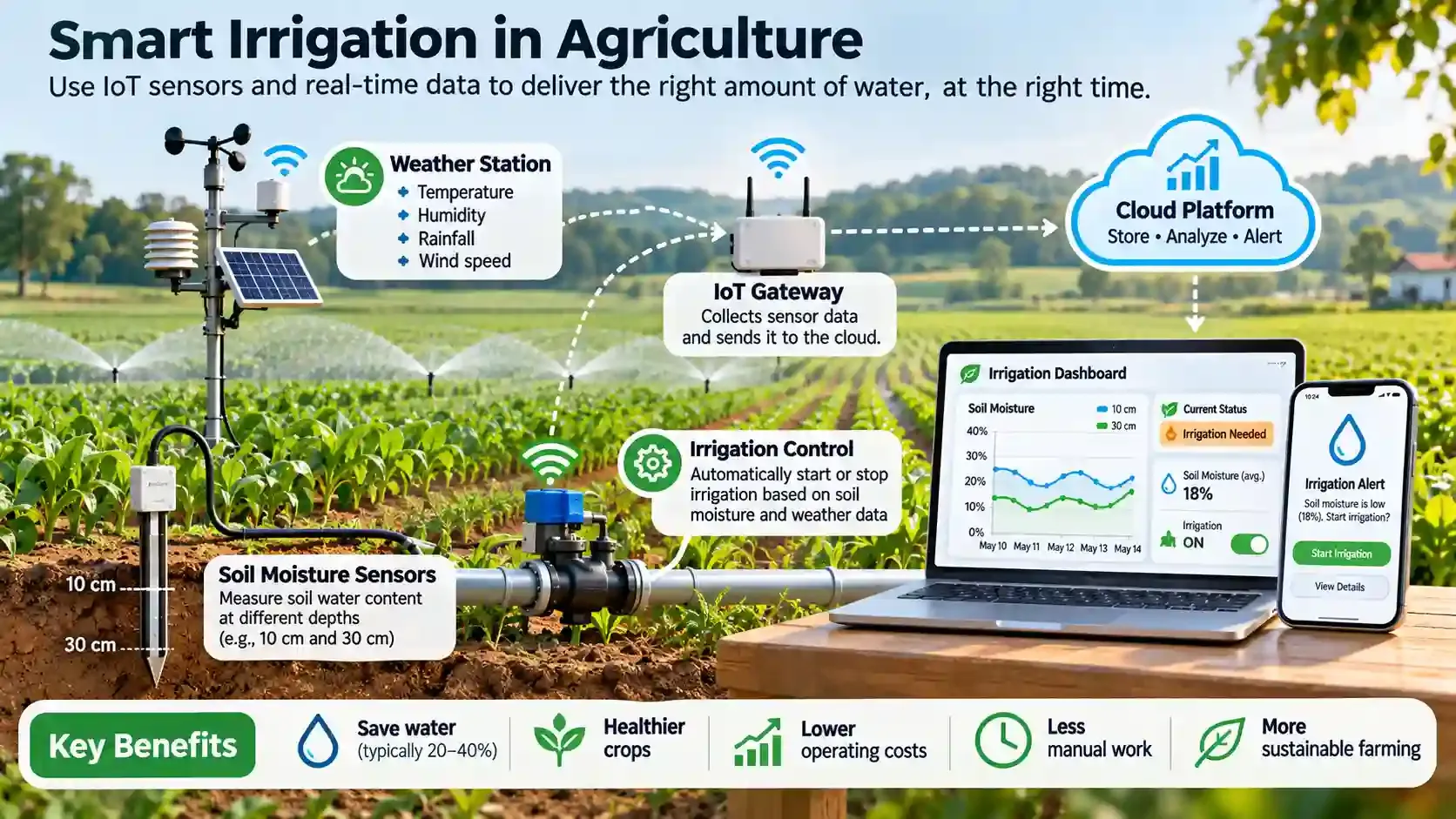
1. Smart Irrigation and Water Management
Smart irrigation is one of the most practical uses of IoT in agriculture.
Soil moisture sensors, weather stations, flow meters, and connected irrigation controllers can help farmers determine when and how much water to apply.
A typical system may monitor:
- Soil moisture at different depths
- Rainfall and temperature
- Irrigation flow and pressure
- Pump operating status
- Water use over time
When soil moisture approaches a locally calibrated threshold, the system can notify the operator or initiate an irrigation event under approved control rules.
This can help reduce unnecessary watering and identify equipment problems. Actual water savings depend on the irrigation system, crop requirements, and existing management practices.
Explore the technology in our guide to IoT-based irrigation systems.
2. Soil Monitoring and Nutrient Management
Soil conditions influence crop establishment, water availability, and nutrient uptake.
IoT soil monitoring systems can measure moisture, temperature, and electrical conductivity. Some specialized devices estimate other soil properties, but nutrient measurements often require calibration and confirmation through laboratory testing.
These measurements help farmers identify changes that may affect crop development.
For example, soil moisture readings from different parts of a field may reveal that one irrigation zone dries more quickly than another.
Combined with soil sampling and agronomic recommendations, this information can support better water and nutrient management.
Read more about soil monitoring using AI and soil and leaf nutrient monitoring.
3. Crop Health Monitoring and Early Stress Detection
IoT devices can continuously measure environmental conditions associated with crop stress, including soil moisture, temperature, humidity, and leaf wetness.
These measurements may help identify conditions that increase the likelihood of drought stress or certain plant diseases.
However, environmental sensors do not automatically diagnose crop diseases.
For more detailed crop assessments, farmers may combine sensor data with field scouting, camera systems, drone imagery, or satellite observations.
For example, soil moisture readings might indicate water stress while aerial imagery helps identify which sections of a field show abnormal vegetation patterns.
Learn how crop monitoring tools and plant health monitoring support agricultural decision-making.
4. Smart Greenhouse Monitoring
Greenhouses require close control of temperature, humidity, ventilation, lighting, and irrigation.
IoT greenhouse systems collect environmental measurements and can connect them to fans, vents, heaters, irrigation controllers, and other equipment.
A greenhouse operator might configure alerts for unusually high temperatures or use connected controls to maintain a target climate range.
The benefits include better visibility into growing conditions and faster responses to equipment failures.
More advanced installations can coordinate environmental controls with crop-specific growing requirements.
Explore greenhouse IoT technologies for more details.
5. Precision Livestock Monitoring
IoT technology also supports livestock farming.
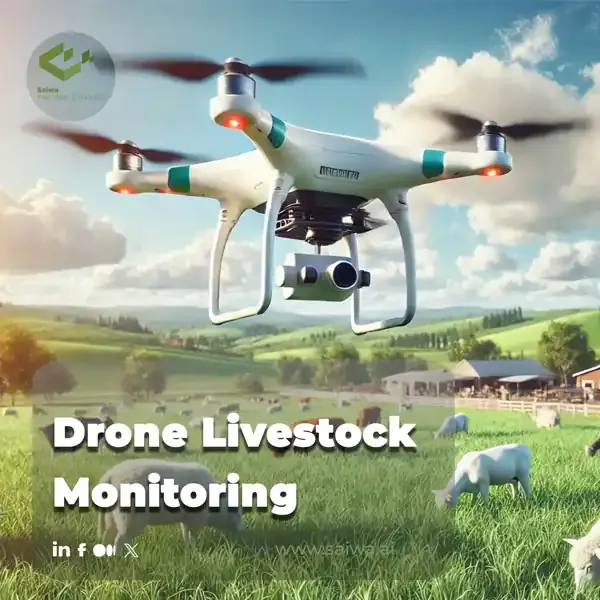
Connected collars, ear tags, and other monitoring devices can record activity, movement, location, and selected physiological measurements.
Depending on the system, these measurements may help identify unusual behavior, support reproductive management, or flag animals that require closer inspection.
For example, a change in activity patterns may prompt a farmer to examine an animal for potential health or welfare concerns.
Such alerts support, but do not replace, veterinary assessment and direct animal observation.
6. Agricultural Equipment Tracking and Predictive Maintenance
Connected tractors, irrigation pumps, and other farm machines can transmit operational information to monitoring platforms.
Useful measurements include:
- Equipment location
- Engine operating hours
- Fuel consumption
- Temperature and vibration
- Fault codes
- Maintenance history
Farm managers can use this information to schedule servicing, identify unusual operating conditions, and reduce avoidable downtime.
When sufficient historical data is available, predictive maintenance models may estimate the likelihood of certain equipment failures.
This application is especially relevant to farms managing machinery across multiple locations.
7. Agricultural Weather Monitoring
Local weather conditions can vary substantially across a large farm.
Connected agricultural weather stations can measure rainfall, wind speed, air temperature, humidity, and other environmental conditions.
These readings help farmers make more informed decisions about irrigation, spraying, frost protection, and field operations.
For example, wind measurements can help determine whether conditions are suitable for a planned spraying operation, alongside product-label requirements and applicable regulations.
In Canada, Shared Services Canada has described a proof-of-concept project connecting agricultural weather stations to cloud dashboards to make field measurements easier to share and analyze.
Source: Government of Canada — Improving Canadian Agriculture Through the Internet of Things
8. Smart Crop Protection and Pest Monitoring
Agricultural IoT can support pest and disease management by collecting environmental measurements and information from connected monitoring equipment.
For example, temperature, humidity, and leaf wetness data can be used in certain disease-risk models.
Connected insect traps with cameras may also help monitor pest activity, depending on their design and recognition capabilities.
These systems can provide earlier warnings, but their recommendations must be checked against local pest conditions, crop stage, and agronomic guidance.
Farmers can combine IoT measurements with smart crop protection systems and AI-based plant disease detection.
9. Grain Storage and Post-Harvest Monitoring
IoT technology can help monitor agricultural products after harvest.
Temperature and humidity sensors installed in storage facilities provide information about conditions that may contribute to spoilage or quality deterioration.
Connected systems can alert operators when measurements exceed configured limits.
In grain storage, monitoring may support decisions about aeration and inspection, although temperature readings alone cannot detect every storage problem.
This application is relevant to grain-producing regions in both the United States and Canada.
10. Farm Automation and Data-Driven Operations
Agricultural IoT becomes more powerful when connected devices exchange information with farm management and automation systems.
For example, a farm may combine soil moisture readings, weather forecasts, irrigation records, and equipment status in one dashboard.
Automated workflows can then assist with scheduling, alerts, and selected control operations.
The goal is not necessarily to remove people from farm management. It is to provide better information and reduce repetitive monitoring tasks.
For a broader discussion, explore automated farming technologies and agricultural data management.
Types of IoT Sensors Used in Agriculture
Selecting the right sensors is essential because inaccurate or poorly placed devices can lead to misleading conclusions.
| Sensor type | What it measures | Common agricultural use |
|---|---|---|
| Soil moisture sensor | Soil water content or water tension | Irrigation scheduling |
| Soil temperature sensor | Temperature at a selected depth | Planting and root-zone monitoring |
| Air temperature sensor | Ambient temperature | Frost and heat monitoring |
| Humidity sensor | Relative humidity | Greenhouse and disease-risk monitoring |
| Leaf wetness sensor | Moisture on a sensing surface | Disease-risk assessment |
| Electrical conductivity sensor | Electrical conductivity | Soil or irrigation-water assessment |
| Water flow sensor | Water movement through a pipe | Irrigation monitoring and leak detection |
| GPS/GNSS tracker | Geographic position | Machinery and asset tracking |
| Livestock activity sensor | Movement or activity patterns | Animal monitoring |
| Connected camera | Images or video | Visual inspection and selected detection tasks |
Not every sensor directly measures the agricultural variable of interest. For example, electrical conductivity is not a direct measurement of individual nutrient concentrations.
Sensor selection should consider measurement accuracy, calibration, durability, power supply, connectivity, and maintenance.
IoT Connectivity Technologies for Smart Farming
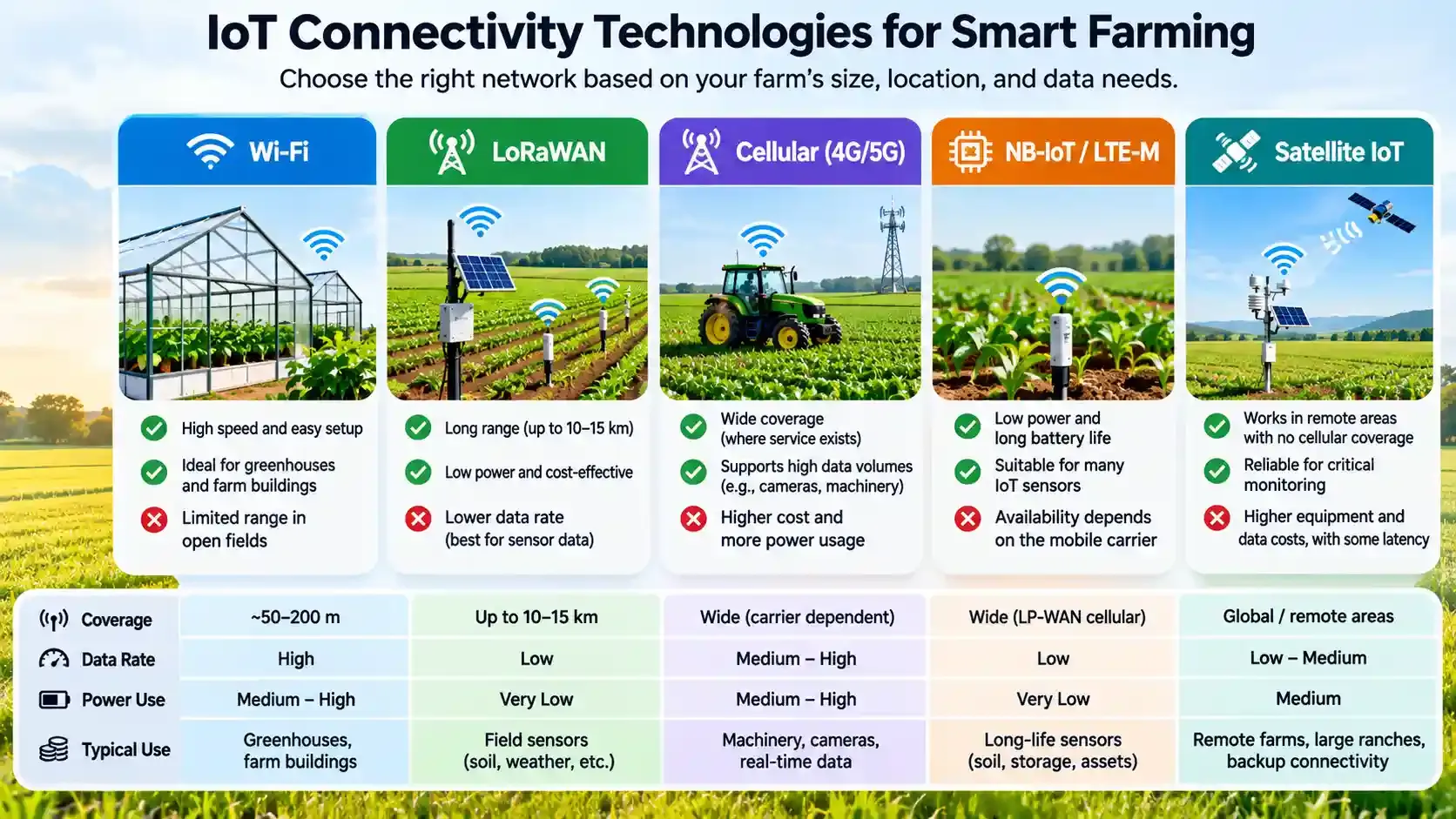
Agricultural IoT devices need reliable communication, but there is no single network technology suitable for every farm.
| Technology | Typical strengths | Main limitations |
|---|---|---|
| Wi-Fi | Convenient for nearby buildings and greenhouses | Limited coverage across large fields |
| LoRaWAN | Long-range, low-power sensor communication | Limited bandwidth and gateway requirements |
| Cellular LTE/4G/5G | Wide-area connectivity where service is available | Coverage, power use, and subscription costs |
| NB-IoT / LTE-M | Low-power cellular connectivity for supported devices | Availability varies by carrier and location |
| Bluetooth | Short-range device setup and communication | Not suitable alone for large-area coverage |
| Satellite IoT | Potential connectivity in remote areas | Device compatibility, cost, latency, and capacity constraints |
For large farms, a combination of technologies may be necessary.
A field sensor network might use LoRaWAN to communicate with a gateway, while the gateway uses cellular or another backhaul connection to transmit readings to a remote dashboard.
Before purchasing equipment, verify coverage in the actual fields, not only at the farm office.
Benefits of IoT in Agriculture
The value of agricultural IoT comes from improving decisions and operations, not simply installing more sensors.
More Informed Farming Decisions
Regular measurements give farmers greater visibility into field conditions between inspections.
Historical data can also reveal recurring patterns that may not be obvious from occasional observations.
Better Water and Resource Management
Smart irrigation systems can help match water applications to measured conditions.
When properly implemented, connected monitoring can also support more targeted use of energy, labor, and other farm resources.
Earlier Detection of Operational Problems
IoT alerts can notify operators about unusual temperatures, low water pressure, equipment faults, or other monitored conditions.
Early notification may reduce the time between a problem developing and a response.
Improved Remote Monitoring
Farmers can monitor multiple locations from a single dashboard, reducing the need for some routine site visits.
However, physical inspections remain necessary for sensor maintenance, troubleshooting, and agronomic verification.
Better Records and Traceability
Connected systems can automatically document environmental measurements, equipment activity, and selected operational events.
These records can support farm management, troubleshooting, and reporting.
Important: IoT does not guarantee higher crop yields or lower operating costs. Outcomes depend on system reliability, agronomic decisions, implementation quality, and the farm's starting conditions.
IoT in Agriculture: United States and Canada
Agricultural IoT systems must account for regional differences in climate, crops, connectivity, and farm operations.
IoT Farming in the United States
In the United States, IoT can support irrigation management, machinery monitoring, livestock operations, and large-scale field data collection.
In irrigated regions, connected moisture sensors and irrigation controllers may be particularly useful for water management.
In major row-crop production areas, connected machinery and environmental monitoring can support operational planning.
The USDA's National Institute of Food and Agriculture has highlighted research combining sensors, hardware, software, and machine learning to improve understanding of crop water use.
Source: USDA NIFA — New Technology Lets Plants Tell Farmers When They Are Thirsty
IoT Farming in Canada
Canadian farms face challenges that include seasonal weather variability, long distances between field locations, and connectivity limitations in some rural areas.
IoT applications can support weather monitoring, grain storage management, greenhouse operations, and equipment tracking.
For example, connected weather stations can help agricultural researchers collect and compare measurements from different field locations.
Agriculture and Agri-Food Canada also identifies digital technologies, sensor systems, and data-driven agriculture as important research areas.
Source: Agriculture and Agri-Food Canada — Strategic Plan for Science
For both countries, equipment should be selected based on actual operating conditions, including winter temperatures, field distances, network coverage, and maintenance accessibility.
IoT vs. Smart Farming vs. Precision Agriculture
These terms are closely related, but they are not identical.
| Concept | Meaning | Example |
|---|---|---|
| IoT in agriculture | Connected devices that collect or exchange data | Soil sensors transmitting moisture readings |
| Smart farming | Broader use of digital technology to improve farm management | IoT, AI, robotics, and automated decision support |
| Precision agriculture | Managing agricultural variability with location-specific information and practices | Variable-rate fertilizer application based on field zones |
IoT is an enabling technology, smart farming is a broader approach, and precision agriculture focuses on managing variability more precisely.
A farm can use precision agriculture without a continuous IoT connection. Similarly, a connected greenhouse temperature monitor is an IoT application even if it does not involve field-scale precision agriculture.
How IoT Works With AI, Drones, and Satellite Monitoring
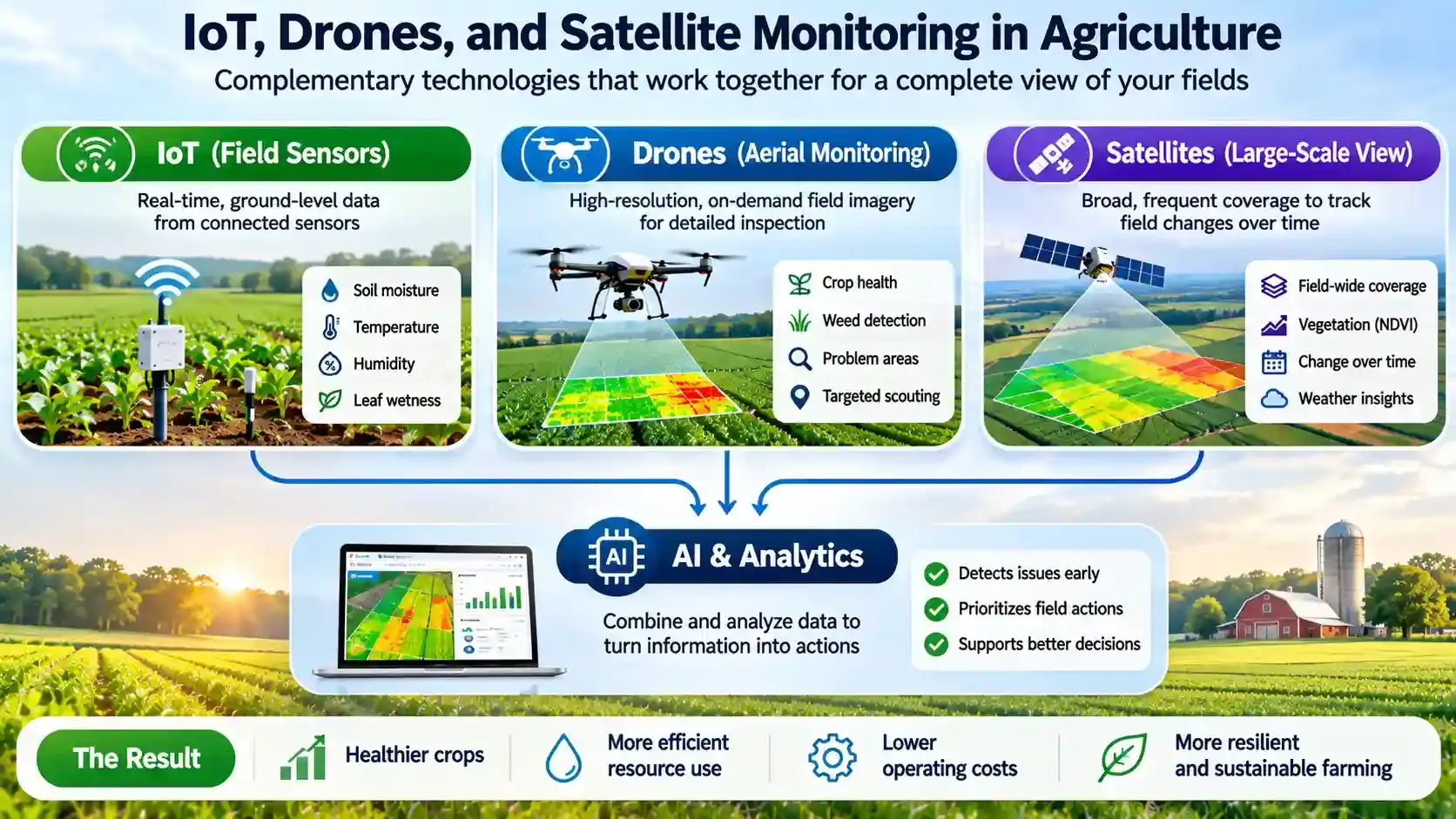
IoT becomes especially useful when sensor measurements are combined with other sources of agricultural information.
IoT sensors provide measurements at specific locations or from particular pieces of equipment.
Drones and satellites can provide broader spatial observations of crop conditions.
Artificial intelligence can analyze these datasets to identify patterns, estimate conditions, or support predictions.
For example, a farmer might use soil sensors to monitor water availability and satellite monitoring in agriculture to identify vegetation changes across a field.
A drone survey can then provide more detailed imagery of selected areas.
AI-based analysis may help identify patterns requiring field investigation.
However, satellite imagery and drone photography are not inherently IoT. They become part of a connected agricultural workflow when their outputs are integrated with sensors, software, or farm management systems.
How to Implement IoT on a Farm
A successful IoT project should begin with a clearly defined agricultural problem.
Step 1: Identify a Measurable Problem
Choose a specific challenge such as excessive irrigation, equipment downtime, greenhouse temperature fluctuations, or insufficient visibility into remote fields.
Avoid purchasing a large sensor network without knowing which decisions the measurements will improve.
Step 2: Select the Appropriate Sensors
Match each sensor to the variable being monitored.
Check measurement range, calibration requirements, environmental protection, battery life, and compatibility with existing equipment.
Step 3: Evaluate Connectivity
Test communication coverage at the intended sensor locations.
Account for terrain, buildings, vegetation, distance, and seasonal changes.
Step 4: Choose a Data Platform
Select software that presents measurements clearly and supports the required alerts, reports, exports, and integrations.
Verify who owns the data and whether it can be exported if the service provider changes.
Step 5: Start With a Pilot
Deploy a limited system in one field, irrigation zone, greenhouse, or equipment group.
Compare sensor measurements with independent observations before relying on the system for important decisions.
Step 6: Measure Results
Track indicators directly connected to the original problem.
Examples include water applied per acre, irrigation labor hours, alert response time, equipment downtime, or the number of unnecessary site visits.
Step 7: Expand Gradually
Once the pilot demonstrates reliable measurements and operational value, extend the system to additional locations.
Document maintenance procedures and train employees before scaling.
How Much Does Agricultural IoT Cost?
The cost of IoT farming systems depends on the number and type of devices, communication infrastructure, software, installation, and ongoing maintenance.
A basic monitoring project may require only a few sensors and a dashboard. A larger deployment may involve many sensor nodes, gateways, automated controllers, integrations, and support contracts.
Rather than relying on a generic price estimate, calculate the total cost of ownership.
Total cost of ownership = Equipment + Installation + Connectivity + Software + Maintenance + Replacement + Training
Compare that cost with measurable potential benefits, such as reduced manual inspections, lower water use, or fewer equipment interruptions.
Request itemized quotations from suppliers and verify whether subscriptions, calibration, and data access are included.
Challenges of IoT in Agriculture
Despite its potential, agricultural IoT introduces technical and operational challenges.
Rural Connectivity
Some agricultural areas have limited cellular coverage or unreliable internet connections.
A system may need local data storage, delayed synchronization, or alternative communications.
Sensor Accuracy and Maintenance
Sensors can drift, become damaged, lose power, or provide misleading measurements if installed incorrectly.
Regular calibration and field verification are essential.
Data Security and Privacy
Connected agricultural systems can expose operational information or create cybersecurity risks if poorly secured.
Use supported devices, strong authentication, access controls, software updates, and secure communication.
Integration Between Platforms
Devices from different manufacturers may use incompatible data formats or communication protocols.
Check interoperability and export options before purchasing.
Return on Investment
An IoT system is valuable only when its information improves a decision or operation enough to justify its costs.
Farmers should evaluate the expected operational benefit before scaling a deployment.
The Future of IoT in Agriculture
Agricultural IoT is evolving toward better integration with artificial intelligence, edge computing, remote sensing, and automated equipment.
Edge computing allows some data processing to occur near the sensor or machine, reducing dependence on continuous cloud connectivity.
AI models can help identify unusual sensor patterns or estimate future conditions, provided they are trained and validated using suitable data.
Connected equipment may also support increasingly coordinated farm operations.
In the United States and Canada, progress will depend not only on technology but also on connectivity, affordability, interoperability, and practical agronomic value.
The strongest systems will be those that turn trustworthy measurements into useful decisions.
How Sairone Supports Data-Driven Agriculture
IoT sensors provide valuable measurements from individual locations, but farmers may also need a broader view of crop conditions across entire fields.
Sairone focuses on AI-driven agricultural imagery analysis, including crop monitoring, plant counting, crop health assessment, and weed detection.
These capabilities can complement connected field sensors by providing spatial information that point measurements alone may not capture.
For example, a farm could use IoT sensors to monitor soil conditions and aerial imagery analysis to investigate crop variability.
Explore Sairone's plant health monitoring capabilities or contact Saiwa to discuss agricultural image analysis.
Sairone should be evaluated as a complementary image-analysis solution, not assumed to provide every type of IoT sensor, network, or automated controller described in this guide.
Frequently Asked Questions About IoT in Agriculture
What is IoT in agriculture?
IoT in agriculture is the use of connected sensors, equipment, and software to collect and exchange agricultural data. It helps farmers monitor conditions and make informed decisions about irrigation, crop management, machinery, and livestock.
How is IoT used in agriculture?
IoT is used for soil moisture monitoring, smart irrigation, greenhouse climate control, weather monitoring, equipment tracking, livestock monitoring, and agricultural automation.
What are IoT sensors in agriculture?
Agricultural IoT sensors are devices that measure conditions such as soil moisture, temperature, humidity, water flow, or equipment activity and transmit the readings to a monitoring or control system.
What is the role of IoT in smart agriculture?
IoT supplies measurements and connectivity that support smart farming. Its data can be combined with AI, automation, and farm management software to improve monitoring and operational decisions.
What is the difference between IoT and precision agriculture?
IoT refers to connected devices and data exchange. Precision agriculture refers to managing agricultural variability using site-specific information and practices. IoT can support precision agriculture, but the two terms are not interchangeable.
Can IoT improve crop yields?
IoT can help farmers identify problems and improve management decisions that influence crop performance. However, yield improvements are not guaranteed and depend on crop conditions, implementation, and the actions taken using the data.
Is IoT suitable for small farms?
Yes. Small farms can begin with a limited number of sensors or a single monitoring application. The investment should be matched to a specific operational need and expected benefit.
What are the main challenges of agricultural IoT?
Common challenges include equipment costs, rural connectivity, sensor maintenance, data security, integration between systems, and demonstrating a return on investment.
Conclusion
IoT in agriculture helps farmers monitor field conditions, connect equipment, and use agricultural data more effectively.
From smart irrigation and soil monitoring to greenhouse automation and livestock tracking, connected technologies can provide information that supports better operational decisions.
For farmers in the United States and Canada, the most effective approach is to begin with a specific problem, choose reliable technology, test it under local conditions, and measure its results.
IoT is most valuable when combined with sound agronomic practices and complementary tools such as AI, drones, and satellite monitoring.
As agricultural technology continues to develop, farms that prioritize reliable data, practical applications, and measurable outcomes will be better positioned to benefit from connected systems.
About the team
Amirhossein Komeili
I’m an AI Developer specializing in Computer Vision and deep learning. At Saiwa, I work on developing and optimizing intelligent systems that apply advanced image analysis to address real-world challenges, particularly in agriculture. My focus is on creating practical, high-impact AI solutions that enhance efficiency, accuracy, and decision-making across diverse applications.
Share this article
Help others discover this content
Comments
Be the first to share your thoughts
No comments yet
Start the conversation by sharing your thoughts