

- Precision Agriculture
- AI in Business
- Agriculture
- Image Processing
Fruit Sorting Using Image Processing: How AI Grading Systems Work
Discover how AI fruit sorting uses image processing to automate fruit grading, detect defects, improve quality control, and optimize sorting efficiency.
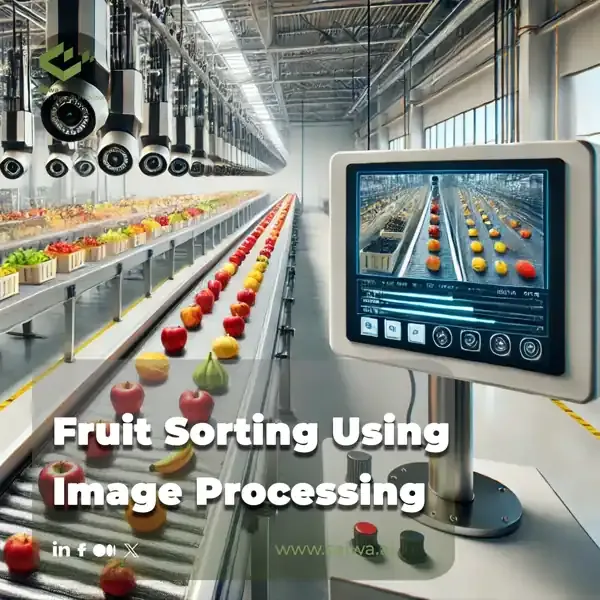
Fruit sorting determines which pieces of produce are packed for sale, sent for processing, or rejected. In a busy packing facility, those decisions must be made consistently—often while hundreds or thousands of pieces of fruit move along a line. That is where fruit sorting using image processing can help.
An automated fruit sorting system captures images of fruit, analyzes visible characteristics such as color, size, shape, and surface defects, and assigns each item to a category. When cameras are connected to a conveyor and sorting mechanism, the system can also direct fruit into the appropriate outlet. Artificial intelligence (AI) helps when appearance is too variable for simple fixed rules.
This guide explains the complete process, how fruit sorting differs from fruit grading, which cameras and algorithms are used, and what a producer should consider before implementing an AI grading system.
In brief: Computer vision can make external fruit inspection more consistent and scalable, but the results depend on image quality, clearly defined grades, representative training data, and the mechanical design of the packing line. A standard color camera cannot reliably see every defect inside a fruit.
What Is Fruit Sorting, and How Is It Different from Fruit Grading?
Fruit sorting is the process of separating fruit into groups according to selected characteristics, such as type, size, ripeness, visible condition, or destination. Fruit grading goes a step further: it assigns a quality class based on specified criteria.
The two terms are often used together because a grading decision usually determines where a fruit is sorted.
| Task | Main question | Practical example |
|---|---|---|
| Sorting | Where should this fruit go? | Send small apples to one packing lane and large apples to another. |
| Grading | What quality class does it meet? | Assign apples to grades based on the applicable requirements for size, shape, color, and defects. |
| Inspection | What attributes or problems can we detect? | Flag a visible bruise, cut, blemish, or unusual color. |
Grading standards are not universal across all fruit. The USDA Agricultural Marketing Service's fruit grade standards, for example, provide commodity-specific terminology and inspection guidance. A grading model should therefore be configured for the fruit variety, market, customer requirements, and applicable standards—not just a general idea of what looks "good."

How Does an Automated Fruit Sorting System Work?
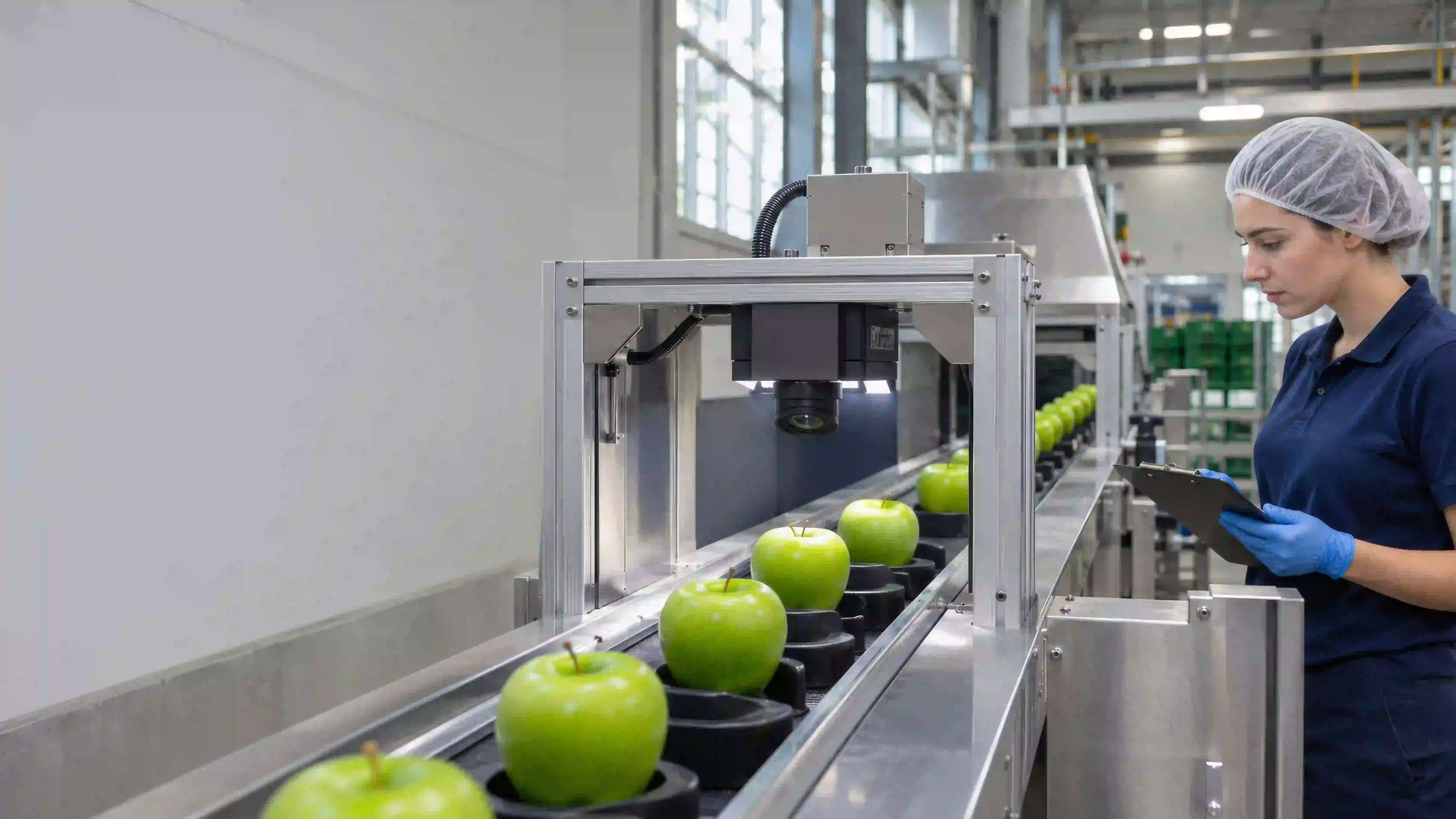
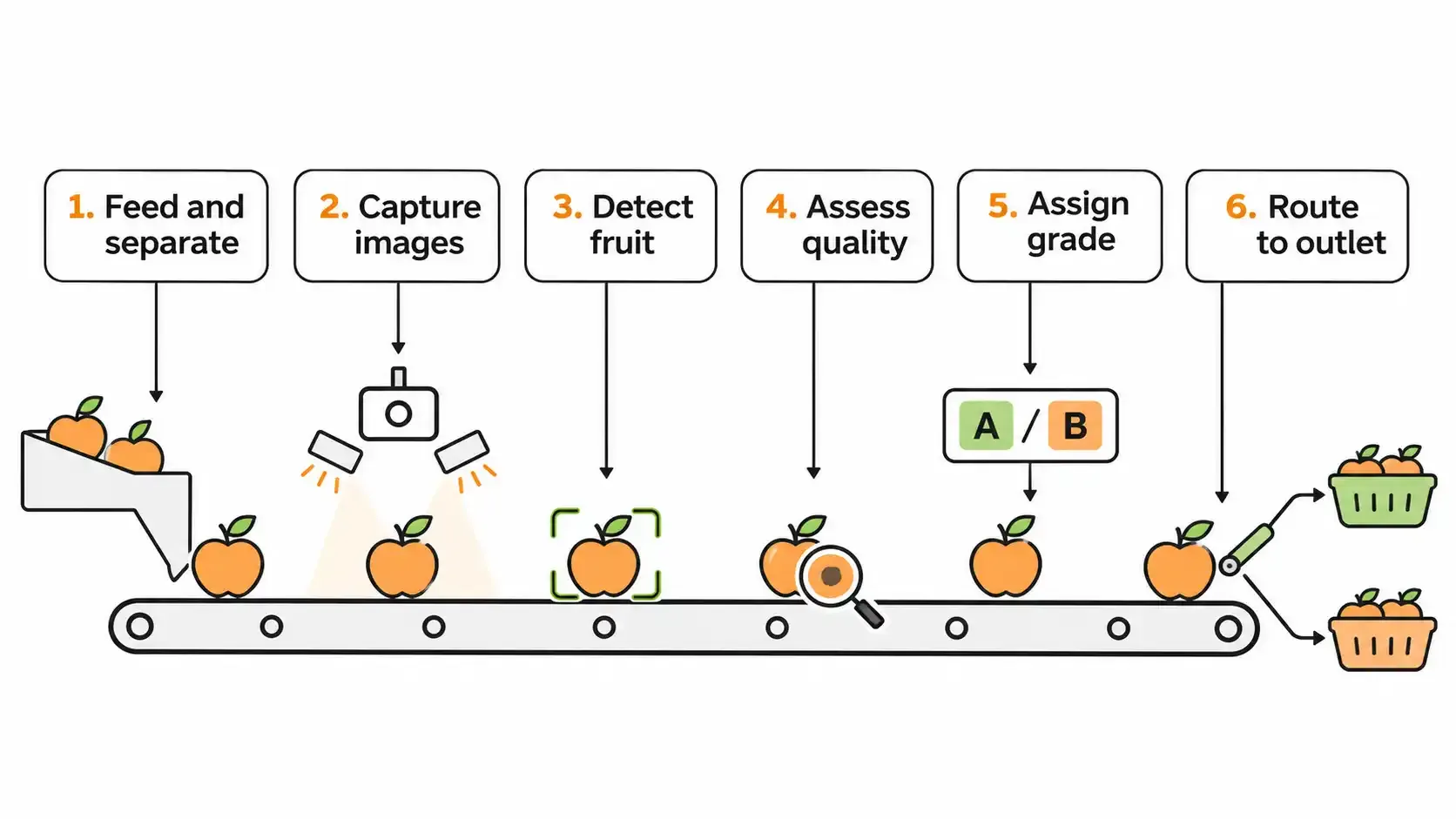
An effective fruit sorting machine is more than an AI model. It combines fruit handling, cameras, lighting, analysis software, and a physical mechanism that directs fruit to the correct output.
1. Fruit feeding and separation
Fruit enters the system on a conveyor, rollers, or individual carriers. Ideally, each item is positioned so it can be seen without overlapping neighboring fruit. Gentle handling matters, especially for delicate produce.
2. Image capture under controlled lighting
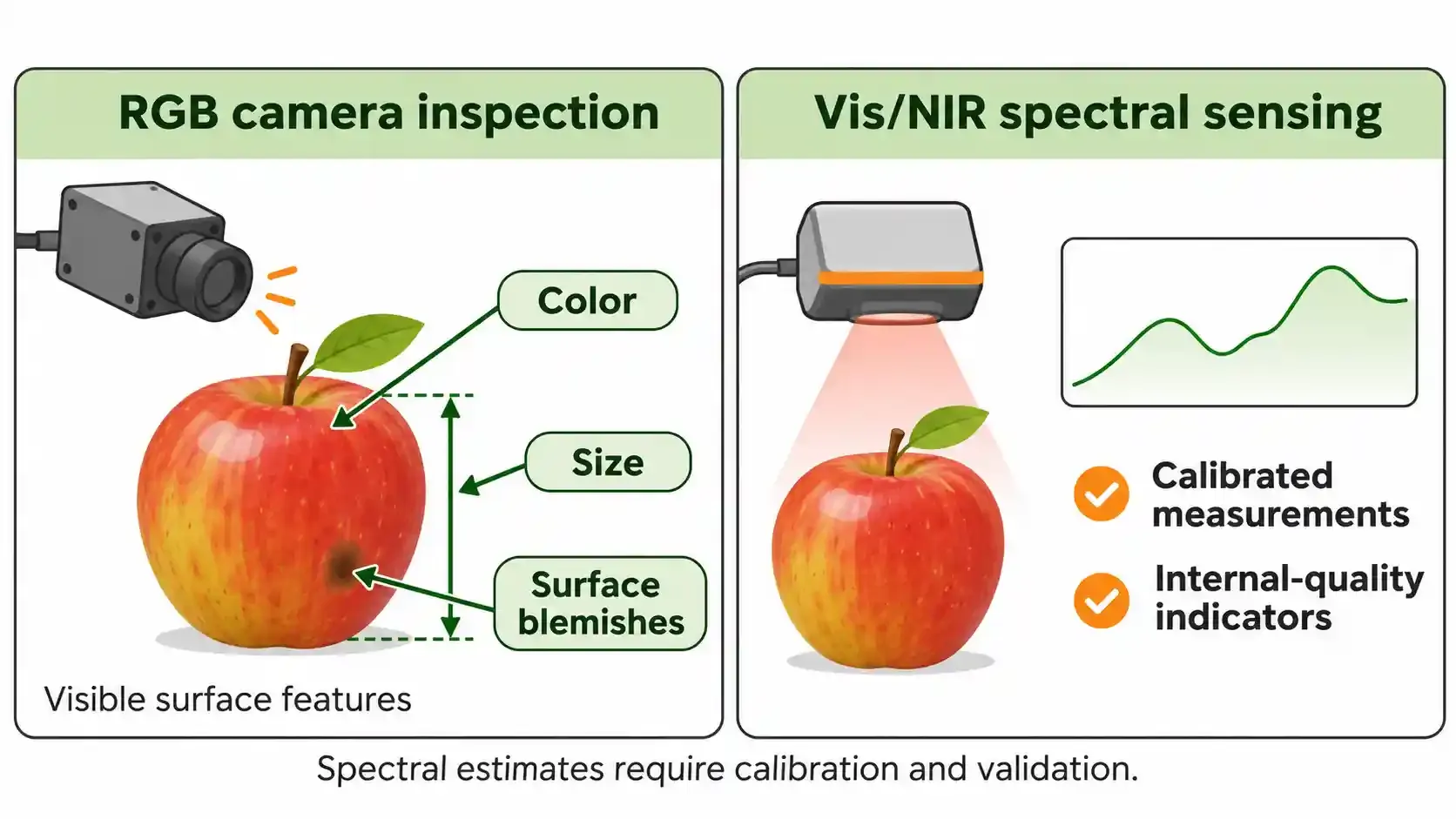
An RGB camera records the fruit's visible appearance. Some systems capture multiple views as the fruit rotates, reducing the chance that a defect remains hidden on the underside. Stable lighting, focus, exposure, and conveyor timing are essential: even a sophisticated model can struggle with blurred or poorly lit images.
3. Image processing and fruit detection
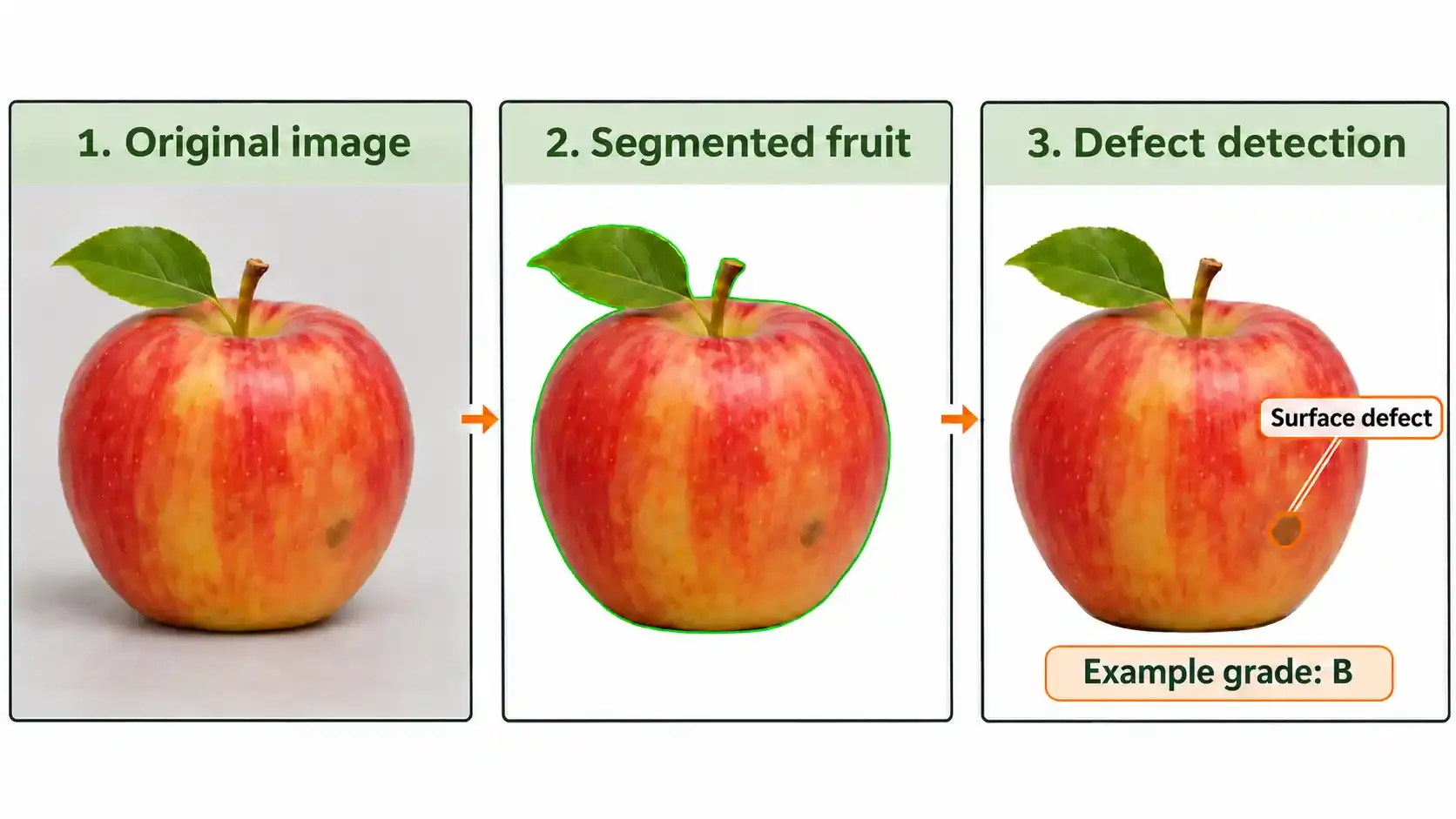
Software first identifies the fruit and separates it from the background. It may correct lighting differences, reduce noise, detect boundaries, and measure color or shape features. This is where traditional image processing methods—such as thresholding and edge detection—can still be useful.
4. Quality analysis and grading
A set of rules or a trained machine-learning model evaluates features relevant to the selected grade. It may classify the entire fruit, locate a surface defect, or outline a damaged area. A model's prediction is then compared with the packing facility's acceptance thresholds.
5. Automatic sorting and quality records
The controller tracks each fruit to the correct position and activates a diverter, gate, or other sorting mechanism. The system can also record counts, assigned grades, reject reasons, and changes in the quality mix from one batch to another.
Which Fruit Characteristics Can Image Processing Measure?
The most useful measurement depends on the type of fruit and the buyer's requirements.
| Characteristic | What the system looks for | Important limitation |
|---|---|---|
| Size and shape | Diameter, projected area, outline, roundness, asymmetry | Physical size needs calibration; a single camera view may not describe full volume. |
| Color | Color distribution, color uniformity, unusual patches | Color is not a universal measure of ripeness or sweetness. |
| Surface defects | Bruises, scarring, cuts, discoloration, spots | Subtle defects can be confused with natural markings, glare, or shadows. |
| Texture | Wrinkles, roughness, surface patterns | Reflections and wet surfaces can affect readings. |
| Ripeness indicators | Visible color and surface changes | Many internal maturity attributes require additional sensors or reference measurements. |
Can a camera detect defects inside fruit?
Not reliably with ordinary RGB images alone. A standard camera mainly observes the visible surface. If the goal includes internal browning, soluble solids, or hidden damage, a facility may need complementary sensing such as visible/near-infrared (Vis/NIR) spectroscopy, hyperspectral imaging, or—in specific applications—other nondestructive techniques. Sensor selection should follow the exact defect or quality attribute being measured, not a blanket claim that AI can see through fruit.
A 2026 review of postharvest grading technologies describes how visual inspection and spectral or other sensors serve different quality-assessment needs.
Traditional Image Processing vs. AI Fruit Grading
Not every automated fruit sorting system requires deep learning. The simplest suitable method is often the most practical.
Rule-based image processing
Traditional algorithms use selected features and thresholds. For example, software might isolate an orange from the conveyor background, calculate its diameter from a calibrated image, and check the proportion of its surface within a color range.
Best suited to: Predictable fruit presentation, stable lighting, measurable geometric properties, and straightforward grading rules.
Main drawback: Rules can become fragile when fruit appearance, lighting, cultivar, or camera angle changes.
Machine learning and deep learning
Machine-learning classifiers such as support vector machines (SVMs) can learn from extracted color, shape, and texture features. Deep-learning models—including convolutional neural networks (CNNs)—can learn more complex visual patterns directly from labeled images. Object detection models are useful when defects must be located, while segmentation models are useful when their areas need to be measured.
Best suited to: Greater visual variation, complex defects, and classification tasks that are difficult to express as a few fixed thresholds.
Main drawback: These methods need enough representative, correctly labeled examples and validation on fruit from real production conditions. A high score on a small laboratory dataset does not guarantee the same performance on a fast-moving line.
A systematic review of artificial vision for fruit inspection discusses common hardware configurations and processing methods, while a 2024 review of CNN-based fruit grading examines visual quality features and dataset challenges.
If you would like a broader introduction, see our guides to image processing in agriculture and computer vision in agriculture.
Fruit Sorting Examples: Apples, Citrus, Mangoes, and Berries
Different fruit types need different inspection criteria and handling methods.
Apples: A system may assess dimensions, surface color, shape, and visible blemishes. Multiple camera views can help reveal damage on different parts of an apple. The target grade must be matched to the relevant cultivar and market specifications.
Oranges and other citrus: Size, visible skin color, and surface defects are common inspection features. A published citrus sorting-machine study describes a physical prototype that combined camera-based decisions with weight grading and mechanical handling. It demonstrates an engineering approach—not a universal accuracy guarantee for all packhouses.
Mangoes: Color, shape, and visible damage can contribute to sorting decisions, but different mango varieties develop different surface colors. A universal "green means unripe" rule would be unreliable.
Berries: Systems must balance rapid inspection with gentle handling. Small size, clustered fruit, delicate surfaces, and short shelf life make mechanical design and reliable image capture particularly important.
These examples show why an automated fruit grading system should be calibrated for the fruit, conditions, and business goal rather than trained as a one-size-fits-all model.
Benefits of Fruit Sorting Using Image Processing
When designed and operated well, automated inspection can offer several practical benefits:
More consistent decisions: A documented grading policy can be applied across shifts and operators.
Higher potential throughput: Cameras can inspect fruit continuously, provided the image-processing speed and mechanical handling match the line rate.
Better visibility into quality: Grade counts and reject reasons can reveal batch-to-batch variation and recurring defects.
Reduced repetitive inspection work: Staff can focus on exceptions, quality assurance, maintenance, and reviewing difficult cases.
More actionable records: Inspection data can support discussions about supplier quality, packing decisions, and process improvements.
However, none of these benefits is automatic. A poorly calibrated system may reject saleable fruit, miss defects, or introduce handling damage. Financial outcomes depend on the actual fruit mix, throughput, staffing, equipment cost, and error rates.
Challenges to Plan for Before Installing an AI Fruit Sorting Machine
Lighting and fruit presentation
Reflections, shadows, conveyor vibration, and fruit touching each other can distort images. Start with consistent illumination, clean optics, proper camera placement, and reliable separation of individual fruit.
Training data and seasonal variation
Fruit changes with variety, orchard, season, storage conditions, and harvest maturity. A model trained on one batch may perform worse on the next. Include representative examples from several relevant conditions and maintain a process for reviewing errors and retraining when necessary.
False rejects and missed defects
Two error types matter: rejecting good fruit and accepting fruit that should be rejected. These have different commercial consequences. Evaluate the model using defect-specific precision and recall, false-reject rates, and false-accept rates—not overall accuracy alone.
Throughput and synchronization
A model that correctly grades still images may still fail in production if images arrive too quickly or the diverter is triggered late. Test the complete line, including camera capture, inference, conveyor tracking, and actuation.
Cleaning, maintenance, and safe handling
Fruit residue and dust can obscure cameras or lighting. The system also needs cleaning routines, calibration checks, hygienic mechanical design, and procedures for handling delicate fruit without causing damage.
How to Choose a Fruit Grading System
Before comparing equipment or requesting a proposal, define the outcome you want.
1. Choose the fruit and grades. Specify the species, varieties, size bands, defect definitions, and intended markets. Use official commodity standards or your buyer's specification where applicable.
2. Specify what you must detect. Is the priority surface damage, size, color, ripeness indicators, or an internal-quality attribute? This determines whether RGB imaging is enough.
3. Set the real operating conditions. State fruit per minute, conveyor configuration, lighting, fruit rotation, and the available equipment space.
4. Request a test on your own samples. Include different harvest lots, varieties, and difficult examples rather than relying only on a vendor's demonstration images.
5. Measure both quality and economics. Track false accepts, false rejects, damage rate, throughput, downtime, maintenance time, and cost per sorted item.
6. Plan for human review. Set a workflow for ambiguous items and for periodically checking whether the grade definitions or model need updating.
An effective pilot should answer a specific question, such as: Can this system identify the defects we care about while keeping false rejection below our acceptable threshold at the required line speed?
Where Sairone Fits in an AI-Powered Agricultural Workflow
Postharvest fruit grading is only one use of computer vision in agriculture. Before fruit reaches the packing line, growers also need to monitor crop development, estimate production, and plan harvest operations.
Sairone provides AI-powered agricultural and environmental analysis workflows, including crop yield estimation and blossom counting and yield estimation. These are preharvest analytics applications, not the same thing as an inline fruit grading machine. Together, preharvest monitoring and postharvest quality inspection illustrate how image-based data can support decisions across the production cycle.
For a wider perspective on automation beyond the packing line, read our article on AI in food technology.
Interested in applying computer vision to your operation? Explore Sairone's services or contact the Saiwa team to discuss your specific images, fruit types, inspection requirements, and integration needs. Confirm the availability and scope of any custom fruit-sorting solution with the team rather than assuming it is an off-the-shelf Sairone service.
Frequently Asked Questions About Fruit Sorting
What is fruit sorting using image processing?
It is a method of inspecting fruit through digital images and using software to assess characteristics such as size, color, shape, and visible defects. The results help determine which category or outlet each fruit should enter.
What is the difference between a fruit sorting machine and a fruit grading system?
A sorting machine physically separates fruit into groups. A grading system assigns categories based on quality rules. A complete automated line often performs both functions.
Does automated fruit sorting always use artificial intelligence?
No. Fixed image-processing rules can be sufficient for simple, controlled tasks. AI and deep learning are useful when visual variation or defect patterns make fixed rules too limiting.
Can AI fruit grading detect bruises or internal defects?
Image-based models can detect many visible surface defects when trained and validated appropriately. Hidden problems may require additional sensors, such as Vis/NIR or hyperspectral equipment; no single camera method detects every quality attribute.
What is needed to start a fruit sorting pilot?
Start with a defined grading specification, representative images or fruit samples, a target line speed, and an acceptable error rate. Then test image capture, the grading model, and the physical sorting action together under realistic conditions.
Conclusion
Fruit sorting using image processing connects cameras, software, and physical handling to make grading decisions at production speed. Traditional image-processing methods can measure straightforward visual characteristics, while AI models can help recognize more complex differences in fruit appearance. Successful installations also need reliable lighting, well-defined grades, suitable sensors, representative data, and consistent mechanical control.
For growers and packing facilities, the right starting point is not choosing the most advanced algorithm. It is deciding which fruit-quality decisions matter, how they will be validated, and whether an automated system can make them reliably under real operating conditions.
References and Further Reading
1. USDA Agricultural Marketing Service — Fruits: Grade Standards and Inspection Instructions. Primary reference for U.S. commodity-specific grading requirements.
2. Artificial Vision Systems for Fruit Inspection and Classification: Systematic Literature Review. Peer-reviewed overview of imaging hardware, methods, and application settings.
3. Postharvest Fruit Grading Technologies and Equipment: A Review. Review of visual, spectral, mechanical, and integrated sorting technologies.
4. A Review of External Quality Inspection for Fruit Grading Using CNN Models. Academic review of visual features, CNN approaches, and datasets.
5. Development of an Optimally Designed Real-Time Automatic Citrus Fruit Grading–Sorting Machine. Research example of computer vision and sorting hardware working together.
About the team
Amirhossein Komeili
I’m an AI Developer specializing in Computer Vision and deep learning. At Saiwa, I work on developing and optimizing intelligent systems that apply advanced image analysis to address real-world challenges, particularly in agriculture. My focus is on creating practical, high-impact AI solutions that enhance efficiency, accuracy, and decision-making across diverse applications.
Share this article
Help others discover this content
Comments
Be the first to share your thoughts
No comments yet
Start the conversation by sharing your thoughts