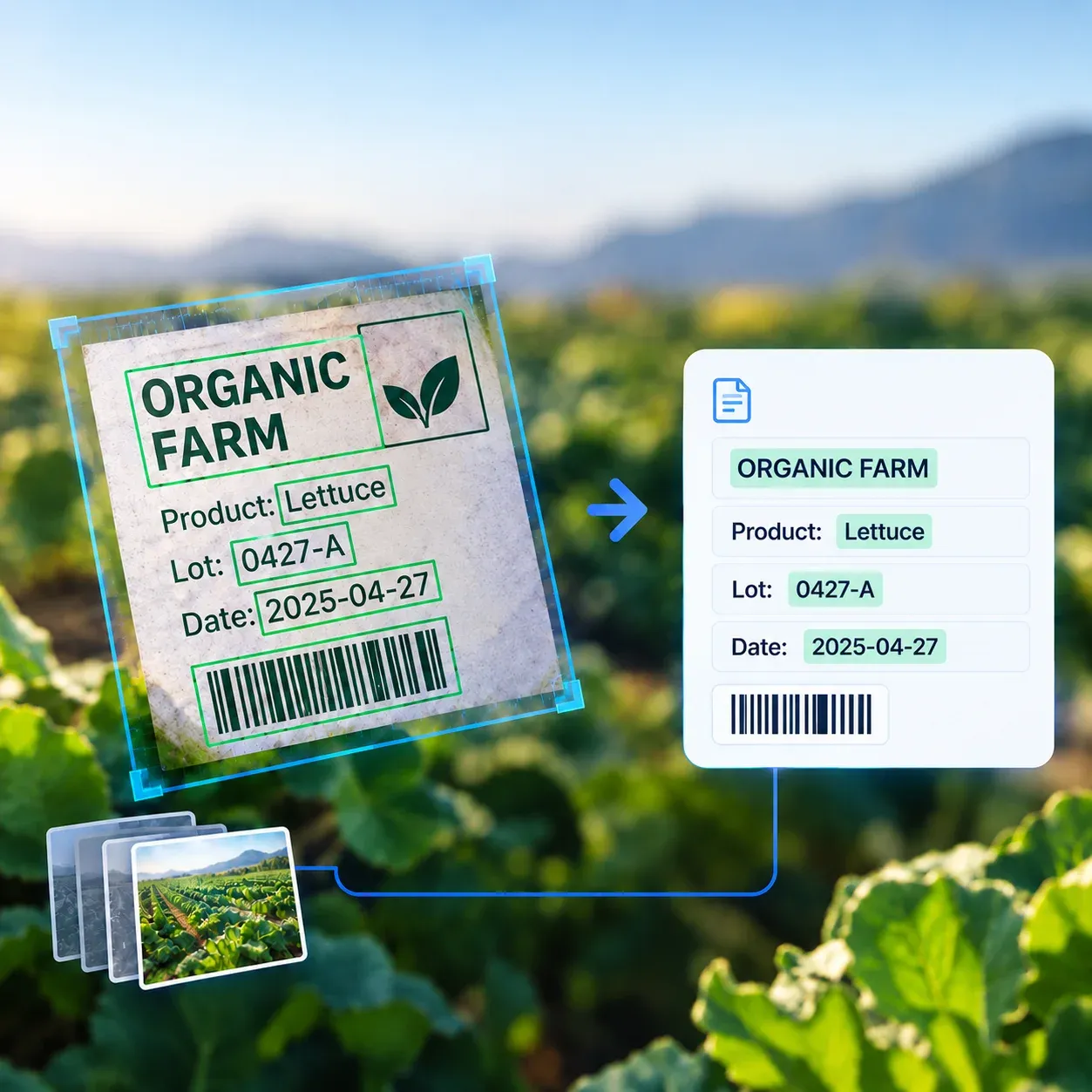
PaddleOCR: A Practical Approach to Text Detection and Recognition
Oct 5, 2026
Written by: Maryam Rajaei
Reviewed by: Boshra Rajaei, PhD
Oct 5, 2026
Written by: Maryam Rajaei
Reviewed by: Boshra Rajaei, PhD
Optical Character Recognition (OCR) is an important component of many computer vision and document-processing systems. By converting text contained in images and documents into machine-readable information, OCR enables applications such as document digitization, information extraction, automated data processing, and intelligent document analysis.
In practical applications, however, OCR is rarely performed on clean, high-resolution images containing perfectly aligned text. Real-world inputs can include scanned documents, photographs, different text orientations, complex layouts, low-quality images, multiple languages, and handwritten content. These conditions can significantly affect the reliability of text extraction.
PaddleOCR is an open-source OCR and document analysis toolkit developed by the PaddlePaddle team. The framework provides components for text detection and recognition as well as more advanced document-processing pipelines. Its current OCR pipeline is based on the PP-OCRv5 model family, while additional pipelines such as PP-StructureV3 extend the system toward document layout and structure analysis.
For computer vision systems such as those developed at Sairone, these capabilities can provide a practical way to convert visual information containing text into structured data that can subsequently be processed by other AI components.
Although OCR is a well-established computer vision problem, deploying it in real-world systems introduces several challenges.
Text can appear in different fonts, sizes, orientations, and visual styles. Printed documents may also contain unusual characters, vertical text, or handwritten content.
PP-OCRv5 specifically targets several of these challenging scenarios, including handwriting, vertical text, uncommon characters, and multiple text types. According to the PaddleOCR documentation, the PP-OCRv5 generation provides substantial improvements over PP-OCRv4 across its internal evaluation scenarios.
OCR systems may receive images captured under very different conditions from the images used during model development.
Examples include:
Low-resolution images
Perspective distortion
Rotated documents
Uneven illumination
Complex backgrounds
Small text regions
Photographed rather than scanned documents
These factors can affect both the ability to locate text and the ability to recognize the individual characters correctly.
An OCR system must solve two related but distinct problems.
First, it must determine where the text is located in the image. This is the text detection stage.
Second, it must determine what the detected text says. This is the text recognition stage.
PaddleOCR separates these components into independent modules. The text detection module identifies text regions, while the recognition module receives those regions and converts them into editable text.
This modular structure is particularly useful when integrating OCR into larger computer vision pipelines because individual components can be configured or replaced independently.
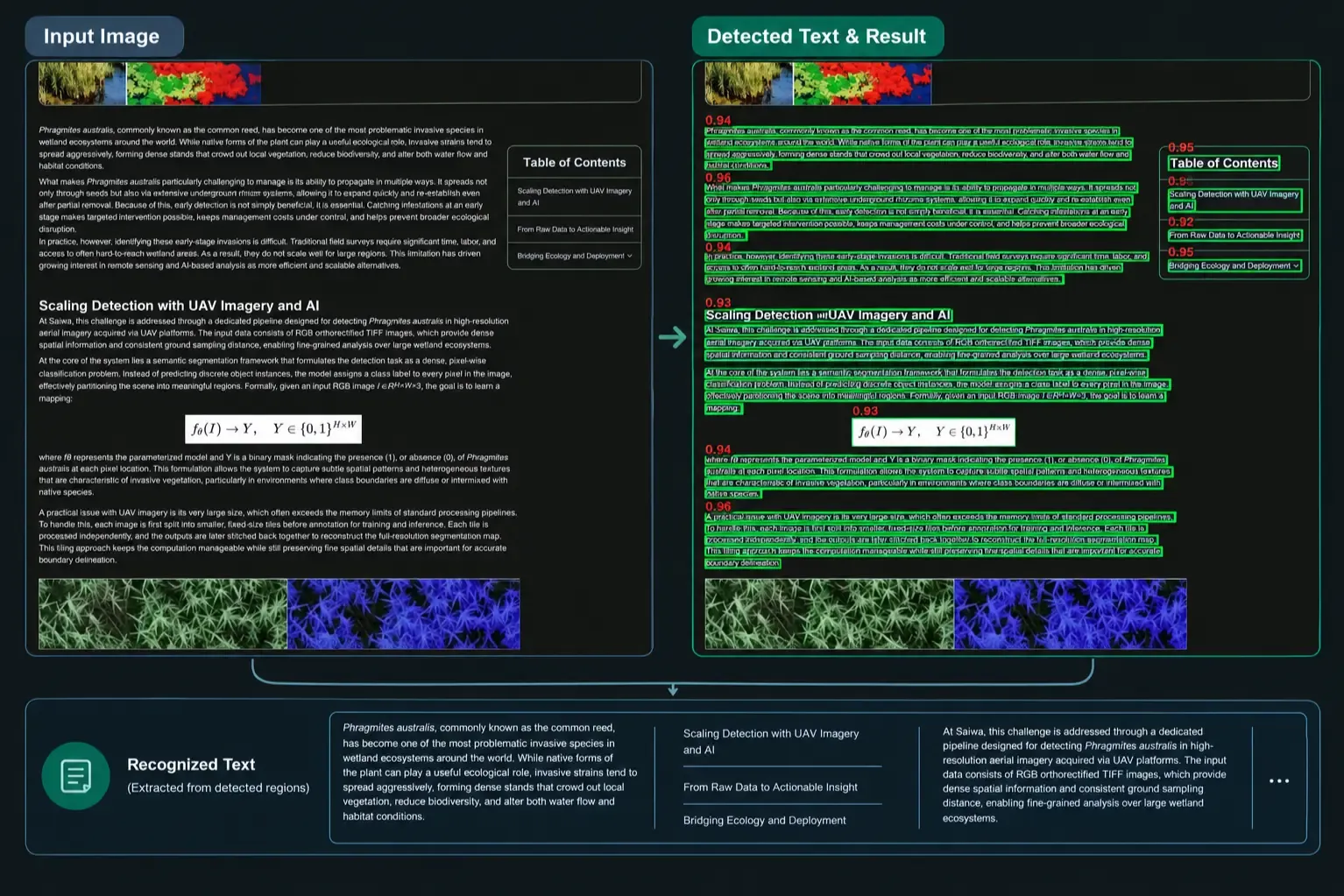
PaddleOCR provides a complete OCR pipeline rather than a single recognition model.
The current PP-OCRv5 pipeline combines text detection and text recognition and can additionally include document orientation classification, document unwarping, and text-line orientation processing depending on the configuration.
One of its important characteristics is the availability of different model configurations for different deployment requirements. For example, PP-OCRv5 provides server-oriented and mobile-oriented detection and recognition models. The mobile models are considerably smaller, while the server models prioritize higher accuracy. The official documentation reports a 4.7 MB model size for PP-OCRv5 mobile detection compared with 84.3 MB for the server detection model.
This makes it possible to select an OCR configuration based on the requirements of a particular application rather than using a single model configuration for every environment.
Another important characteristic of PaddleOCR is its multilingual support.
The current documentation lists support for a large number of languages, including English, German, French, Spanish, Turkish, Arabic, Persian, Urdu, and many others. The exact language availability depends on the OCR model generation being used.
This is particularly relevant for document-processing systems where the language of incoming documents cannot always be assumed in advance.
PaddleOCR also provides multilingual recognition models designed to process multiple languages within a broader OCR framework. The PP-OCRv5 multilingual recognition documentation currently describes support covering 106 languages.
OCR is increasingly becoming only one stage of a larger document-understanding pipeline.
While traditional OCR primarily answers the question:
What text appears in this image?
modern document-processing systems also need to answer questions such as:
Where is each piece of information located?
Which text belongs to a table?
What is the structure of the document?
Which elements represent headings, paragraphs, or other document components?
How should the extracted information be organized?
PaddleOCR addresses these requirements through additional pipelines such as PP-StructureV3.
PP-StructureV3 extends OCR toward document parsing and layout understanding, allowing the system to process documents with multiple layouts and structures rather than treating the input simply as an image containing independent text regions.
This distinction is important when OCR is used as part of a larger AI workflow. Extracted text can become an intermediate representation that is subsequently used for information extraction, classification, search, or language-model-based processing.
To evaluate an OCR framework for practical deployment, benchmark accuracy alone is not sufficient.
A useful evaluation should consider several dimensions:
Text detection accuracy
Text recognition accuracy
Performance on different image qualities
Handling of different text orientations
Multilingual support
Inference speed
Memory requirements
Model size
Deployment flexibility
The PP-OCRv5 documentation reports improvements over PP-OCRv4 across multiple detection and recognition scenarios.
For example, the reported average detection score for PP-OCRv5 server detection is 0.827 across the listed evaluation categories, compared with 0.662 for PP-OCRv4 server detection. For recognition, the reported weighted average for PP-OCRv5 server recognition is 0.8401 compared with 0.5735 for PP-OCRv4 server recognition. These are PaddleOCR's reported evaluation results and should not be interpreted as measurements from Sairone's own datasets.
The framework also provides separate mobile and server configurations, allowing the accuracy–resource trade-off to be adjusted according to deployment requirements.
The choice of OCR configuration can have a significant effect on system performance.
For applications where inference resources are limited, the PP-OCRv5 mobile models provide substantially smaller models. For applications where recognition accuracy is more important and GPU resources are available, the server models provide a higher-capacity alternative.
PaddleOCR also supports inference optimization mechanisms including TensorRT and MKL-DNN, depending on the deployment environment and configuration.
The framework can be used through both command-line interfaces and Python APIs, making it possible to integrate OCR into existing computer vision and AI applications.
For production systems, however, model selection should be based on the actual characteristics of the target data. A model that performs well on public benchmarks may still require additional evaluation or customization when applied to domain-specific documents.
At Sairone, computer vision systems are designed around practical image-analysis problems rather than isolated model benchmarks.
OCR can complement these systems whenever visual data contains textual information that is relevant to the downstream analysis.
A typical pipeline can be represented as:
Image → Text Detection → Text Recognition → Structured Information → AI Analysis
The OCR stage can therefore act as an intermediate layer between visual input and higher-level AI processing.
For example, detected text can be passed to subsequent components for classification, information extraction, indexing, or other forms of automated analysis.
The modular design of PaddleOCR also makes it possible to select only the components required by a particular workflow. A system that only requires text extraction can use the standard OCR pipeline, while more complex document-processing applications can make use of document orientation, unwarping, layout analysis, and document-structure processing.
This flexibility makes PaddleOCR particularly relevant when OCR needs to operate as part of a larger computer vision or AI pipeline rather than as a standalone application.
PaddleOCR demonstrates how modern OCR systems are moving beyond simple character recognition toward complete document understanding pipelines.
Its architecture separates text detection and recognition while providing additional modules for orientation, document processing, and structural analysis. This allows developers to adapt the system to different application requirements.
However, OCR performance remains strongly dependent on the characteristics of the input data. Difficult images, unusual document formats, domain-specific terminology, very small text, and languages or writing styles with limited representation in a particular model can still produce recognition errors.
For this reason, practical evaluation should always include representative data from the intended deployment environment.
In particular, multilingual applications should verify the selected model and language configuration rather than assuming that language support is identical across all PaddleOCR model generations. The current documentation shows that PP-OCRv5, PP-OCRv4, and PP-OCRv3 have different language support.
OCR has evolved from a relatively isolated text-recognition task into an important component of modern document and computer vision pipelines.
PaddleOCR provides a broad ecosystem for this process, ranging from text detection and recognition through multilingual OCR and more advanced document-structure analysis. Its PP-OCRv5 generation provides separate server and mobile configurations, while additional pipelines such as PP-StructureV3 extend the framework toward structured document understanding.
For real-world AI systems, the primary value of such a framework is not simply the ability to recognize characters. Its modular architecture allows OCR to become one component within a larger pipeline that transforms visual documents into structured, machine-readable information.
For Sairone, this makes PaddleOCR a useful technology to consider wherever textual information forms part of the visual data being analyzed and needs to be connected with subsequent computer vision or AI processing stages.
[1] PaddlePaddle. PaddleOCR: Powerful, Lightweight OCR Toolkit. GitHub repository.
https://github.com/PaddlePaddle/PaddleOCR
[2] Cui, C., Sun, T., Lin, M., et al. PaddleOCR 3.0 Technical Report. arXiv, 2025.
PaddleOCR 3.0 Technical Report