



Cucumber Crop Management - Guidelines for Scientific Cultivation
Master cucumber crop management with expert tips on soil, nutrients, irrigation, and technology to boost yield, prevent disease, and grow sustainably.
Written by Amirhossein
Reviewed by Boshra
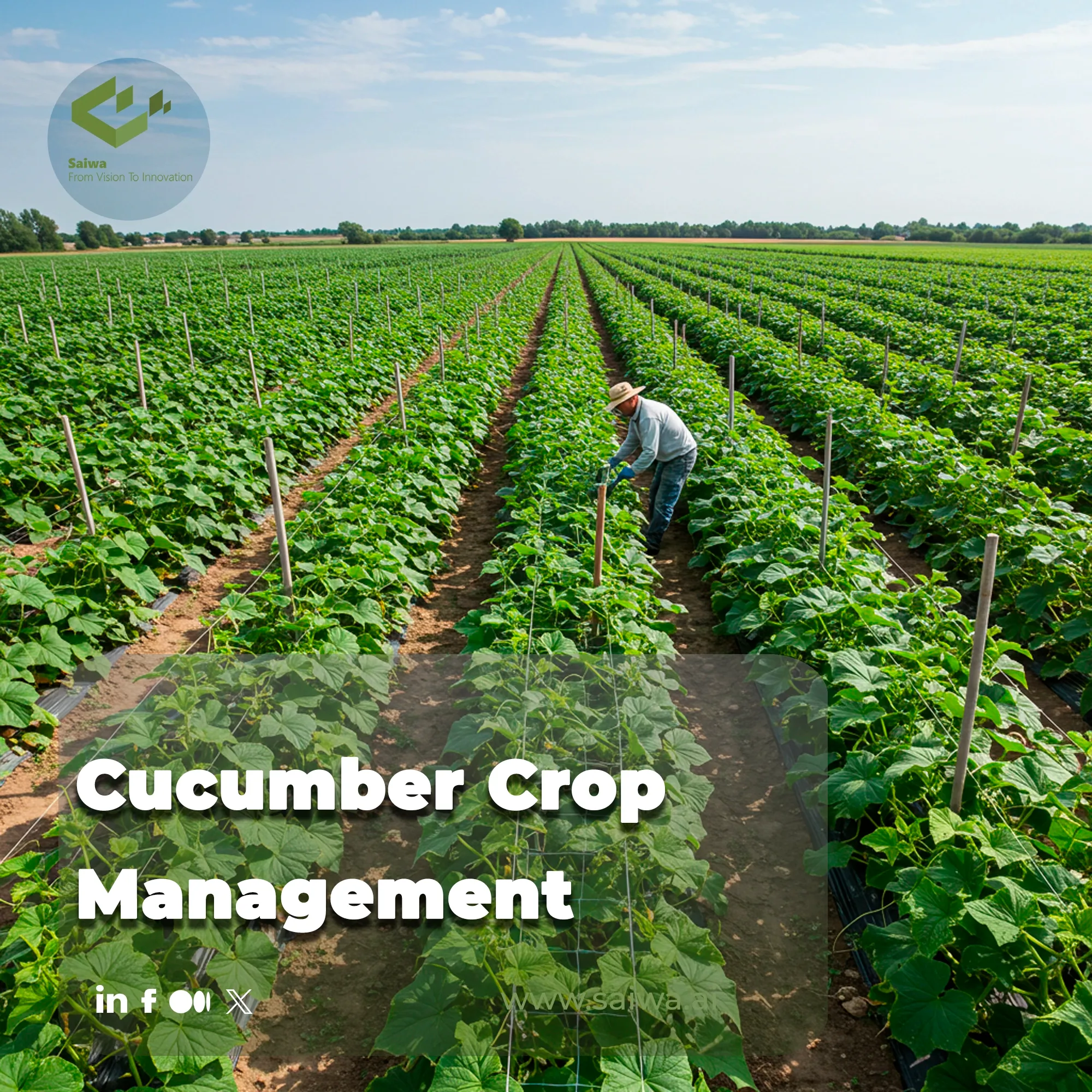
Achieving profitable, high-yield cucumber production is a complex interplay of environmental control, precise resource allocation, and proactive problem-solving. The narrow margin for error, where minor deviations in care can significantly impact yield and quality, elevates crop management from a simple practice to a scientific discipline. Here, technology-driven insights become indispensable.
Platforms like Saiwa’s Sairone are transforming this landscape by converting field data into actionable strategies. This guide offers a comprehensive roadmap for the scientific cultivation of cucumbers, merging foundational agronomic principles with the power of modern technological oversight.

Soil and Climatic Requirements for Cucumber

The genetic potential of a cucumber variety can only be fully realized when its foundational environmental needs are met. This plant's semi-tropical origin dictates its primary requirements, making the selection of a suitable site the first critical step. To achieve optimal growth and fruit development, several key factors must be precisely managed:
Soil: The ideal medium is a light-textured, well-drained sandy loam, rich in organic matter. A soil pH maintained strictly between 6.0 and 6.8 is critical for nutrient availability.
Temperature: As a heat-loving plant, cucumbers thrive in day temperatures of 20-22°C and night temperatures of 19-20°C. They are highly sensitive to frost, and soil temperature should be at least 16°C for successful germination.
Moisture and Light: High humidity and abundant light intensity are essential for vigorous growth and photosynthesis.
Nutrient Management in Cucumber Cultivation
Cucumbers are notoriously heavy feeders, with a voracious appetite for nutrients that peaks dramatically during the fruiting stage. Effective cucumber crop management hinges on a dynamic and responsive nutrient strategy. A modern approach moves beyond simple application and embraces precision. This typically involves two key stages we will discuss now.
The Role of Key Elements
A pre-planting soil test is non-negotiable for establishing baseline levels of phosphorus and potassium. However, nitrogen management is the most dynamic factor, requiring split applications to match the plant’s evolving needs throughout its rapid growth cycle.
Modern Fertilization Methods
Fertigation (nutrient delivery via drip irrigation) stands out as the most efficient method. It provides a steady, controlled supply of nutrients directly to the root zone, preventing the "feast and famine" cycles of traditional top-dressing and ensuring consistent growth.
Irrigation Practices for Cucumber Fields
Consistent moisture is paramount. The cucumber’s relatively shallow root system and rapid vegetative growth make it extremely susceptible to water stress, which can lead to bitter fruit and reduced yields. To illustrate the impact of the chosen irrigation method, let’s compare the two primary approaches.
Criteria | Drip Irrigation | Conventional Irrigation (e.g., Furrow) |
Water Use Efficiency | High (Up to 90%) | Low to Moderate (High evaporation loss) |
Initial Cost | Higher | Lower |
Impact on Plant Health | Reduces foliar diseases | Can increase fungal and bacterial spread |
Weed Management in Cucumber Cultivation
Weed competition presents a formidable challenge, directly threatening yields by usurping water, nutrients, and sunlight. An Integrated Weed Management (IWM) strategy is the most sustainable approach, combining several techniques you can review below.
Agronomic and Mechanical Controls
Using organic or plastic mulches is highly effective in suppressing weeds. However, this is often supplemented by manual weeding, which is effective but prohibitively expensive and labor-intensive on a commercial scale.
Chemical Controls
While herbicides offer a solution, their blanket application poses environmental risks and can be inefficient. The goal is to move towards more targeted applications.
Biological Controls
Incorporating cover crops such as rye or sorghum can naturally suppress weed growth through shading and allelopathic effects. Additionally, certain beneficial microorganisms are being explored for their potential to inhibit weed seed germination and compete with invasive species without harming cucumbers.
Precision Spraying and AI-Based Weed Detection
Advancements in AI-driven weed detection and precision spraying technologies enable farmers to identify and treat weed patches with remarkable accuracy. Drones or smart sprayers equipped with cameras and sensors can reduce herbicide usage by up to 75%, cutting costs, minimizing runoff, and promoting environmentally responsible farming.
Cultural and Preventive Practices
Crop rotation, proper field drainage, and maintaining clean borders prevent weed seed buildup and reinfestation. Encouraging early canopy closure through optimal plant density also helps cucumbers outcompete emerging weeds naturally.
Managing the Critical Window From Flowering to Harvest
In cucumber production, many of the most expensive mistakes happen after the canopy is established, not at planting. By the time the crop enters flowering and early fruit set, its shallow root system, rapid nutrient uptake, and high water demand leave very little room for inconsistency.
This is the stage where yield, fruit quality, and crop uniformity are most vulnerable to short irrigation gaps, unbalanced fertigation, and delayed disease response.
Keep moisture steady, not excessive
The current article correctly notes that cucumbers are highly sensitive to water stress and that drip irrigation is the most efficient delivery method. That principle is supported by field and greenhouse research showing that drip irrigation, when paired with appropriate fertilization, improves yield, nutrient uptake, and water-nitrogen use efficiency.
A field study on cucumber found that irrigation frequency and nitrogen fertilization significantly affected fruit number, yield, and water-use efficiency, with the highest yield recorded under a three-times-per-week drip schedule combined with nitrogen fertilization.
That does not mean every farm should copy the same schedule, because soil type, climate, and system design still matter. It does mean that moderate, repeatable moisture delivery is generally more productive than large fluctuations between dry stress and heavy rewetting.
Match fertigation to crop demand
Cucumbers are heavy feeders, and the article is right to emphasize that nutrient demand rises sharply during fruiting. In practice, this is where fertigation becomes more than a convenience: it allows growers to deliver nitrogen and potassium in smaller, better-timed doses that match crop uptake more closely.
Regional fertilizer guidance also shows that yield response to nitrogen is not unlimited. A University of Florida summary reported that cucumber yield increases were not significant above 65 lb/acre N in the trials reviewed, while full relative yield was achieved at 130 lb/acre N, which reinforces the need for calibrated, site-specific programs rather than automatic overapplication.
For commercial fields, the key lesson is to treat nitrogen as a managed flow, not a single event. Too little slows canopy function and fruit fill, while too much can waste input, reduce efficiency, and complicate crop balance.
Separate downy mildew from powdery mildew early
The article already identifies downy mildew and powdery mildew as major cucumber diseases, but operationally they should never be treated as interchangeable threats.
Penn State Extension notes that preventive fungicide applications are more effective than applications made after downy mildew is detected, and it also warns that fungicides targeting downy mildew will not control powdery mildew.
That distinction matters in fast-moving cucumber systems because a delay of only a few scouting cycles can turn a manageable hotspot into a field-wide loss of leaf area, fruit quality, and harvest momentum.
Production factor | Main risk during fruiting | Management priority |
Irrigation inconsistency | Bitter fruit, reduced yield, and uneven plant performance under shallow rooting. | Maintain frequent, stable moisture delivery through drip rather than large wet-dry swings. |
Poor fertigation balance | Lower nutrient efficiency and weaker fruit development. | Split nitrogen and support fruiting demand with stage-appropriate fertigation. |
Slow foliar disease response | Rapid canopy loss from downy or powdery mildew. | Scout early, distinguish the disease correctly, and use the right preventive program. |
Why precision monitoring matters here
This is also the point in the season where monitoring technology becomes especially valuable. Sairone’s crop health workflow supports stress interpretation, localized alerts, season-long tracking, and prescription-map export, which helps teams respond to emerging cucumber problems before they spread across the full block.
For professional growers and ag-service providers, that means the goal is not simply to irrigate more or fertilize more. The goal is to keep water, nutrients, and disease prevention synchronized closely enough that the crop can hold fruit load and maintain quality through repeated harvests.
Weed Control by Sairone in Cucumber Fields
This is where precision agriculture fundamentally alters the weed management equation. Instead of relying on manual labor or broad-spectrum chemical application, growers can leverage advanced AI.
Sairone’s sophisticated weed detection capabilities, powered by high-resolution drone imagery, generate precise maps pinpointing weed infestations. This data-first approach enables a revolutionary shift in strategy.
Surgical Precision: Allows for spot-spraying, drastically reducing herbicide use and associated costs.
Data-Driven Decisions: Replaces guesswork with exact location and density data of weed populations.
Enhanced Sustainability: Minimizes chemical runoff, protecting soil health and the surrounding ecosystem.
Explore how Sairone’s technology can bring this level of intelligence to your cucumber fields.
Pest and Disease Management

Vigilant protection against pests and diseases forms the final pillar of successful cultivation. A proactive and integrated approach to cucumber crop management is far more effective than reactive treatments. This involves constant monitoring for early signs of trouble, as key threats demand immediate attention.
Key Pests
Cucumber Beetles: Notorious not only for feeding damage but also for transmitting bacterial wilt. Consistent plant health monitoring and trapping can help manage populations.
Common Diseases
Downy and Powdery Mildew: These fungal diseases can decimate a crop. Management relies on ensuring good air circulation through proper spacing and trellising, and using resistant varieties when possible.
Note: Some visuals on this blog post were generated using AI tools.
About the team
Continue reading
Crop Monitoring Tools Explained: Key Technologies, Features, and Selection Tips
The evolution of precision agriculture is fundamentally shifting farm management from reaction-based remedies to proactive, data-driven stra

How Much Nitrogen Does Corn Need?
Determining the precise nitrogen requirement for corn is a critical agronomic challenge that extends far beyond traditional, simplified form

AI in Agricultural Supply Chain - A complete guide
Over the coming decades, the global agricultural industry faces immense challenges to cost-effectively boost production volumes to nourish s

Automated Leaf Disease Detection Using Image Processing and ML
Plant disease manifests visually on leaves through spots, scorching, mold, distorted tissue, discoloration, and abnormal growth patterns. Ea

Crop Scouting for Agriculture: A Smarter Way to Optimize Farm Performance
Farming is no longer just about intuition or planting seeds. Margins are tighter, input costs are rising, and the climate is shifting unpred
Amaranthus Palmeri Control: Effective Methods and Strategies
Understanding Amaranthus Palmeri: Biology and CharacteristicsKey Biological Traits of Amaranthus PalmeriAmaranthus palmeri (Palmer Amaranth)
Comments
Be the first to share your thoughts
No comments yet
Start the conversation by sharing your thoughts
Share this article
Help others discover this content
Table of Contents
No headings were found on this page.