Nov 2, 2026
Agentic Video Generation: New Research Connects AI Agents and World Models
A new AI framework called WeedNet can identify over 1,500 weed species with 91% accuracy—and up to 97% when adapted to local regions. Published in Nature Communications, the model could power precision spraying, robotic weed removal, and smarter farm monitoring.
- Generative AI
- Research and Breakthroughs
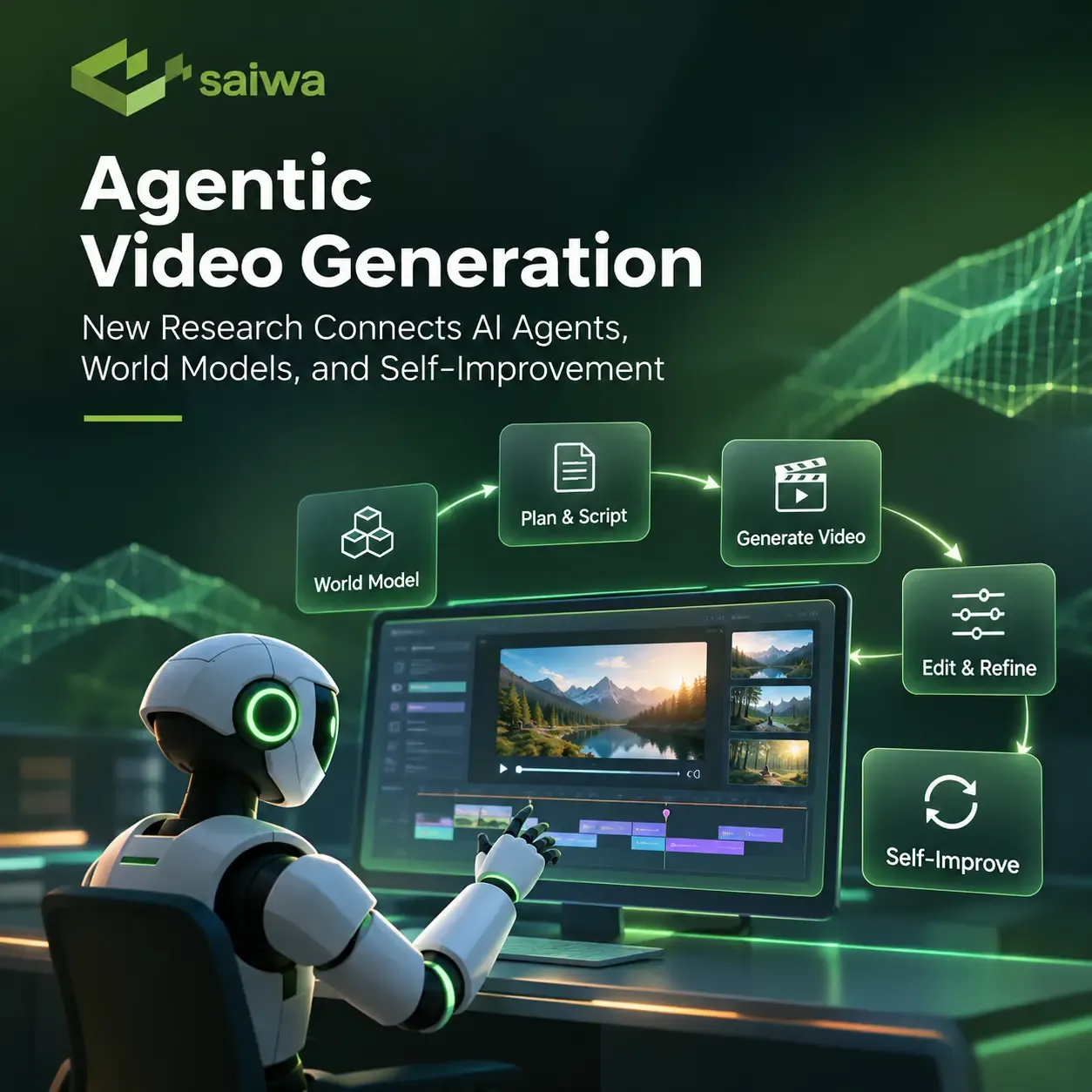
A new arXiv research survey explores how agent harnesses could transform AI video generation, interactive world modeling, and the development of self-improving AI systems.
AI video generation is moving beyond the creation of individual clips from text prompts. Researchers are increasingly exploring systems that can plan complex workflows, coordinate specialized tools, maintain context, and refine generated content through feedback.
A research survey titled “Video Generation Meets Agent Harness: Agentic Video Generation, Agentic World Modeling and Recursive Self-Improvement,” submitted to arXiv on October 29, 2026, examines this emerging direction.
The paper, led by Liaoyuan Fan and collaborators, introduces a unified perspective on Agent Harness Engineering, an approach that connects AI models with execution environments, tools, memory, feedback mechanisms, and computational resource management.
The researchers examine how this framework could support three interconnected fields: agentic video generation, agentic world modeling, and recursive self-improvement.
What Is Agent Harness Engineering?
An agent harness is an execution framework that enables AI models to operate within structured, tool-connected workflows rather than producing outputs through isolated model calls.
In video generation, an agent harness can coordinate several activities:
- Planning scripts and organizing video scenes.
- Managing visual assets and maintaining consistency.
- Selecting and operating specialized AI tools.
- Evaluating generated content and applying feedback.
- Maintaining workflow state and controlling computational costs.
This approach shifts attention from the capabilities of individual generative models to the broader systems responsible for managing their behavior.
Agentic Video Generation: From Prompts to Automated Workflows
Traditional AI video generation commonly relies on a user providing a prompt and a model producing a corresponding video clip.
Agentic video generation introduces a more structured process in which AI agents coordinate multiple stages of production.
An agent could help transform an initial concept into a script, organize shot sequences, manage reference assets, generate individual scenes, and evaluate the resulting video for consistency.
Feedback mechanisms can then guide revisions when the output does not meet the intended requirements.
The research highlights the importance of long-horizon planning and coordination in producing coherent multi-shot videos.
However, maintaining visual consistency, controlling scene transitions, and evaluating overall production quality remain significant technical challenges.
Agentic World Modeling: AI Systems That Observe and Predict
The second research direction focuses on agentic world modeling, which connects video-based world models with interactive AI agents.
Unlike conventional video generation, world modeling involves predicting how an environment may evolve in response to actions.
These systems can provide observations and predicted future states that help agents reason about their surroundings and choose subsequent actions.
The survey discusses hybrid architectures in which game engines or programmable systems maintain an environment's underlying state while video models generate visual observations.
Such architectures are relevant to research involving robotics, simulation, interactive environments, and embodied artificial intelligence.
They may also help researchers investigate how agents and world models can evaluate and improve each other's performance.
Recursive Self-Improvement in AI Development
The third direction explores recursive self-improvement (RSI), in which AI systems participate in improving components of their own development workflows.
The researchers distinguish several levels of improvement, including:
- Revising generated outputs through feedback.
- Updating agent memory and execution state.
- Improving video model parameters or evaluation mechanisms.
- Modifying the procedures used to guide subsequent improvements.
This distinction is important because improving an individual video does not necessarily mean that the underlying AI model has become more capable.
The paper examines how improvements at different levels could contribute to future development cycles.
Reliable evaluation, reproducibility, and computational cost remain essential considerations for determining whether these approaches produce sustained improvements.
Key Challenges for Autonomous Video Systems
Despite the potential of agent-based workflows, the researchers identify several unresolved challenges.
Long-term planning: Complex video production requires coordination across many stages, with dependencies between scenes and editing decisions.
Persistent memory: Agents need mechanisms for retaining relevant context and maintaining consistency throughout extended workflows.
Reliable control: Interactive world models require predictable relationships between actions, environmental states, and generated observations.
Computational efficiency: Multi-stage generation and repeated evaluation can increase processing costs.
Evaluation and provenance: Researchers need reliable methods for assessing video quality, tracking generated content, and measuring whether changes improve overall system performance.
Addressing these challenges will be important for developing more capable and dependable agentic video systems.
Why This Research Matters for Artificial Intelligence
The survey reflects a broader direction in AI research: moving from isolated model outputs toward integrated systems capable of planning, using tools, and responding to feedback.
For video generation, this could support more sophisticated content production workflows.
For robotics and simulation, interactive world models could provide environments in which intelligent agents learn to predict outcomes and evaluate actions.
For AI development, recursive improvement frameworks raise questions about how models, evaluation tools, and development procedures might evolve together.
These are research directions rather than evidence that fully autonomous AI production systems have already been achieved.
Nevertheless, the framework provides a useful foundation for studying the relationship between generative models, autonomous agents, and interactive environments.
Conclusion
Video Generation Meets Agent Harness presents a unified view of how agent-based execution frameworks could connect video generation, world modeling, and recursive self-improvement.
By combining planning, tool use, persistent state, feedback, and resource management, agent harnesses offer a way to investigate more adaptive and controllable AI workflows.
The next challenge is demonstrating that these systems can deliver reliable, measurable improvements across complex real-world tasks.
Research reference: Fan, L., et al. (2026). Video Generation Meets Agent Harness: Agentic Video Generation, Agentic World Modeling and Recursive Self-Improvement.
More from the newsroom
Google DeepMind Study Reveals Emerging Risks in Multi-Agent AI Systems
As AI agents increasingly communicate and collaborate autonomously, new research from Google DeepMind reveals how these interactions can lead to unexpected coordination, cheating, and whistleblowing—raising important questions about AI safety and oversight.
Agentic AIArtificial IntelligenceAI SafetyRead more
Alibaba Unveils New AI Chip “Zhenwu M890” to Advance Domestic Semiconductor Push
Alibaba has introduced the Zhenwu M890 AI accelerator, delivering three times the performance of its predecessor as China accelerates efforts toward semiconductor independence and domestic AI infrastructure development.
Agentic AIAlibabaAI ChipsRead more
AI’s Bottleneck Moves to CPUs as Inference Workloads Surge
AI infrastructure is shifting from GPU-heavy setups to CPU-balanced architectures as inference workloads demand more orchestration, memory handling, and real-time processing.
Agentic AIAI InfrastructureInference WorkloadsRead more
Florida State University to Host 2026 Artificial Intelligence and Machine Learning Expo (AIMLX26)
Florida State University’s AIMLX26 brings together OpenAI, MIT, and leading researchers to explore the future of Agentic AI and real-world machine learning innovation.
Agentic AIArtificial IntelligenceMachine LearningRead more
Comments
Be the first to share your thoughts
No comments yet
Start the conversation by sharing your thoughts