




Weed Identification Pictures: A Guide to Common Field Weeds
Identify 16 common field weeds with pictures, scientific names, key visual traits and a comparison chart. Learn how AI can support weed identification.
Accurate weed identification is the foundation of effective weed management. Whether scouting a soybean field, inspecting cereal crops, or monitoring agricultural land, recognizing unwanted plants helps growers understand weed pressure and make informed management decisions.
However, many weeds look similar, particularly during early growth. Identifying them requires more than recognizing their color or general appearance.
This weed identification pictures guide covers 16 agricultural weeds found across different regions of North America. It includes broadleaf weeds, grassy weeds, and sedges, along with their scientific names, distinguishing characteristics, and practical identification techniques.
You will also learn how photographic identification, artificial intelligence, and computer vision can complement traditional field scouting.
How to Identify Weeds in Crop Fields
Identifying an unfamiliar weed begins with examining several physical characteristics. Leaf shape, stem structure, flowers, reproductive structures, and growth habits can help narrow down the possible species.
A reliable identification should combine multiple characteristics rather than depend on a single photograph or visual feature.
Leaf Shape and Arrangement
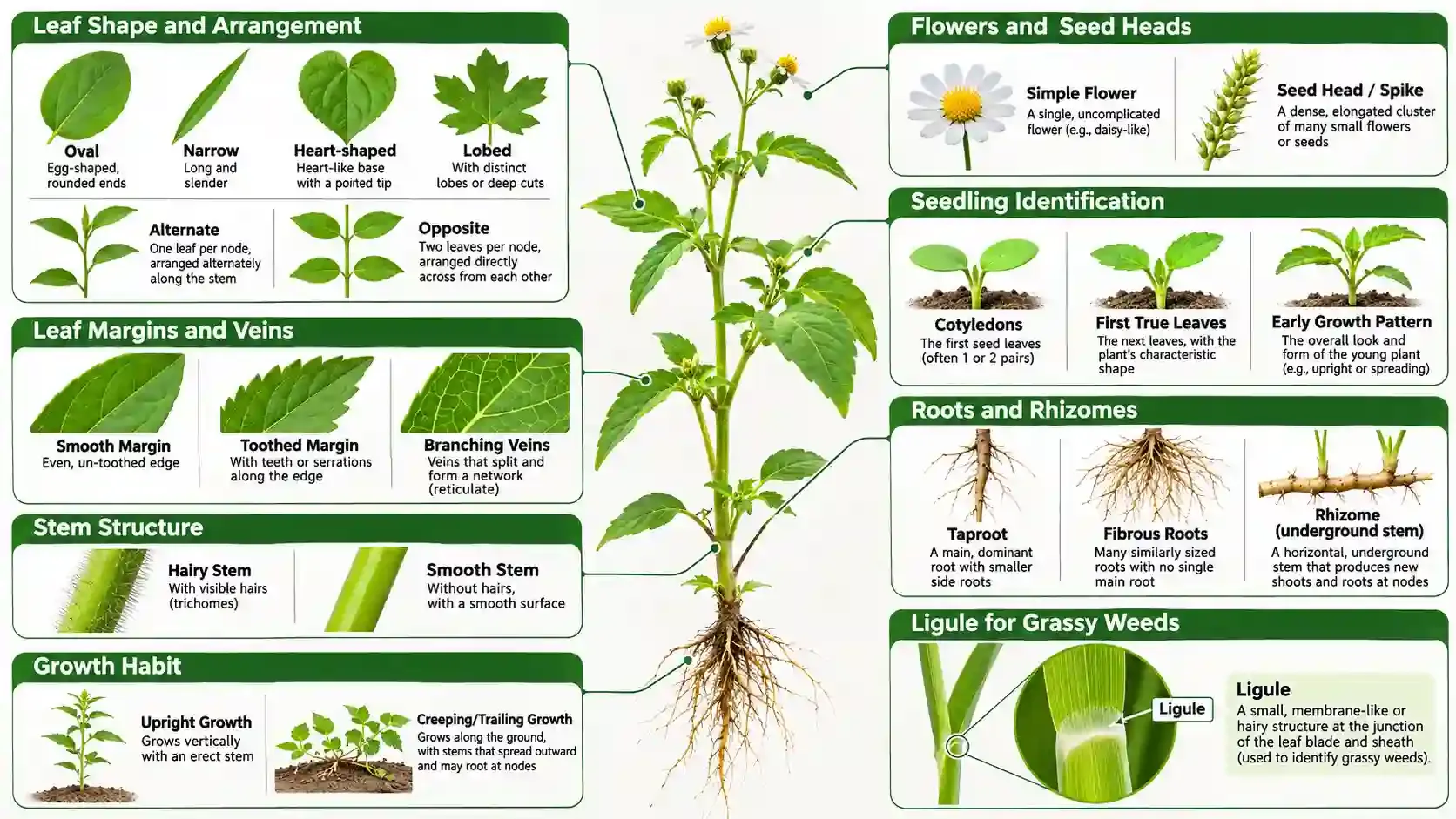
Leaves provide some of the most accessible clues for identifying agricultural weeds.
Important characteristics include:
- Leaf shape: Oval, triangular, heart-shaped, narrow, or deeply divided.
- Leaf margins: Smooth, toothed, lobed, or wavy.
- Leaf arrangement: Alternate, opposite, or whorled.
- Leaf surface: Hairy, smooth, waxy, or powdery.
- Leaf veins: Parallel or branching.
For example, velvetleaf has large, heart-shaped leaves with a soft surface, while common ragweed produces deeply divided foliage.
Stem Structure and Growth Habit
Examine whether the stem is hairy or smooth, upright or trailing, and round, flattened, or triangular.
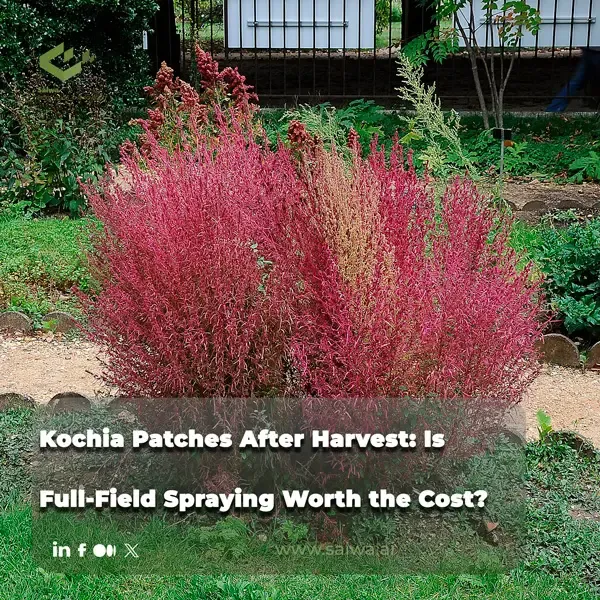
Growth habits can also provide important clues. Field bindweed develops trailing or climbing shoots, whereas kochia typically forms an upright, densely branched plant.
Flowers, Seed Heads, and Underground Structures
Flowers and seed heads are especially useful for distinguishing mature weeds. Examine their color, shape, arrangement, and position on the plant.
Underground structures can help identify perennial species. Some weeds reproduce through spreading roots, while others develop rhizomes or tubers.
For example, johnsongrass produces underground rhizomes, while nutsedges develop tubers.
Seedling Identification
Young weeds often look different from mature plants. During early growth, useful identification features include:
- Cotyledon shape.
- First true leaves.
- Leaf arrangement.
- Stem and leaf hairs.
- Grass leaf collars and ligules.
The University of Missouri's weed identification guide for corn and soybean provides additional resources for identifying agricultural weeds at the seedling stage.
Understanding the Three Main Types of Field Weeds
Agricultural weeds can be grouped into three major categories based on their botanical characteristics.
| Weed category | Typical characteristics | Examples |
|---|---|---|
| Broadleaf weeds | Varied leaf shapes, usually with branching veins | Palmer amaranth, ragweed, velvetleaf |
| Grassy weeds | Narrow leaves, parallel veins, leaf sheaths | Barnyardgrass, foxtail, wild oat |
| Sedges | Grass-like foliage, often triangular stems and three-ranked leaves | Yellow nutsedge, purple nutsedge |
Understanding these categories makes it easier to narrow down an unfamiliar plant before attempting species-level identification.
Weed life cycles also matter. Annual weeds complete their life cycle within one growing season or year, while perennial weeds survive for multiple years and may reproduce through underground structures.
Broadleaf Weed Identification Pictures
Broadleaf weeds include a wide range of plants that compete with crops for sunlight, nutrients, water, and growing space.
The following species are important identification examples for North American agricultural environments, although their prevalence varies by region and crop.
1. Palmer Amaranth
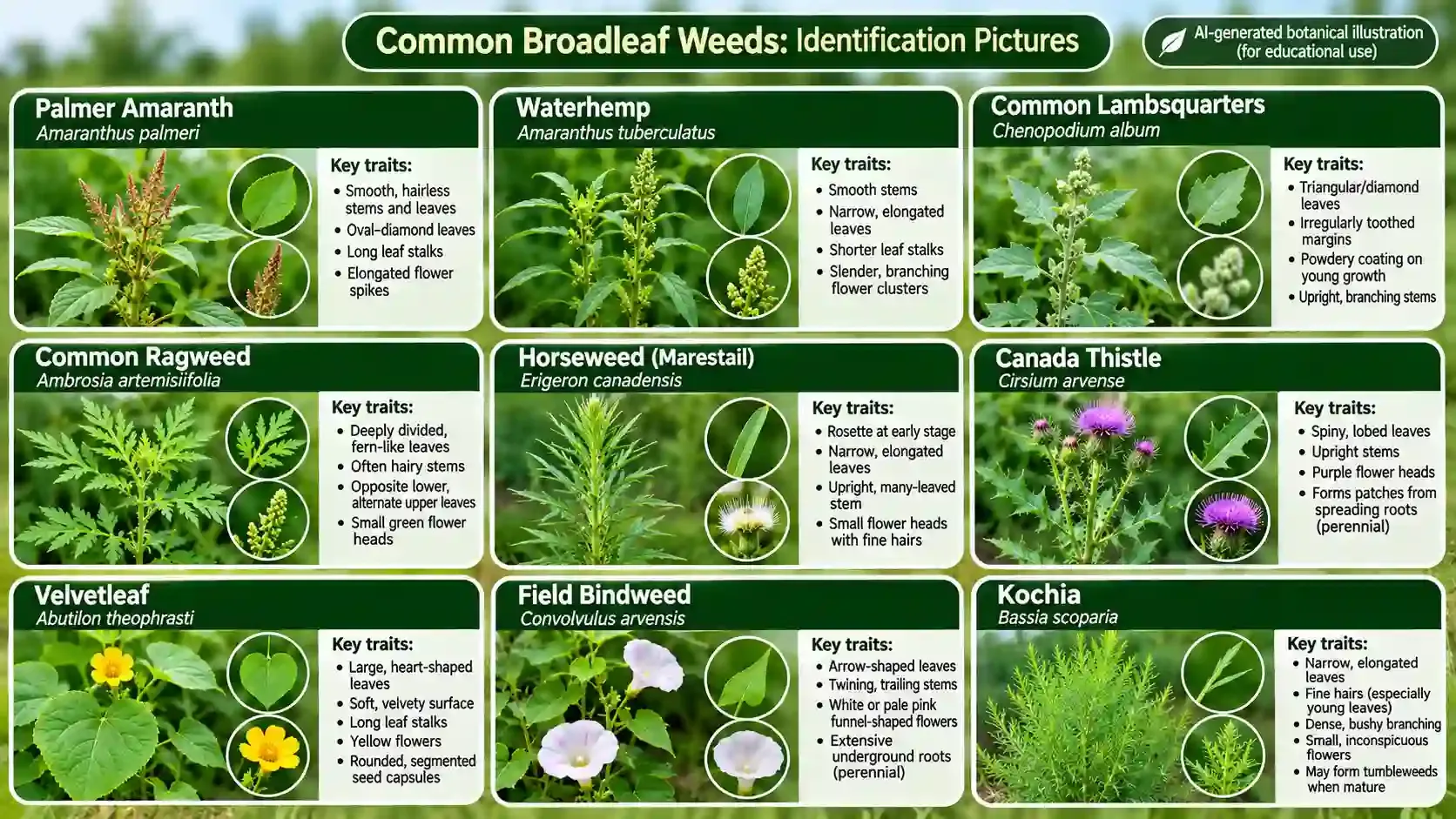
Scientific name: Amaranthus palmeri
Life cycle: Summer annual
Palmer amaranth is an upright weed that can develop rapidly under favorable growing conditions. It is an important weed in several row-crop production regions.
Identification characteristics:
- Smooth, generally hairless stems and leaves.
- Oval to diamond-shaped leaves.
- Long petioles, sometimes longer than the leaf blade.
- Elongated flower spikes.
- Prickly female flower heads at maturity.
How to distinguish it: Compare the length of the leaf stalk with the leaf blade when separating Palmer amaranth from waterhemp.
For additional botanical photographs and identification details, consult the Ontario Palmer amaranth identification guide.
2. Waterhemp
Scientific name: Amaranthus tuberculatus
Life cycle: Summer annual
Waterhemp belongs to the same genus as Palmer amaranth and can be difficult to distinguish from related pigweed species.
Identification characteristics:
- Smooth, hairless stems.
- Narrow, elongated leaves.
- Leaf stalks commonly shorter than the leaf blade.
- Slender, branching flower clusters.
- Green or reddish stems.
How to distinguish it: Waterhemp generally has narrower leaves and shorter petioles than Palmer amaranth. Confirm the identification using several characteristics.
The Ontario waterhemp identification guide provides additional species-level comparisons.
Waterhemp is also a relevant example of how agricultural imagery can support species-specific monitoring. Saiwa's drone-based waterhemp detection project in corn fields explores this application.
3. Common Lambsquarters
Scientific name: Chenopodium album
Life cycle: Annual
Common lambsquarters is frequently encountered in cultivated soils and disturbed agricultural environments.
Identification characteristics:
- Triangular to diamond-shaped leaves.
- Irregularly toothed leaf margins.
- Pale, powdery coating on young growth.
- Upright, branching stems.
- Clusters of small green flowers.
How to distinguish it: Look closely at the growing tips. The whitish appearance of young foliage is a useful identification clue.
4. Common Ragweed
Scientific name: Ambrosia artemisiifolia
Life cycle: Annual
Common ragweed grows in agricultural fields, field margins, and disturbed areas.
Identification characteristics:
- Deeply divided, fern-like leaves.
- Frequently hairy stems.
- Opposite lower leaves and commonly alternate upper leaves.
- Small green flower heads.
- Elongated male flower clusters.
How to distinguish it: Its finely divided foliage separates it from many other broadleaf field weeds. Examine leaf arrangement and reproductive structures to distinguish it from related species.
5. Horseweed (Marestail)
Scientific name: Erigeron canadensis, synonym Conyza canadensis
Life cycle: Annual, including winter annual growth patterns
Horseweed, also known as Canada fleabane or marestail, can emerge at different times of the year.
Identification characteristics:
- A low-growing rosette during early development.
- Narrow, elongated leaves.
- An upright stem with numerous leaves.
- Small flower heads concentrated toward the upper portion of mature plants.
- Seeds associated with fine hairs that assist wind dispersal.
How to distinguish it: Compare photographs from both the rosette and mature growth stages because the plant's appearance changes substantially as it develops.
6. Canada Thistle
Scientific name: Cirsium arvense
Life cycle: Perennial
Canada thistle can establish persistent patches through its spreading underground root system.
Identification characteristics:
- Irregularly lobed leaves.
- Sharp, spiny leaf margins.
- Upright stems.
- Small pinkish-purple flower heads.
- Multiple shoots occurring in localized patches.
How to distinguish it: Canada thistle commonly forms colonies of interconnected shoots, unlike some thistles that develop primarily as individual plants.
7. Velvetleaf
Scientific name: Abutilon theophrasti
Life cycle: Summer annual
Velvetleaf is a distinctive broadleaf weed encountered in several agricultural production systems, including corn and soybean fields.
Identification characteristics:
- Large, heart-shaped leaves.
- Fine hairs that produce a soft texture.
- Long leaf stalks.
- Yellow flowers.
- Rounded, segmented seed capsules.
How to distinguish it: The combination of heart-shaped leaves and a velvety surface is particularly useful once the first true leaves have developed.
8. Field Bindweed
Scientific name: Convolvulus arvensis
Life cycle: Perennial
Field bindweed develops trailing and climbing shoots that can spread across the soil and around neighboring vegetation.
Identification characteristics:
- Arrow-shaped leaves.
- Slender, twining stems.
- White or pale pink funnel-shaped flowers.
- Creeping or climbing growth.
- Extensive underground roots.
How to distinguish it: Field bindweed can resemble hedge bindweed. Compare flower size, leaf proportions, and the bracts beneath the flowers.
9. Kochia
Scientific name: Bassia scoparia, synonym Kochia scoparia
Life cycle: Annual
Kochia is particularly relevant to agricultural production in the Great Plains and western regions of North America.
Identification characteristics:
- Narrow, elongated leaves.
- Fine hairs, especially on young plants.
- Dense branching.
- Small, inconspicuous green flowers.
- Mature plants that may detach and disperse seeds as tumbleweeds.
How to distinguish it: Despite having narrow leaves, kochia is not a grass. Its branching growth and leaf structure help distinguish it from grassy weeds.
Additional botanical descriptions and field photographs for these broadleaf weeds can be found through the Ontario Crop IPM weed identification database.
Grass Weed Identification Pictures
Grassy weeds can be particularly difficult to identify in cereal fields because their foliage may resemble the surrounding crop.
Useful identification characteristics include leaf hairs, ligules, leaf sheaths, seed heads, and underground structures.
A ligule is a small structure located at the junction between the leaf blade and sheath. Its presence, absence, and appearance can help distinguish grass species.
10. Barnyardgrass
Scientific name: Echinochloa crus-galli
Life cycle: Annual
Barnyardgrass grows in cultivated fields and other disturbed environments, particularly where moisture conditions are favorable.
Identification characteristics:
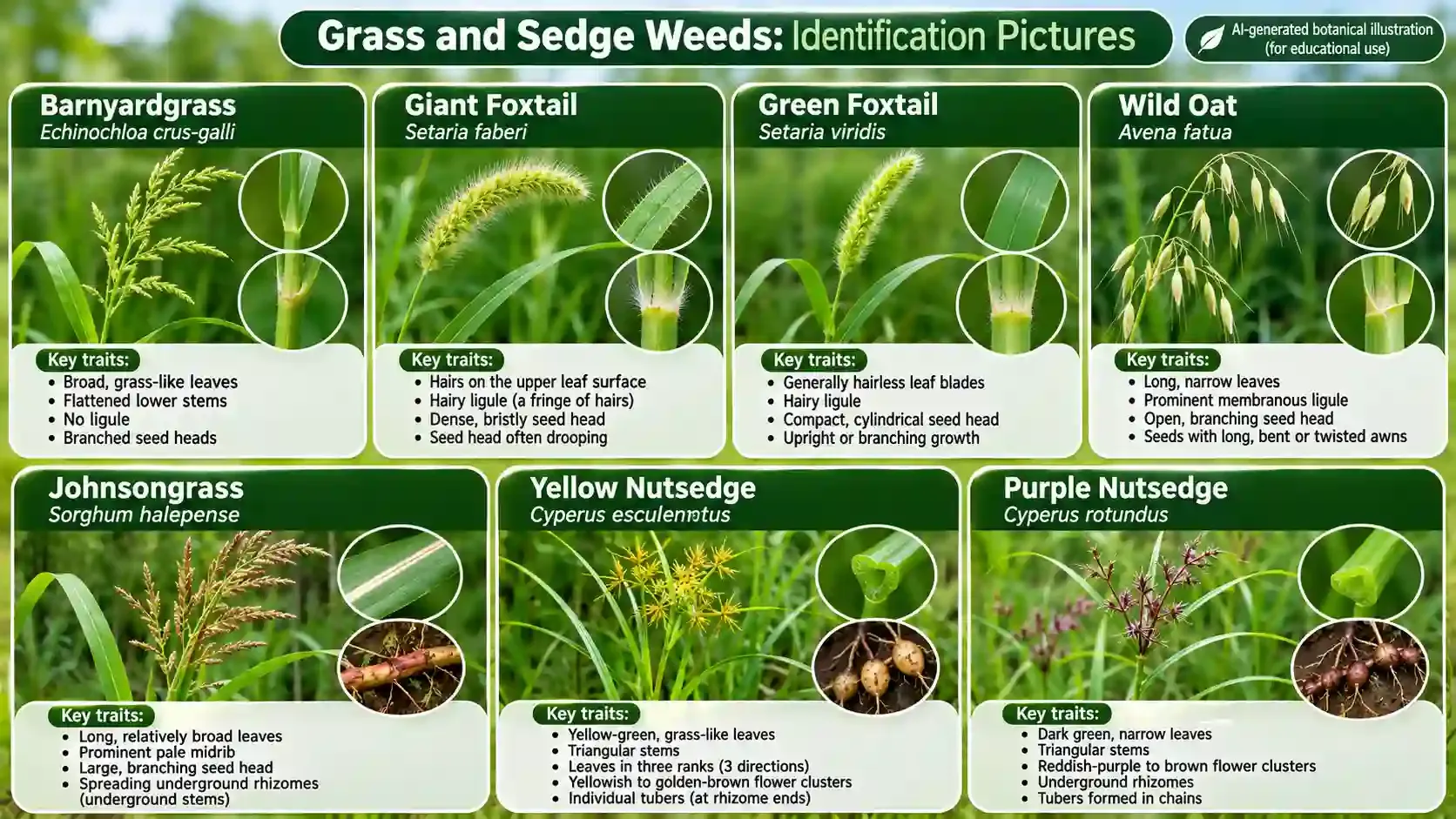
- Relatively broad grass-like leaves.
- Flattened lower stems or leaf sheaths.
- Absence of a ligule.
- Branched seed heads.
- Upright or spreading growth.
How to distinguish it: Check the leaf collar. The absence of a ligule is a particularly useful feature when comparing barnyardgrass with other annual grasses.
See the Ontario barnyardgrass identification guide for additional photographs.
11. Giant Foxtail
Scientific name: Setaria faberi
Life cycle: Summer annual
Giant foxtail produces distinctive bristly seed heads and can establish dense populations in cultivated fields.
Identification characteristics:
- Hairs on the upper surface of the leaf blade.
- A ligule consisting of fine hairs.
- Dense, bristly seed heads.
- Mature seed heads that frequently droop.
- Upright growth.
How to distinguish it: Inspect the upper leaf surface. Its hairs are a useful characteristic when separating giant foxtail from green foxtail.
12. Green Foxtail
Scientific name: Setaria viridis
Life cycle: Annual
Green foxtail is a grassy weed that occurs in cultivated soils and disturbed areas.
Identification characteristics:
- Generally hairless leaf blade surfaces.
- A hairy ligule.
- Compact, cylindrical seed heads.
- Visible seed head bristles.
- Upright or branching growth.
How to distinguish it: Unlike giant foxtail, green foxtail generally lacks hairs across the upper surface of its leaf blades.
13. Wild Oat
Scientific name: Avena fatua
Life cycle: Annual
Wild oat is an important identification challenge in cereal production because its seedlings can resemble cultivated grasses.
Identification characteristics:
- Long, narrow leaf blades.
- A prominent membranous ligule.
- Open, branching seed heads.
- Seeds with long, bent or twisted awns.
- Young leaves that often twist counterclockwise.
How to distinguish it: Examine the direction of leaf twisting and the ligule during early growth. Seed characteristics provide additional evidence at maturity.
For more information, refer to the Ontario wild oats identification guide.
14. Johnsongrass
Scientific name: Sorghum halepense
Life cycle: Perennial
Johnsongrass reproduces through seeds and underground rhizomes, allowing established infestations to persist across growing seasons.
Identification characteristics:
- Long, relatively broad leaf blades.
- A prominent pale central vein.
- Tall, upright growth.
- Large, branching seed heads.
- Thick underground rhizomes.
How to distinguish it: Examine underground structures when possible. The presence of rhizomes helps distinguish established johnsongrass from similar annual grasses.
Sedge Weed Identification Pictures
Although sedges resemble grasses, they belong to a separate botanical family.
Many sedges have triangular stems and leaves arranged in three directions. These characteristics provide useful initial clues when distinguishing them from true grasses.
15. Yellow Nutsedge
Scientific name: Cyperus esculentus
Life cycle: Perennial
Yellow nutsedge can occur in moist agricultural soils and irrigated fields.
Identification characteristics:
- Yellow-green, grass-like leaves.
- Triangular stems.
- Leaves arranged in three directions.
- Yellowish to golden-brown flower clusters.
- Underground tubers typically formed individually at rhizome ends.
How to distinguish it: Compare the underground structures with those of purple nutsedge. Yellow nutsedge generally develops individual tubers rather than chains.
16. Purple Nutsedge
Scientific name: Cyperus rotundus
Life cycle: Perennial
Purple nutsedge is particularly associated with warmer growing environments and can persist through its underground reproductive structures.
Identification characteristics:
- Dark green, narrow leaves.
- Triangular stems.
- Reddish-purple to brown flower clusters.
- Underground rhizomes.
- Tubers that commonly develop in chains.
How to distinguish it: The arrangement of underground tubers is one of the most useful ways to separate purple nutsedge from yellow nutsedge.
The University of California's nutsedge identification guide provides additional photographs and comparisons of both species.
Weed Identification Chart
The following weed identification chart provides a quick comparison of the 16 species covered in this guide.
| Common name | Scientific name | Category | Life cycle | Key identification feature |
|---|---|---|---|---|
| Palmer amaranth | Amaranthus palmeri | Broadleaf | Annual | Long petioles and prickly female flower heads |
| Waterhemp | Amaranthus tuberculatus | Broadleaf | Annual | Narrow leaves and smooth stems |
| Common lambsquarters | Chenopodium album | Broadleaf | Annual | Powdery young foliage |
| Common ragweed | Ambrosia artemisiifolia | Broadleaf | Annual | Deeply divided leaves |
| Horseweed | Erigeron canadensis | Broadleaf | Annual | Basal rosette and narrow leaves |
| Canada thistle | Cirsium arvense | Broadleaf | Perennial | Spiny leaves and spreading roots |
| Velvetleaf | Abutilon theophrasti | Broadleaf | Annual | Velvety, heart-shaped leaves |
| Field bindweed | Convolvulus arvensis | Broadleaf | Perennial | Arrow-shaped leaves and twining stems |
| Kochia | Bassia scoparia | Broadleaf | Annual | Narrow leaves and bushy growth |
| Barnyardgrass | Echinochloa crus-galli | Grass | Annual | Absence of a ligule |
| Giant foxtail | Setaria faberi | Grass | Annual | Hairy upper leaf surface |
| Green foxtail | Setaria viridis | Grass | Annual | Generally hairless leaf blades |
| Wild oat | Avena fatua | Grass | Annual | Open seed heads and bent awns |
| Johnsongrass | Sorghum halepense | Grass | Perennial | Pale midrib and underground rhizomes |
| Yellow nutsedge | Cyperus esculentus | Sedge | Perennial | Individually formed tubers |
| Purple nutsedge | Cyperus rotundus | Sedge | Perennial | Tubers formed in chains |
This chart is intended as a practical reference rather than a definitive botanical identification key.
For a more extensive collection of verified species photographs, explore the UC IPM Weed Identification Gallery.
How to Distinguish Similar-Looking Weeds
Closely related species can share similar leaf shapes, growth habits, and reproductive structures. Comparing specific distinguishing features can improve identification reliability.
| Similar-looking weeds | What to examine |
|---|---|
| Palmer amaranth vs. waterhemp | Petiole length, leaf proportions, and female flower heads |
| Giant foxtail vs. green foxtail | Hairs on the upper leaf blade |
| Yellow nutsedge vs. purple nutsedge | Flower color and underground tuber arrangement |
| Field bindweed vs. hedge bindweed | Flower size, leaf shape, and bract position |
| Wild oat vs. cereal crops | Ligules, leaf twisting, and seed characteristics |
Avoid confirming a species from a single feature when several closely related plants occur in the same growing region.
Common Mistakes in Weed Identification
Even experienced agricultural professionals can encounter difficulties when identifying unfamiliar plants.
The following mistakes are particularly important to avoid.
Relying on One Plant Characteristic
Leaf shape or flower color alone may not provide enough information to distinguish closely related species.
Compare several features, including stem structure, leaf arrangement, and reproductive characteristics.
Ignoring Plant Growth Stages
Seedlings often differ considerably from mature plants. Compare specimens with reference photographs showing a similar growth stage.
When identification remains uncertain, collect additional photographs as the plant develops or consult a qualified agronomist.
Confusing Grassy Weeds with Sedges
Narrow leaves do not necessarily indicate that a plant belongs to the grass family.
Inspect the stem shape, leaf collar, and leaf arrangement to narrow down its botanical category.
Ignoring Regional Differences
Weed populations vary according to climate, soil, crop rotation, moisture conditions, and geography.
A species common in southern agricultural regions may be uncommon in northern production systems.
The Cornell field crop weed identification resource provides useful agricultural context for identifying weeds associated with field crops.
Assuming Herbicide Resistance from Appearance
Visual identification can help establish which species is present, but it cannot reliably confirm whether a particular plant or population is resistant to an herbicide.
Resistance requires additional evidence, such as documented treatment history, appropriate testing, or specialist assessment.
How to Identify Weeds Using Photos and AI
Photographic identification provides an additional way to recognize unfamiliar weeds, document field observations, and compare plant characteristics.
AI-assisted image analysis can extend this approach by detecting and classifying supported weed species within suitable images.
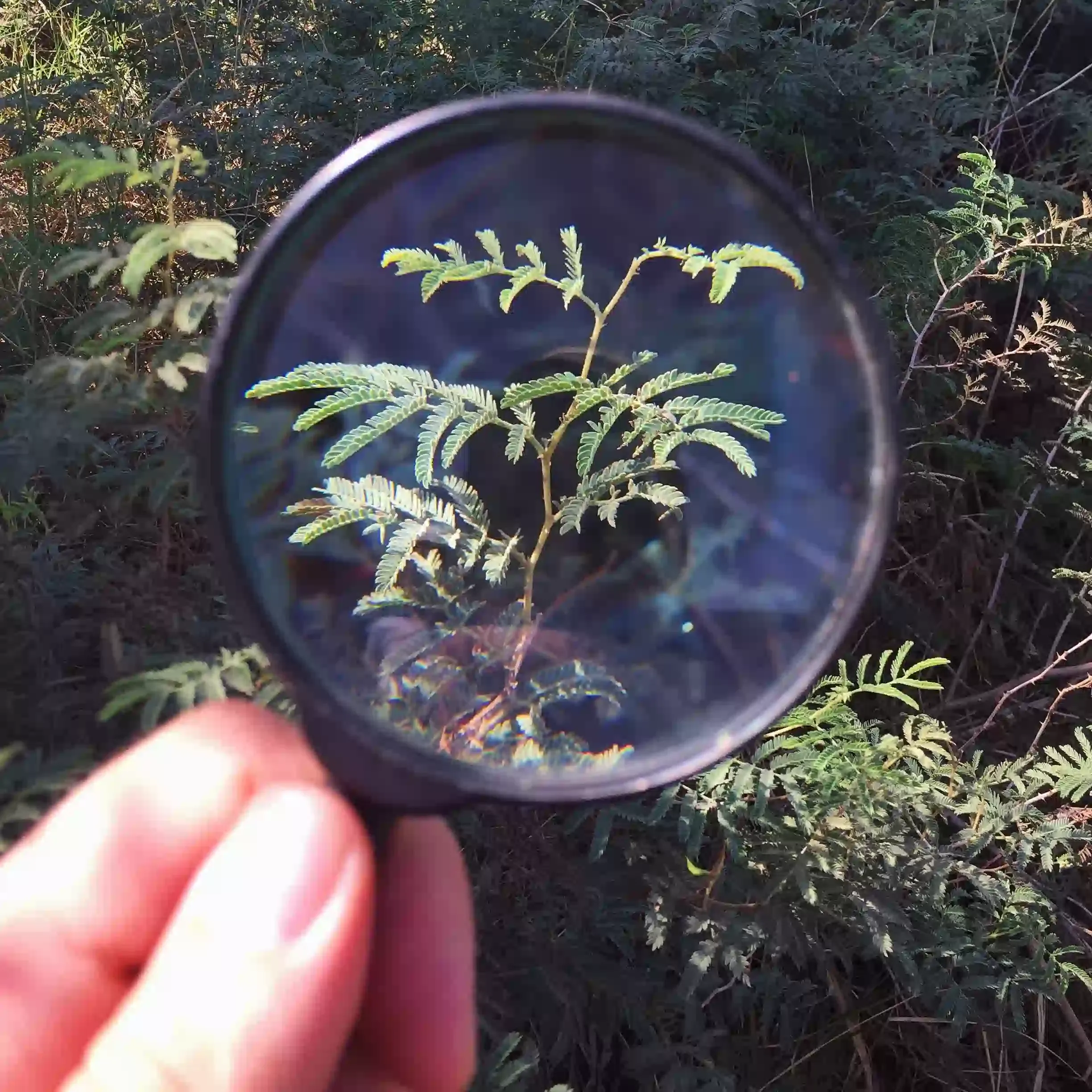
How to Capture Useful Weed Identification Photos
The quality of an image affects how much information can be obtained from it.
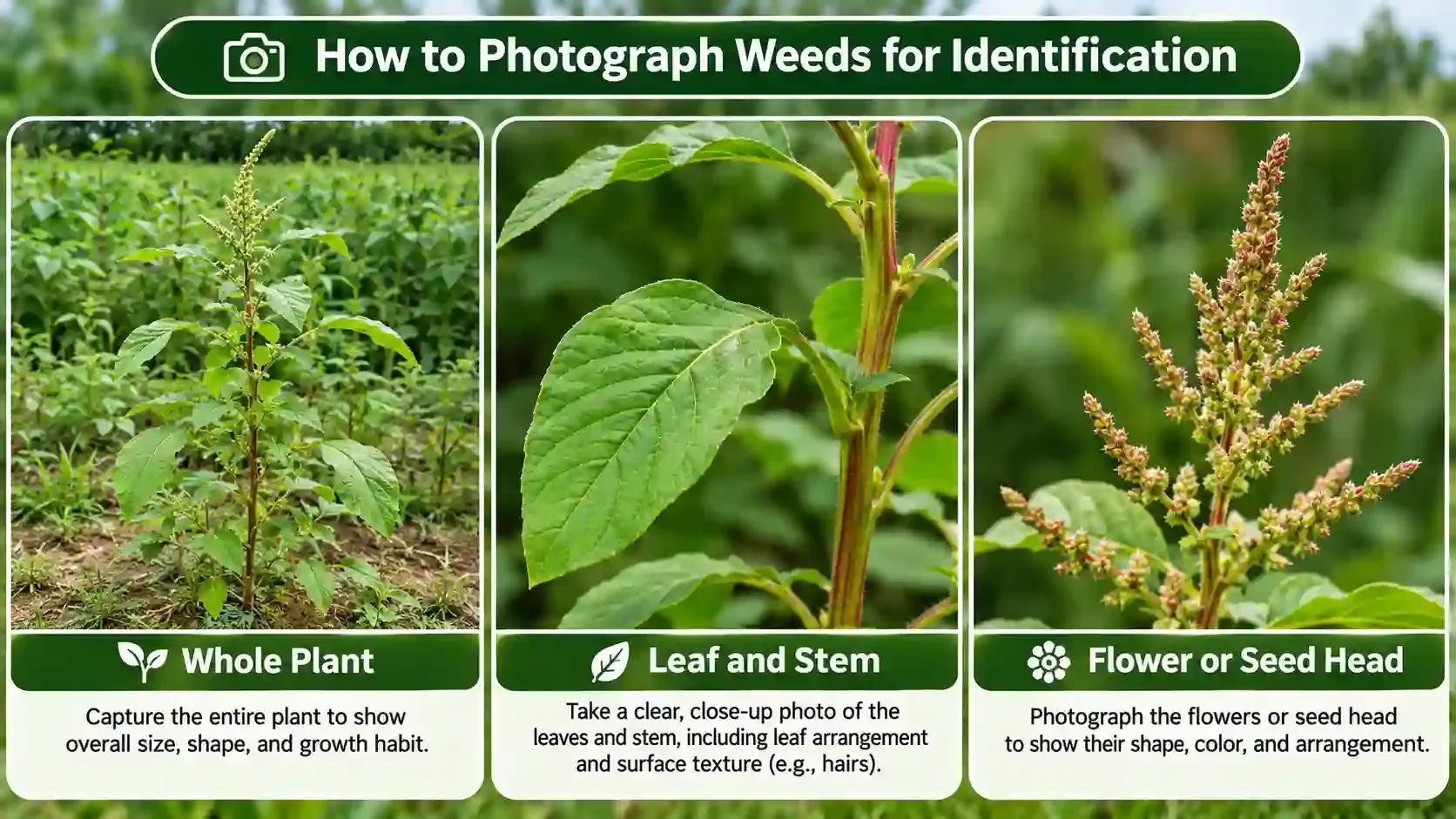
When photographing an unfamiliar weed, follow these steps:
- Photograph the whole plant to document its growth habit.
- Capture close-up images of individual leaves.
- Include the stem, leaf arrangement, and leaf collar.
- Photograph flowers or seed heads when present.
- Keep important plant structures in focus.
- Include a size reference when practical.
Capture additional angles if foliage or neighboring plants hide important details.
How to Photograph Weeds for Identification
These photographs can be compared with botanical references or analyzed using an appropriate AI-based identification system.
How AI-Assisted Weed Identification Works
AI-based weed identification systems use computer vision models trained to recognize visual patterns in plant imagery.
Depending on the application, these models may classify individual plants, locate weeds within an image, or generate information about the spatial distribution of detected weeds.
A typical AI-assisted workflow involves:
- Capturing suitable plant or field imagery.
- Selecting a model that supports the target species.
- Processing images to detect or classify plants.
- Reviewing the results and resolving uncertain detections.
- Using validated outputs to support field observations or management planning.
Readers interested in the underlying technologies can explore weed detection using machine learning.
Limitations of AI-Based Weed Identification
AI identification is not equally reliable for every species or image.
Important factors include image resolution, lighting, plant maturity, overlapping foliage, the similarity of different species, and the plant categories represented in model training.
A model may perform well for supported weeds under suitable conditions but struggle when unfamiliar species or different field conditions are introduced.
AI-assisted identification should therefore complement agricultural expertise rather than replace expert verification when consequential decisions depend on the result.
From Individual Weed Identification to Field-Scale Detection
Identifying a weed species from a close-up photograph answers an important question: what plant is present?
Field-scale weed detection addresses an additional question: where are weeds located across the agricultural area?
These tasks are related but require different image resolutions, analytical methods, and workflows.
| Individual weed identification | Field-scale weed detection |
|---|---|
| Focuses on individual plants | Focuses on weed occurrence and spatial distribution |
| Often uses close-up photographs | May use drone or other field imagery |
| Examines species-level characteristics | Locates supported weeds or affected areas |
| Supports species identification | Supports scouting and spatial management planning |
Drone imagery, for example, can help agricultural professionals inspect larger areas and identify locations requiring further investigation.
However, not every aerial image contains enough detail for species-level identification. Image resolution, crop canopy, plant size, and model capabilities influence the suitability of the results.
Learn more about aerial image analysis for AI-based weed identification and how drone weed mapping can support field-level weed management.
Using Sairone for AI-Powered Weed Identification
Sairone, developed by Saiwa, provides AI-powered image analysis for agricultural and environmental applications, including weed and invasive plant detection.
The platform's weed and invasive plant control solution supports the detection and classification of available weed species using suitable field imagery.
Its documented workflow allows users to upload images, apply AI detection models, inspect the results, and export supported outputs.
For geospatial applications, Sairone can also generate weed distribution and clustering maps for further field analysis.
These capabilities connect individual weed observations with larger agricultural monitoring workflows.
How to Identify Weeds with Sairone
Users can access the Sairone weed identification by picture tool and follow its image-analysis workflow:
- Start a new weed detection session.
- Select the appropriate image type.
- Upload a suitable photograph or supported aerial image.
- Configure the relevant detection settings.
- Process the image and review detected weeds.
- Export results in an available format when required.
Sairone's official documentation describes support for general images and GeoTIFF imagery, along with confidence-based detection review and export functionality.
Its available species library includes Palmer amaranth and waterhemp. However, the 16 species presented in this educational guide should not be interpreted as a complete list of supported Sairone models.
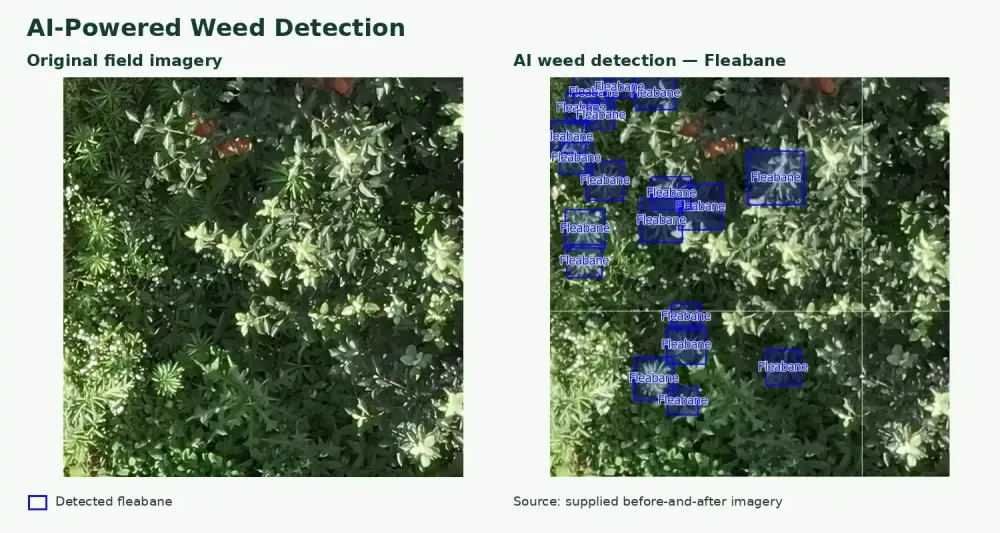
Want to identify weeds using your own field images? Explore Sairone's AI-powered weed identification tool.
Frequently Asked Questions
How can I identify a weed from a picture?
Examine its leaves, stem, growth habit, flowers, and seed heads. Compare several features with reliable botanical photographs. An AI-assisted identification tool may provide additional information when the species is supported and the image quality is suitable.
What are the three main types of agricultural weeds?
Broadleaf weeds, grassy weeds, and sedges are three major categories commonly used in agricultural weed identification. Their leaf structures, stem characteristics, and reproductive features help distinguish them.
How can I tell the difference between Palmer amaranth and waterhemp?
Palmer amaranth often develops longer leaf stalks relative to its leaf blades, while waterhemp typically has narrower leaves and shorter petioles. Mature female flower structures provide additional identification clues.
Can weeds be identified before they flower?
Many weeds can be identified before flowering by examining cotyledons, true leaves, stem hairs, growth habits, and grass ligules. However, closely related species may require additional growth or expert assessment.
What is the difference between annual and perennial weeds?
Annual weeds complete their life cycle within a year or growing season. Perennial weeds survive for multiple years and may reproduce through seeds, spreading roots, rhizomes, or tubers.
Can artificial intelligence identify every weed species?
No. AI-assisted identification depends on the species supported by the model, training data, image quality, and environmental conditions. Unfamiliar plants and closely related species may require further verification.
What is the difference between weed identification and weed detection?
Weed identification determines which plant species is present, while weed detection establishes whether weeds are present and, in some applications, where they are located.
Some computer vision systems combine both functions. Explore this distinction further in Sairone's comprehensive weed detection guide.
Conclusion
Accurate weed identification starts with understanding the physical characteristics that distinguish one plant from another.
By examining leaf shape, stem structure, flowers, seed heads, and underground reproductive structures, agricultural professionals can develop a clearer understanding of the weeds present in their fields.
The weed identification pictures and comparison charts in this guide provide a practical starting point for recognizing broadleaf weeds, grassy weeds, and sedges.
Photographic identification and computer vision offer additional opportunities to complement traditional field scouting. When applied with suitable imagery, supported models, and appropriate verification, these technologies can help connect species identification with field-scale weed monitoring.
Explore Sairone's weed and invasive plant control solution to learn more about AI-assisted weed detection and agricultural image analysis.
Share this article
Help others discover this content
Comments
Be the first to share your thoughts
No comments yet
Start the conversation by sharing your thoughts