




- Wildlife Conservation
Animal Detection in Images: AI Methods, Tools, and Workflow
Learn how AI detects animals in images, identifies species, processes camera-trap photos, and handles common accuracy challenges.
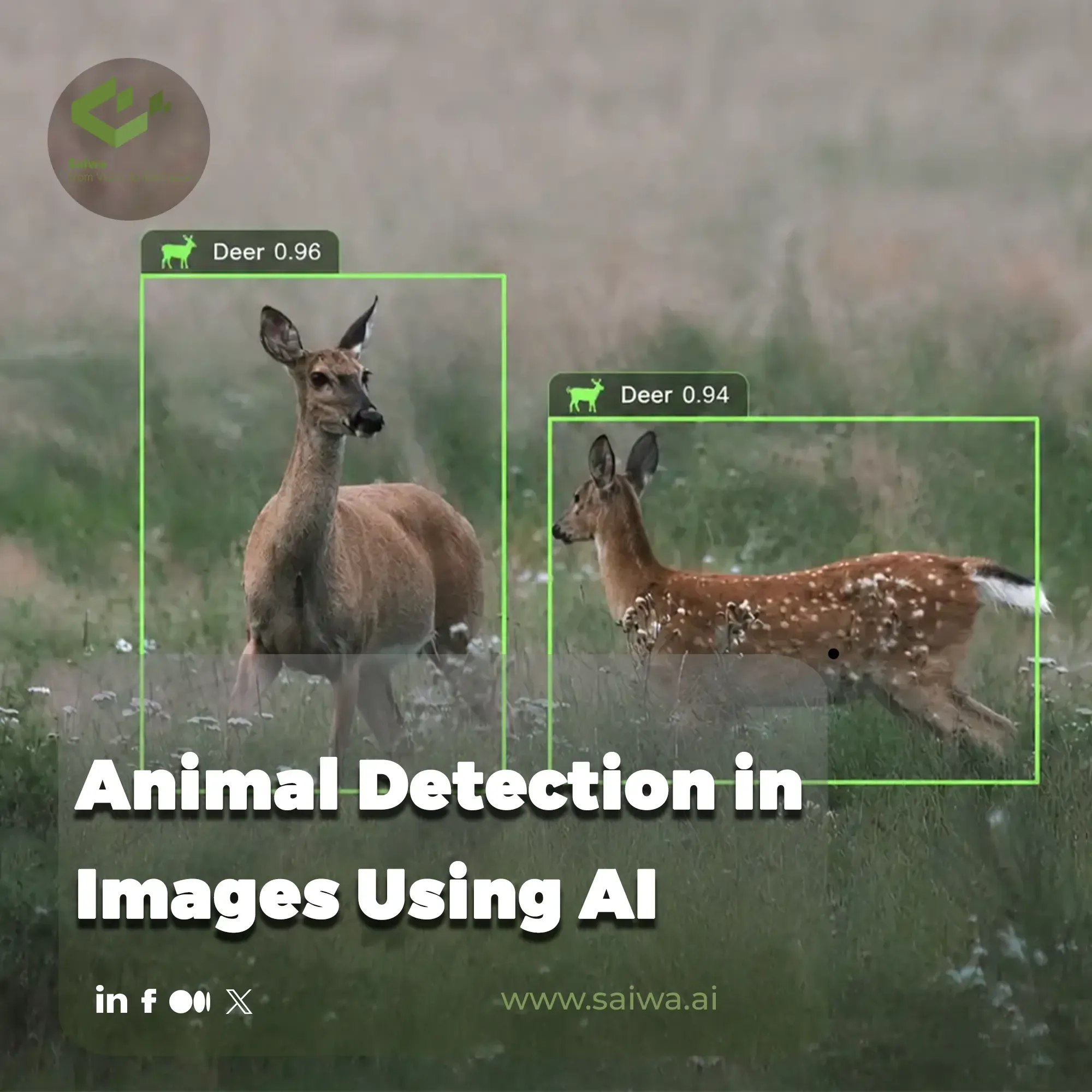
Wildlife researchers can collect thousands of photographs from camera traps in a single monitoring project, yet many of those images may contain nothing more than moving vegetation, shadows, or empty landscapes. Manually reviewing every photograph takes valuable time and can delay species monitoring, biodiversity assessments, and conservation research. As image collections grow, researchers need efficient ways to identify relevant photographs without overlooking important wildlife observations.
Animal detection in images uses artificial intelligence (AI) and computer vision to find animals in digital photographs. Depending on the system, AI can locate animals, separate animal images from empty frames, and support species identification. These capabilities can make large image collections easier to organize and analyze, particularly when conservation teams work with photographs collected from multiple camera traps, field cameras, and other imaging systems.
However, detecting an animal and identifying its species are different tasks. A reliable workflow must also account for missed animals, incorrect predictions, environmental conditions, and human verification. This guide explains how AI animal detection works, how to process large wildlife image datasets, and what to consider when evaluating an animal detection system.
What Is Animal Detection in Images?
Animal detection in images is the process of finding animals within digital photographs using image-processing or computer vision techniques. Modern AI-based systems typically use machine learning models trained on labeled images. These models learn visual patterns associated with animals and apply that knowledge to new photographs, allowing researchers to identify potentially relevant images without examining every frame manually.
An animal detection system may produce:
- A prediction indicating whether an animal is present.
- A bounding box showing the animal's location.
- A confidence score associated with the prediction.
- One or more detected animals within the same image.
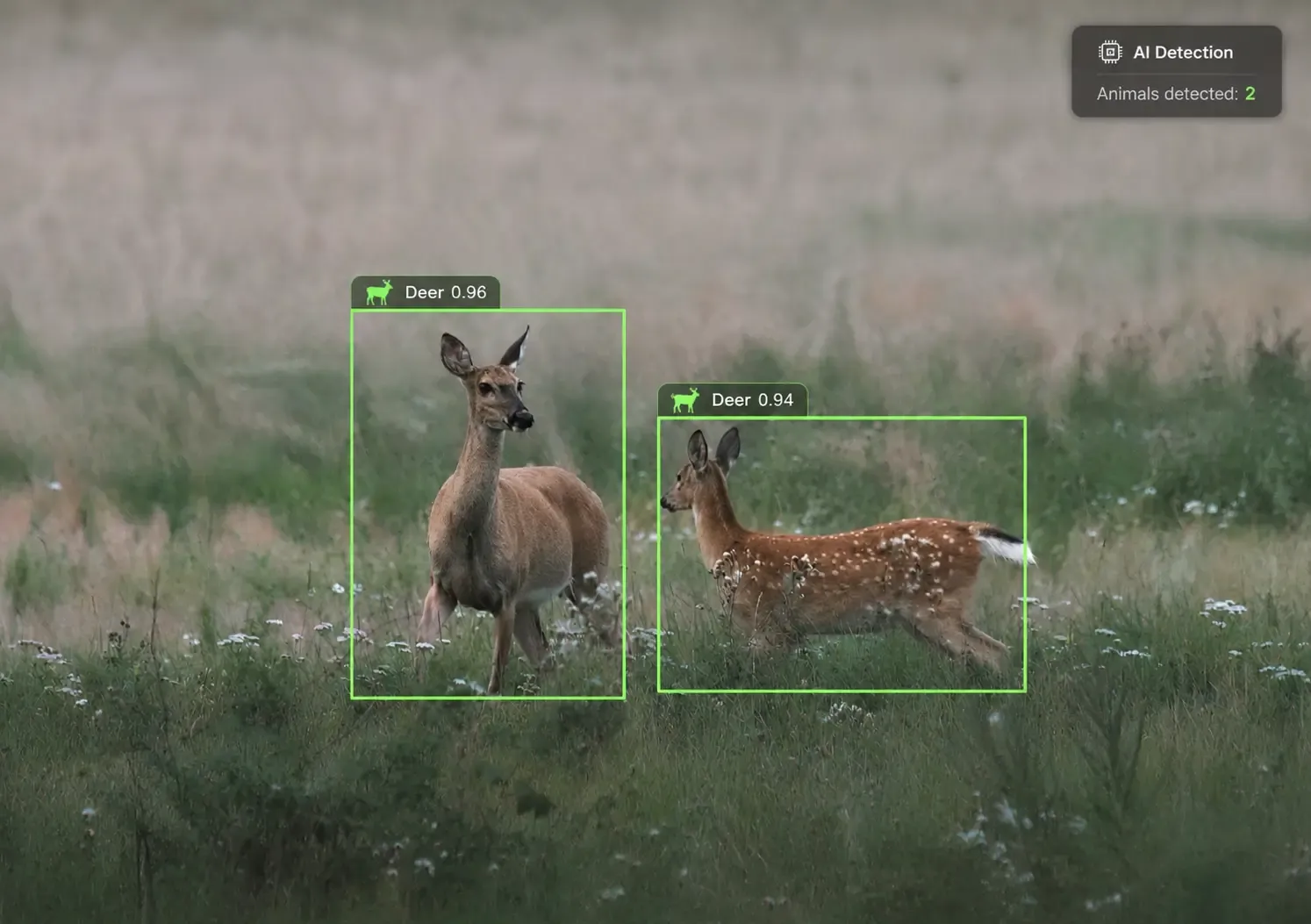
For example, a camera-trap photograph might contain two deer standing near vegetation. An object detection model can identify the regions containing the animals and return two bounding boxes, making their locations easier to inspect. Whether the system can also identify the animals as deer depends on its classification capabilities and the categories it was trained to recognize.

Animal Detection vs. Image Classification
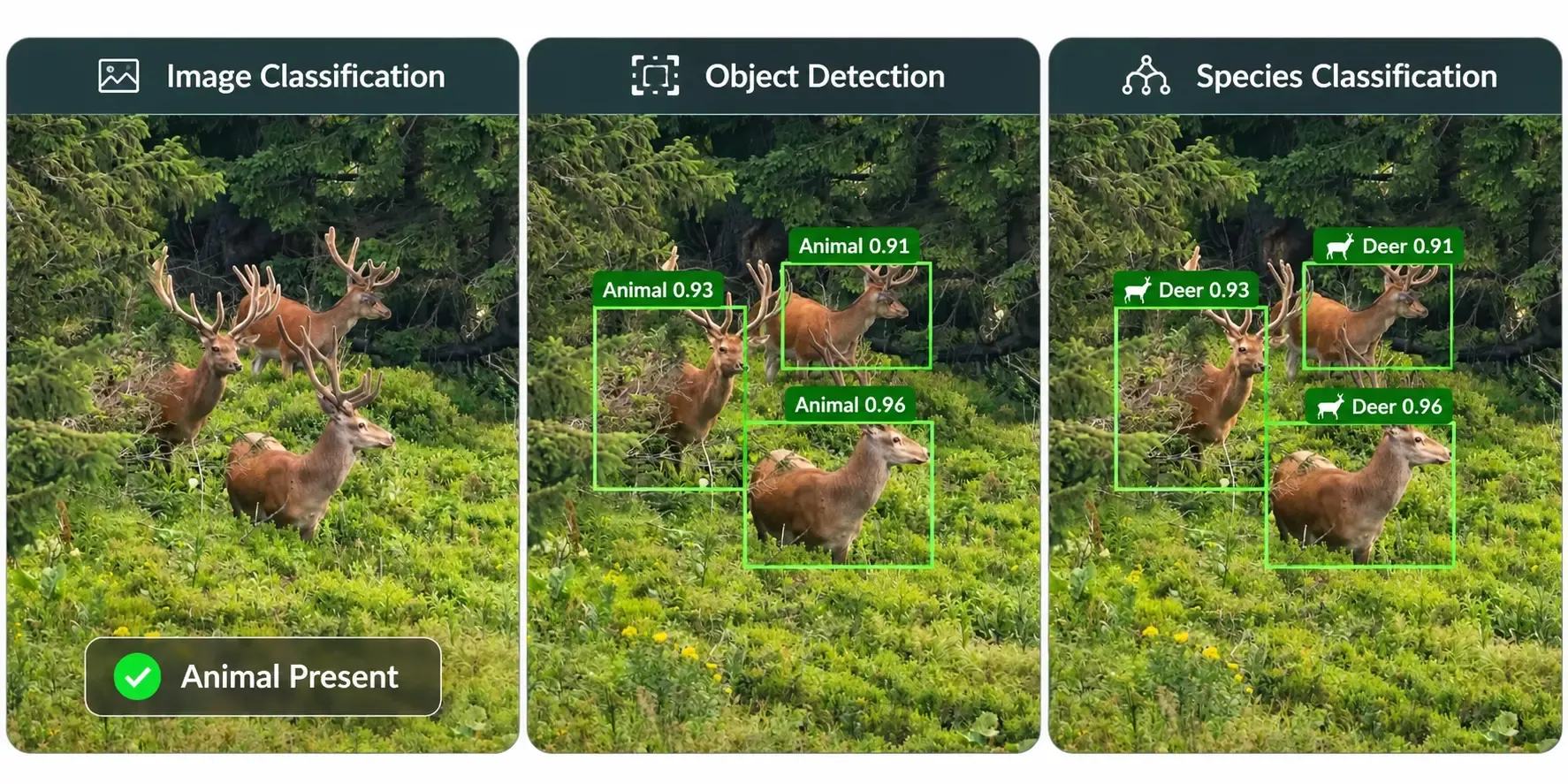
Animal detection and image classification answer different questions, even though both rely on computer vision. Image classification assigns a label to an entire image, such as "animal present," "deer," or "empty." Object detection, in contrast, identifies the locations of individual objects within an image, usually by drawing bounding boxes around them. Species classification and animal counting introduce additional tasks that may be performed separately or combined with detection.
| Task | Main question | Typical output |
|---|---|---|
| Image classification | What does this image contain? | Image-level label |
| Animal detection | Where are the animals? | Bounding boxes and confidence scores |
| Species classification | Which species is shown? | Species or taxonomic label |
| Animal counting | How many animals are visible? | Estimated number of animals |
These tasks can be combined, but they should not be treated as interchangeable. A photograph may contain several animals of different species, and an image-level classifier may return only one label for the entire scene. An object detector, however, can locate multiple animals individually, providing information that can be used for further classification or counting.
Animal Detection vs. Species Identification
Finding an animal does not necessarily reveal its species. For example, Microsoft's MegaDetector is designed to detect animals, people, and vehicles in camera-trap photographs. It identifies object locations but does not classify animals to the species level. Species identification requires an additional classification capability that can distinguish between different animal categories.
Google's SpeciesNet project demonstrates an approach combining object detection with species classification. This distinction matters when choosing software because a conservation team that only needs to separate animal images from empty photographs may not require the same system as a researcher studying the distribution of individual species. Defining the intended output before selecting a model helps ensure that the chosen technology matches the project's scientific and operational requirements.
How Does AI Detect Animals in Images?
AI animal detection generally involves analyzing visual features and predicting whether image regions contain animals. Modern systems use trained computer vision models to recognize patterns associated with wildlife, identify potentially relevant image regions, and generate predictions that can be reviewed or processed further. The exact methods depend on the model architecture, training data, and intended application.
Object Detection and Bounding Boxes
Object detection models examine an image and identify regions likely to contain objects of interest. A typical detection result includes a rectangular bounding box around an animal and a confidence score indicating the model's confidence in its prediction. For example, a system analyzing a woodland photograph might identify an animal partially visible behind a tree, allowing a reviewer to locate it without manually inspecting every part of the image.
Bounding boxes can also support downstream tasks such as species classification and counting visible animals. However, a bounding box does not guarantee that the prediction is correct. It may contain an incorrectly detected object, or the model may fail to locate an animal that is actually present. Detection results therefore need to be interpreted in the context of the model's limitations and the project's accuracy requirements.
Deep Learning and Computer Vision Models
Many modern animal detection systems use deep learning, particularly convolutional neural networks and other neural-network architectures developed for computer vision. During training, a model receives images and corresponding annotations that may identify animal locations, categories, or species. The model adjusts its parameters to recognize patterns associated with the labeled examples and uses those learned patterns to generate predictions when processing new photographs.
Different architectures offer trade-offs involving computational requirements, processing speed, accuracy, and deployment conditions. A model suitable for analyzing photographs on a workstation may not be the best choice for processing images on a resource-constrained field device. The appropriate model depends on the animals being studied, image quality, available hardware, and the intended research outcome.
Step-by-Step Animal Image Detection Workflow
A practical animal image detection workflow involves more than running photographs through a model. Conservation and research teams must organize their image collections, process photographs, review uncertain predictions, and prepare structured results for analysis. Establishing a consistent workflow helps maintain data quality while reducing repetitive manual work.
![A professional horizontal workflow diagram illustrating five stages of AI wildlife image analysis: "Collect & Organize Images" → "Detect Animals" → "Identify Species" → "Human Review" → "Export & Analyze Results." Include simple icons for a camera, AI detection box, animal species, human verification, and analytics dashboard. Use a clean, modern scientific design.]](https://cdn3.saiwa.ai/AI_Wildlife_Image_Analysis_Workflow_73fa9abf8a.webp)
Step 1: Collect and Organize Images
The process begins with photographs collected from sources such as camera traps deployed in wildlife habitats, stationary field cameras, drone-based wildlife surveys, and other photographic monitoring equipment. Images should be organized with useful metadata whenever available, including camera location, capture date, timestamp, camera identifier, and survey project. These details help researchers connect image observations to specific locations and monitoring periods.
Before processing, teams should check for corrupted files, inconsistent formats, duplicates, and missing metadata. Maintaining reliable image records is especially important when results will be used for ecological research or long-term monitoring, where incomplete or inconsistent information can affect subsequent analysis.
Step 2: Detect Animals and Identify Potentially Empty Images
Next, an animal detection model analyzes the image collection. For each photograph, it may identify animal locations and generate confidence scores. Images with detected animals can then be separated from those with no detections above the selected confidence threshold, reducing the number of photographs requiring immediate manual attention.
However, an image with no detected animal is not necessarily an empty image. A model may miss an animal because it is small, partially hidden, poorly illuminated, or visually unfamiliar. For this reason, teams should validate the model's performance before automatically excluding images from further analysis. Reviewing a representative sample of images classified as empty can help reveal missed detections.
Step 3: Identify Animal Species When Required
If a project requires species-level information, detected animals can be passed to an appropriate classification model. In a two-stage workflow, the detector first identifies an animal's location, and a classifier then examines the detected region or associated image to predict its species. For example, a model might first detect an animal and then attempt to distinguish between a fox and a domestic dog.
The accuracy of species predictions depends on image quality, visual similarities between species, training data, and the model's ability to recognize animals from the target geographic region. Because locating an animal and identifying its species involve different prediction tasks, species classification should be evaluated separately from animal detection.
Step 4: Review Predictions and Handle Uncertainty
Automated predictions should be reviewed according to the project's accuracy requirements. Rather than inspecting every result with equal priority, teams can focus their attention on observations that are more likely to contain errors or require additional interpretation.
A practical review process may prioritize:
- Predictions with low confidence.
- Species that are difficult to distinguish visually.
- Images containing partially hidden animals.
- Unexpected species observations.
- Images from unfamiliar camera locations.
- A sample of images classified as empty.
Human review is particularly important when detection results contribute to scientific conclusions or conservation decisions. Reviewers should be able to correct labels and preserve the original predictions when appropriate, making it possible to distinguish automated outputs from verified observations.
Step 5: Export and Analyze Results
After detection and review, the results can be organized into structured records that support further research, reporting, and monitoring. Depending on the system, these records may include:
- Image filename or identifier.
- Camera location and capture time.
- Animal detection category.
- Bounding-box coordinates.
- Confidence score.
- Species prediction, if available.
- Human verification status.
Researchers may use these records to examine when a species appears at particular camera locations or compare verified observations across survey periods. Structured outputs also make it easier to integrate detection results with other ecological datasets and analysis tools.
Important: The number of animals detected in photographs is not automatically equivalent to the number of unique animals in a population. Repeated photographs, missed detections, and sampling methods must be considered before making population estimates.
Common Challenges in AI Animal Detection
Although computer vision can help automate image analysis, its performance depends heavily on the conditions under which photographs are collected. Wildlife monitoring often involves unpredictable environments, variable image quality, and animals that may be difficult to distinguish from their surroundings. Understanding these challenges is essential for selecting appropriate models and interpreting their outputs.
Small, Distant, or Partially Hidden Animals
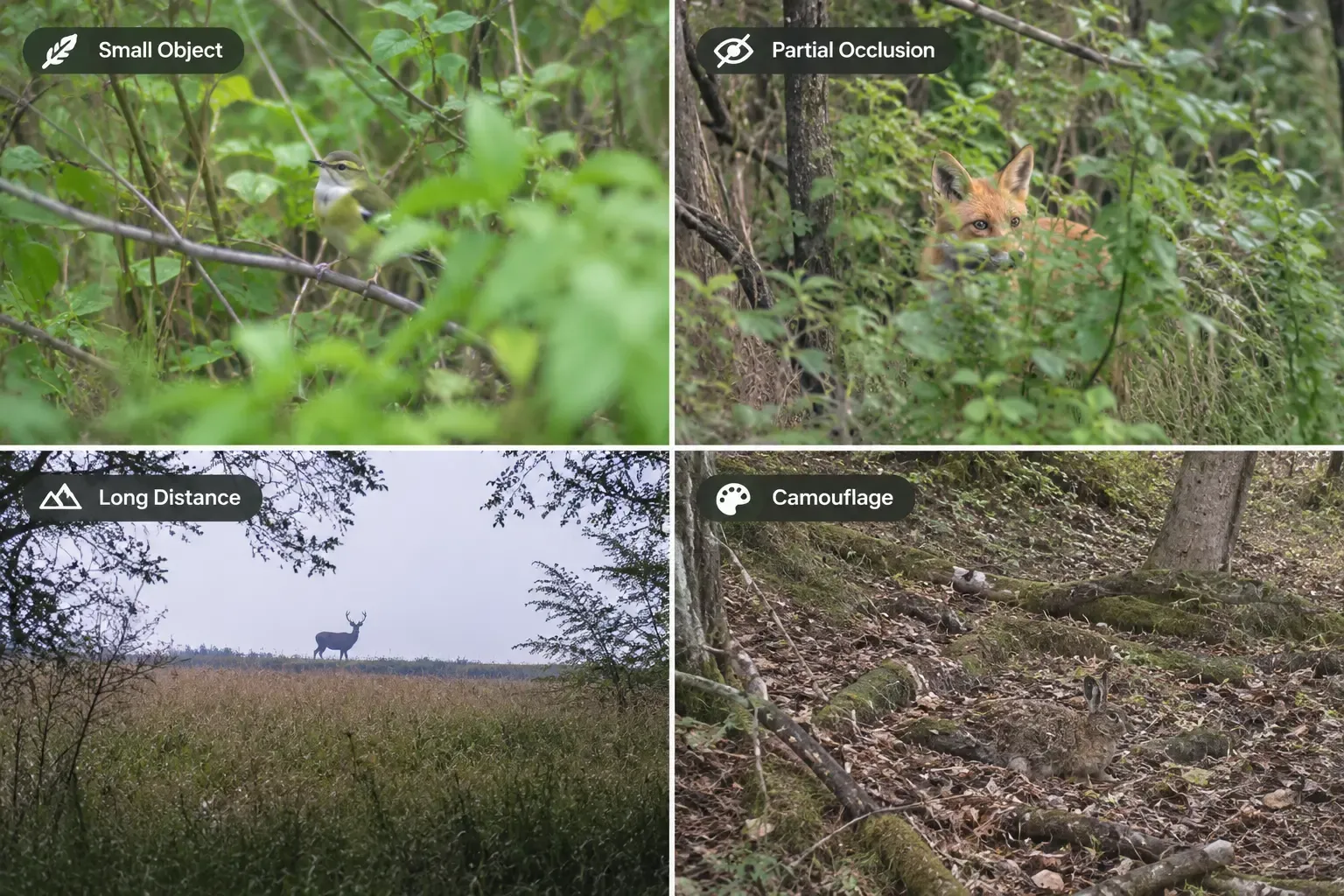
Animals may occupy only a small part of a photograph, appear near the edge of the frame, or remain partially hidden behind vegetation. Some species also blend naturally into their surroundings, making it difficult for a detection model to distinguish them from the background. For example, a small bird in a dense forest image may be harder to detect than a large deer photographed in an open clearing.
These conditions can increase the likelihood of missed detections, particularly when the model has not been trained on similar examples. Detection performance should therefore be tested on images that reflect the project's actual field conditions, including challenging backgrounds and animals of different sizes.
Lighting, Weather, and Camera Conditions
Wildlife photographs can vary considerably in quality because cameras operate across different environments and times of day. Common challenges include:
- Low-light and nighttime images.
- Infrared camera-trap photographs.
- Motion blur.
- Rain, fog, and shadows.
- Overexposure or underexposure.
- Differences in camera angle and resolution.
A model trained primarily on clear daytime photographs may perform differently on infrared nighttime images or photographs affected by poor visibility. These differences can influence whether animals are detected successfully and how confidently the system produces predictions. Testing on representative field data is therefore essential before relying on a model for large-scale monitoring.
False Positives and Missed Detections
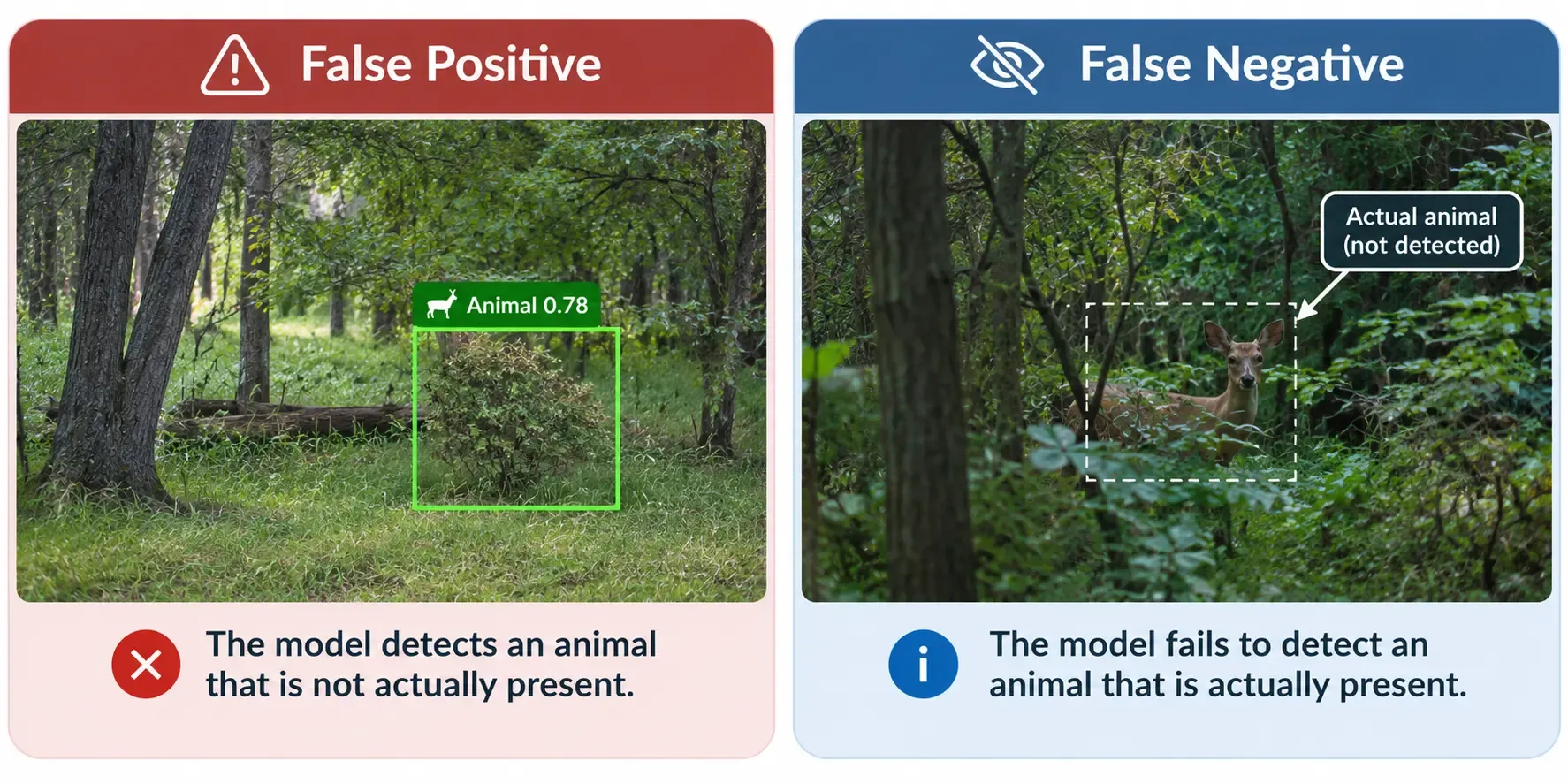
Two important types of detection errors are false positives and false negatives. A false positive occurs when the model reports an animal that is not present, while a false negative occurs when the model fails to detect an animal that is actually visible in the photograph. Both errors can affect workflow efficiency and the reliability of research results.
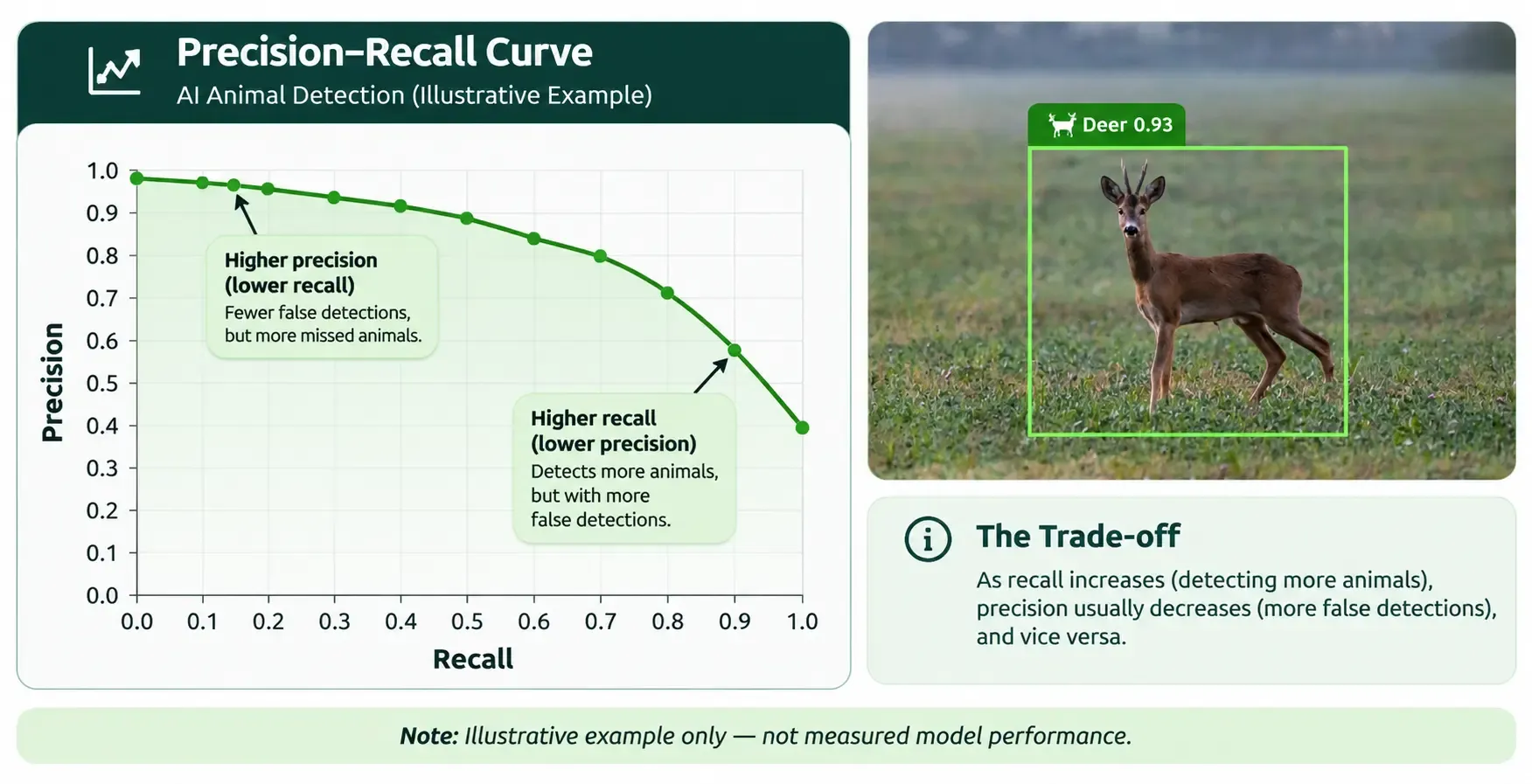
False positives can increase the amount of manual review required, whereas false negatives may be more consequential when researchers are trying to document rare species or assess animal presence. Changing a model's confidence threshold can influence the balance between these errors. A higher threshold may reduce false positives but can also increase missed detections, while a lower threshold may capture more animals at the cost of additional incorrect predictions.
The appropriate balance depends on the project's objectives. Research focused on detecting rare or vulnerable species may place particular importance on minimizing missed detections, while other workflows may prioritize reducing unnecessary manual review.
Model Generalization Across Locations
An animal detection model may perform well on images similar to its training data but less reliably in a different environment. Changes in vegetation, camera placement, species composition, and lighting can affect predictions, even when the underlying detection task remains the same.
A model evaluated on photographs from one geographic region should not automatically be assumed to perform equally well elsewhere. Testing across independent camera locations and relevant field conditions helps reveal these limitations and provides a more realistic understanding of how the system will perform during deployment.
How to Evaluate an Animal Detection System
Selecting an animal detection system requires evaluating both technical performance and practical workflow requirements. A model that produces accurate predictions on a small collection of sample images may still be unsuitable for a research project if it cannot handle the expected image volume, preserve metadata, or support reliable verification.
Precision and Recall
Two commonly used performance measures are precision and recall. Precision measures the proportion of reported positive detections that are correct, while recall measures the proportion of actual positive instances that the model successfully detects. These metrics help researchers understand different aspects of detection performance rather than relying on a single general accuracy claim.
For example, a system with high precision may produce relatively few false animal detections, while a system with high recall may detect more of the animals present, including difficult cases, although it may also generate more false positives. For object detection, evaluation must also define how predicted bounding boxes are matched to ground-truth annotations. Intersection over Union (IoU) and average precision are commonly used for this purpose.
A model's performance should be measured on a representative, independently labeled test dataset rather than inferred from promotional accuracy claims. The appropriate evaluation metrics and acceptable error rates depend on the intended research application.
Test With Representative Wildlife Images
Before adopting a system for a large project, prepare a labeled evaluation sample that reflects actual operating conditions. The dataset should contain examples of the target species, relevant non-target animals, empty photographs, daytime and nighttime images, different camera locations, difficult backgrounds, and partially obscured animals.
Where possible, evaluation images should be separated by camera location or collection period to reduce the risk of overly optimistic results caused by closely related training and test images. If species identification is part of the workflow, its classification performance should be measured separately from animal detection performance. This approach helps researchers identify whether errors arise from failing to locate an animal or from assigning an incorrect species label.
Batch Processing and Human Review
Large image collections introduce operational requirements beyond model accuracy. Teams should consider whether the selected system can:
- Process the expected number of images.
- Preserve useful metadata.
- Produce structured outputs.
- Support inspection and correction of predictions.
- Handle processing failures.
- Integrate results into the project's analysis workflow.
A system that performs well on individual photographs may still be unsuitable if processing large datasets requires excessive manual intervention. Batch-processing capabilities, clear review procedures, and reliable output management can therefore be just as important as model performance when evaluating a solution for operational use.
Deployment and Data Management
Some projects analyze photographs on local computers, while others use remote servers or cloud-based infrastructure. The appropriate approach depends on connectivity, computing resources, data-management requirements, and operational constraints. Teams should also consider storage capacity, access controls, image retention, and the handling of sensitive wildlife-location data.
For projects involving endangered or vulnerable species, location information may require particular care. Appropriate data-management practices can help protect sensitive observations while ensuring that authorized researchers can access the information needed for monitoring and analysis.
Applications in Wildlife Research and Monitoring
AI-based animal detection can support a range of wildlife research activities by helping teams process photographs and organize visual observations. Its value depends on the research question, the quality of the collected images, and the reliability of the detection and verification workflow.
Camera-Trap Image Analysis
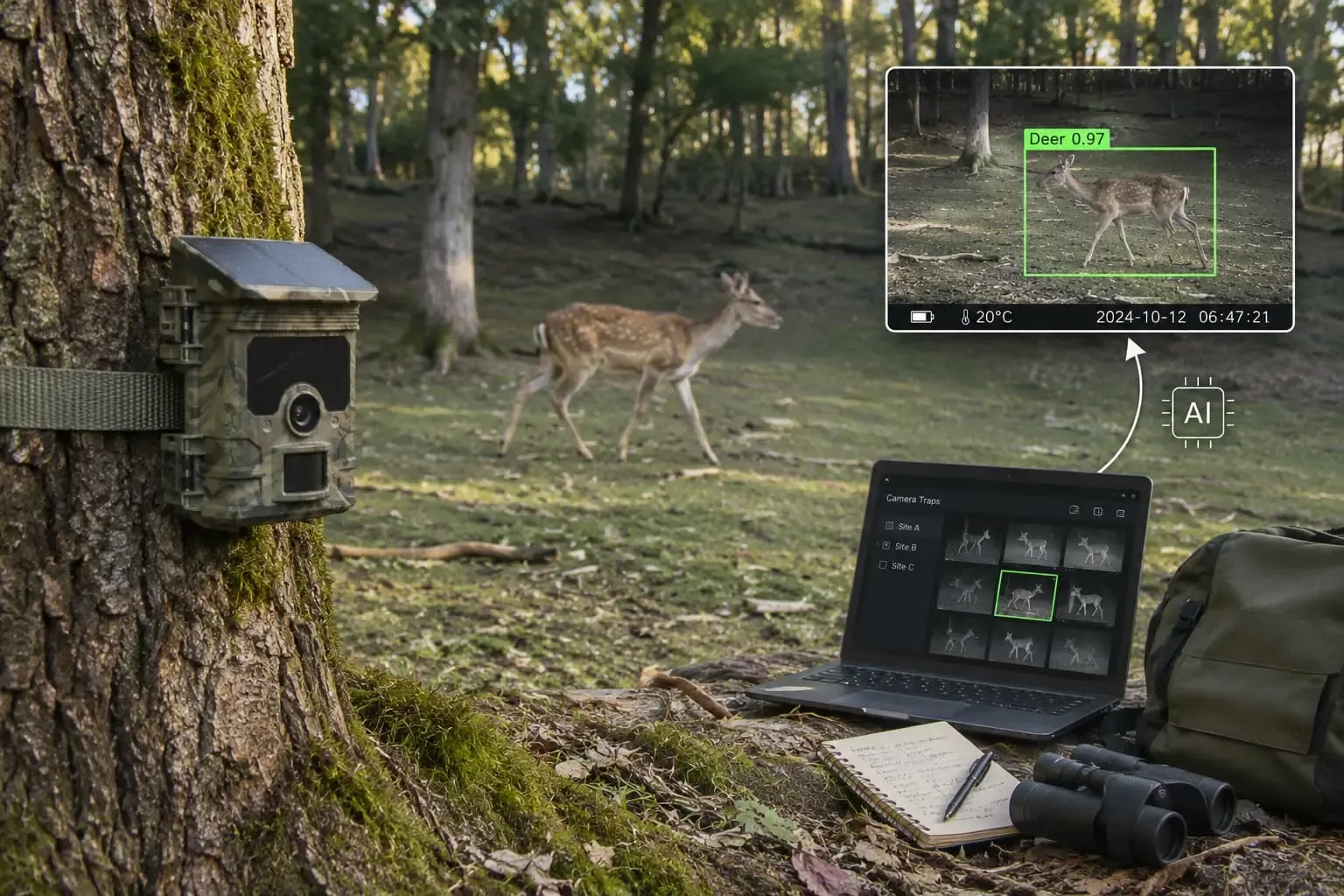
Camera traps can collect photographs over extended periods without requiring a person to remain at the observation site. This makes them useful for monitoring wildlife activity across different habitats and times of day, but it can also produce large image collections that require substantial review.
AI-assisted image analysis can help researchers identify images containing animals and prioritize relevant photographs for inspection. When appropriate species classification is available, the resulting records can support studies of species occurrence and activity patterns. The reliability of these analyses depends on image collection methods, model performance, and verification procedures.
Wildlife Conservation and Monitoring
Animal detection can contribute to broader wildlife monitoring projects by helping teams organize visual observations and identify photographs relevant to conservation research. Potential applications include documenting animal presence at monitored locations, reviewing observations over time, and supporting species-specific studies.
For a broader discussion of the technologies involved, see Computer Vision for Wildlife Conservation. Projects requiring continuous detection or sensor-based alerts may involve different technical requirements. The related guide to Wildlife Detection Systems explores that broader category.
Using Sairone for Animal Detection
Sairone's wildlife conservation solution presents AI-based analysis of animal images and videos as part of its wildlife-related offering. The official product information describes animal detection and identification-oriented analysis, alongside wildlife reporting applications.
For organizations evaluating Sairone, the next step is to define the specific detection problem and confirm whether the available solution meets the project's requirements. Important considerations include the species being studied, the type and volume of visual data, expected processing times, and the level of verification needed before results can be used in research or monitoring.
Useful questions include:
- Which animal species must be detected?
- What types of images or video will be analyzed?
- Is animal presence sufficient, or is species identification required?
- What image volumes and processing times are expected?
- How will detection accuracy be evaluated?
- What review and reporting outputs are necessary?
These requirements should be discussed before assuming that a particular model, deployment method, or workflow is supported. Clearly defining the intended application makes it easier to evaluate whether a solution can provide the necessary detection capabilities, outputs, and operational support.
Discuss Your Project: Explore your animal detection requirements with the Saiwa team through the Sairone wildlife conservation page.
Frequently Asked Questions
Can AI identify animal species from photos?
Yes. AI-based image classification systems can predict animal species from photographs when they have suitable training data and classification capabilities. However, animal detection alone does not guarantee species identification. Some systems only locate animals, while others combine detection with species classification to provide more detailed information about the animals appearing in an image.
Can AI analyze thousands of wildlife images?
Yes. Batch-processing systems can analyze large image collections and produce automated detection results, helping researchers organize photographs and prioritize relevant observations. Actual processing time depends on the model, image resolution, hardware, and implementation. Human verification may still be necessary, particularly when the results will be used for scientific research or conservation decisions.
How accurate is AI animal detection?
There is no single accuracy figure that applies to all animal detection systems. Performance varies with the model, species, camera conditions, evaluation dataset, and selected confidence threshold. Precision, recall, and appropriate object-detection metrics should be measured on representative project data to determine whether a system meets the required level of reliability.
Is animal detection the same as animal counting?
No. Animal detection identifies animals or their locations within images, while counting estimates the number of visible animals. Counting unique animals across multiple photographs is more complex because the same individual may appear repeatedly. Reliable population estimates require additional consideration of sampling methods, repeated observations, and detection limitations.
Do camera-trap images always require species classification?
No. If the goal is simply to identify photographs containing animals, an animal detector may be sufficient. Species classification becomes necessary when the project requires species-specific records or analysis, such as studying the occurrence or activity patterns of particular wildlife species.
Conclusion
AI-based animal detection in images can make large wildlife photograph collections easier to process by locating animals, organizing detections, and helping researchers prioritize relevant images. These capabilities can reduce repetitive manual work and support more efficient monitoring, particularly when image collections contain large numbers of empty or irrelevant photographs.
A reliable workflow begins with clear project objectives and representative data. It then combines appropriate detection methods, species classification when needed, performance evaluation, and human verification. The most important distinction is that detecting an animal, identifying its species, and producing reliable ecological conclusions are separate tasks, each requiring appropriate methods and validation.
Organizations planning wildlife image-analysis projects should evaluate these requirements carefully before selecting a system. For projects involving animal detection and wildlife monitoring, explore Sairone's wildlife conservation solution and discuss the intended use case with the Saiwa team.
About the team
Share this article
Help others discover this content
Comments
Be the first to share your thoughts
No comments yet
Start the conversation by sharing your thoughts