



Leaf Nutrient Analysis - Unlocking Plant Health with Precision
Optimize crop nutrition with Leaf Nutrient Analysis using smart tools like Sairone, imaging, and in-field data.
Written by Maryam
Reviewed by Boshra
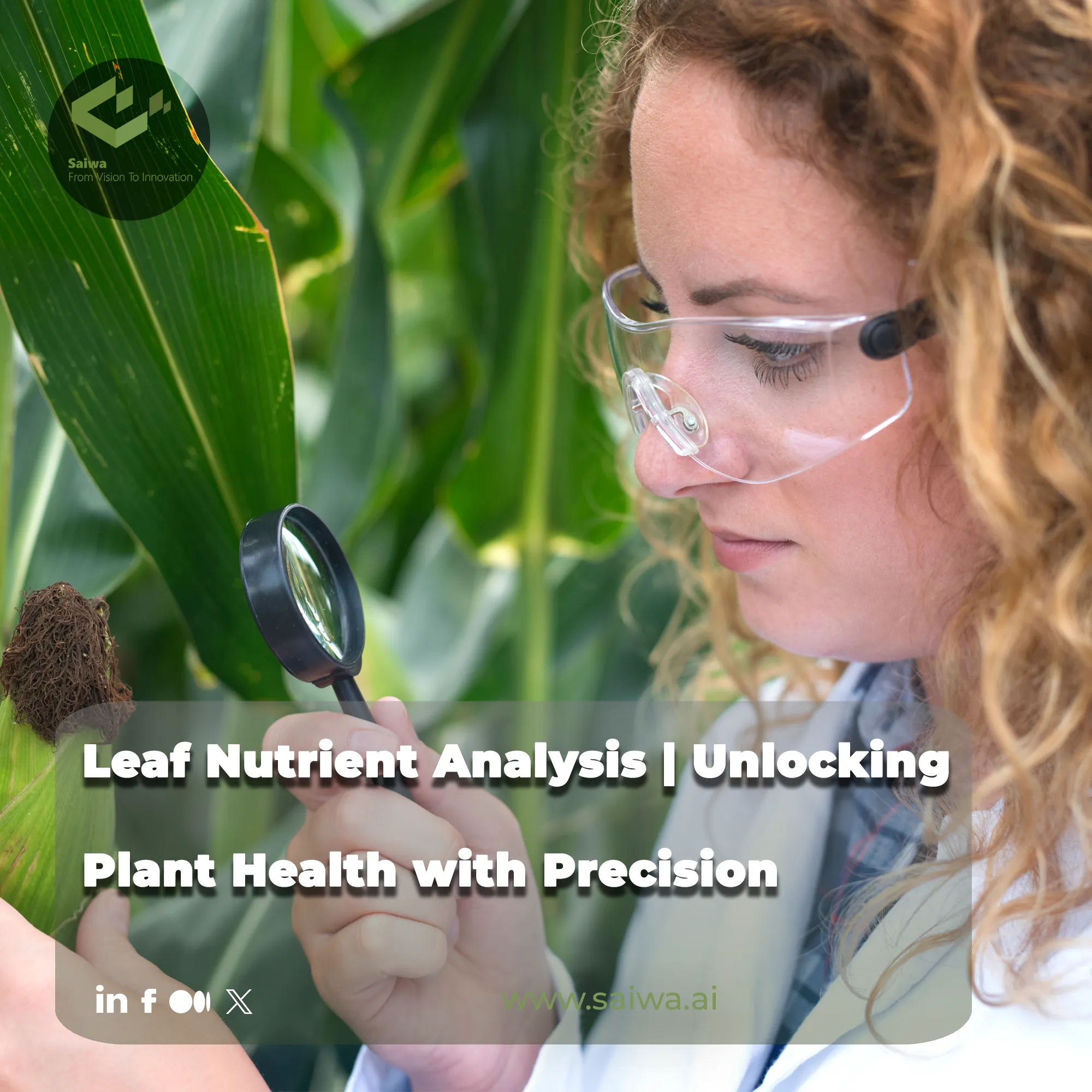
Importance of Leaf Nutrient Analysis in Modern Agriculture
Managing crop nutrition effectively is a cornerstone of modern agriculture, requires more than just soil testing. While soil tests reveal what nutrients are available, they don't show what the plant has actually absorbed. This is where Leaf Nutrient Analysis provides a decisive advantage.
By offering a direct snapshot of a plant’s internal nutrient status, it uncovers hidden deficiencies before they impact growth and yield. This level of precision is now amplified by advanced platforms like Saiwa’s Sairone, which uses AI and drone imagery to elevate diagnostics from the lab to the entire field.
This article explores the science, methods, and future of leaf analysis, demonstrating how data-driven insights are unlocking superior plant health.

Methods of Leaf Nutrient Analysis
Historically, growers have relied on two primary approaches for assessing nutrient levels. We explore these methods below:
Traditional Laboratory Techniques:
Lab analysis provides precise, quantitative data through established procedures. These include:
Dry Ashing and Wet Digestion Procedures: Preparing leaf samples by breaking them down with heat or acid.
Colorimetric and Titrimetric Analyses: Classic chemical methods to measure nutrient concentrations.
Atomic Absorption Spectroscopy (AAS): A highly accurate method for quantifying specific mineral elements.
Visual Deficiency Symptom Identification:
This field-based approach relies on expert observation of visible cues:
Common Changes in Leaf Color and Shape: Identifying issues like yellowing (chlorosis), purpling, or distorted growth.
Nutrient-Specific Deficiency Indicators: Recognizing distinct patterns, such as chlorosis in new vs. old leaves to pinpoint the specific missing nutrient.

Best Practices for Leaf Sampling
The reliability of any analysis depends entirely on the quality of the sample collected. To ensure accuracy, the following practices are crucial:
Optimal Timing for Sampling: Collecting tissue during key physiological growth stages.
Proper Sampling Techniques: Gathering recently matured leaves from multiple plants to create a representative sample.
Handling and Transporting Samples: Protecting samples from contamination and degradation during transit.
How to Interpret Leaf Nutrient Results Correctly
Leaf nutrient analysis is powerful because it measures the plant’s actual nutritional status, not just the theoretical nutrient supply in the soil. Washington State University describes leaf tissue analysis as one of the most valuable and standardized tools for diagnosing nutrients and monitoring orchard nutritional status, which is why it remains so important even when soil testing is already part of the program.
That distinction matters in real farm conditions because a field can contain nutrients on paper while the crop still struggles to absorb them efficiently. The current article already notes that soil tests show what is available, while leaf analysis shows what the plant has actually absorbed.
Why leaf results need context
A leaf report should never be read in isolation. Nutrient imbalance may be linked to pH, moisture stress, root limitation, poor timing of fertilizer delivery, or within-field variability rather than a simple shortage of fertilizer in the entire field.
This is exactly why precision agriculture has become so valuable for nutrient management. A review on precision agriculture explains that proximal and remote sensing can delineate within-field variation in soil and crop attributes, making nutrient decisions more responsive and site-specific instead of uniform across the whole field.
In practical terms, leaf analysis answers a different question than soil testing. Soil data helps estimate nutrient supply potential, while leaf analysis reveals whether the crop is actually accessing that supply at the right growth stage.
That makes leaf analysis especially useful for detecting hidden hunger, confirming suspected deficiency, and checking whether a fertility program is performing as intended before visual symptoms become severe.
A better interpretation workflow
The most reliable way to use leaf nutrient data is to combine it with other evidence rather than reacting to a single low value.
Compare leaf results with recent soil data to see whether the issue is low supply or poor uptake.
Check whether symptoms are concentrated in specific zones rather than the whole field. Precision agriculture research shows that spatial variability matters because nutrient conditions are rarely uniform across productive farms.
Review irrigation, root-zone conditions, and recent weather, since water and nutrient management are closely linked in precision farming systems.
Use imagery or in-season monitoring to confirm whether the nutrient signal matches visible or spectral stress patterns across the canopy. Remote sensing reviews note that nutrient stress can alter plant spectral reflectance before the problem becomes obvious to the eye.
Evidence source | What it tells you | Best use in diagnosis |
Leaf analysis | What the plant has actually absorbed. | Confirms current nutrient status. |
Soil testing | What nutrients are present or potentially available in the root zone. | Explains supply-side constraints. |
Remote sensing | Where stress is appearing spatially across the field. | Helps target scouting and variable-rate action. |
Farm records and irrigation data | What management or environmental factors may be limiting uptake. | Prevents over-correcting the wrong problem. |
Why this improves decisions
This interpretation framework reduces one of the most common fertilizer mistakes: applying more nutrients when the real problem is uneven uptake, stress interaction, or field heterogeneity. Precision nutrient management reviews emphasize that better sensing, better models, and better spatial targeting are all needed because no single technology can explain every soil property or nutrient response on its own.
It also supports sustainability. Precision agriculture research shows that site-specific nutrient management can improve nutrient use efficiency while reducing leaching and excessive accumulation in parts of the field.
This is where Sairone fits naturally into the workflow. The current article states that Sairone uses AI and drone imagery to identify nutrient stress across the field, while its crop health platform adds localized alerts, plant health indices, and prescription-map export for precision treatment.
For growers, agronomists, and ag-service providers, the real value of leaf nutrient analysis is not just receiving a lab report. It is using that report with spatial and operational context to make faster, more accurate, and more economical fertility decisions.
Turning Leaf Nutrient Data into Smart Farm Decisions
management plan transforms data into action. This information enables targeted fertilizer applications, which optimize crop yield and minimize environmental runoff by preventing overapplication.
Leaf nutrient data can also guide irrigation schedules, soil amendments, and harvest timing by revealing early signs of quality or maturity issues. Combining this data with soil test results, drone imagery, or AI-driven platforms like Sairone yields even more powerful insights, helping farmers fine-tune their inputs, cut unnecessary costs, and adopt sustainable practices without sacrificing yield.
Cutting-Edge Technologies Revolutionizing Leaf Nutrient Analysis
Today, technology is profoundly reshaping this field. These advancements are shifting Leaf Nutrient Analysis from a delayed, lab-based task to a rapid, in-field science. Several key technologies are driving this change:
Remote Sensing with Hyperspectral and Multispectral Imaging
Utilizing drone and satellite-mounted sensors to capture specific light wavelengths reflected from plants, revealing chemical composition and stress levels remotely.
IoT-Integrated Sensor Networks and Data Analytics
Deploying in-field sensors that continuously collect and stream data on soil moisture, nutrient levels, and plant conditions for immediate analysis.
AI and Machine Learning–Driven Nutrient Predictions
Applying intelligent algorithms to process vast datasets from sensors, allowing them to identify complex patterns and accurately predict nutrient deficiencies.
Drone and LiDAR-Based Precision Monitoring
Leveraging drones for rapid visual assessment of vast areas, combined with LiDAR technology to create detailed 3D maps of crop structure and density.
Data-Driven Decision-Making Platforms
Integrating all incoming data into sophisticated software that translates complex metrics into clear, actionable insights and management recommendations for growers.

Sairone’s Smart Solutions for Precise Leaf Nutrient Analysis
Saiwa’s Sairone platform sits at the apex of this technological revolution. It leverages AI to automate the analysis of drone imagery, providing powerful insights for Plant health Monitoring.
By translating complex visual data into clear, actionable maps, Sairone empowers growers and agronomists to identify nutrient stress, weed detection, and manage interventions with unparalleled precision. This tool moves producers beyond simple problem-solving, enabling a proactive and highly efficient approach to crop management.
Conclusion
The evolution of leaf analysis from reactive lab testing to a proactive, data-driven science marks a pivotal moment in agriculture. By integrating AI and advanced remote sensing, growers can now manage crop nutrition with incredible detail and foresight. This paradigm shift not only maximizes farm profitability but also champions a more sustainable, efficient, and resilient food production system for the future.
Note: Some visuals on this blog post were generated using AI tools.
About the team
Continue reading

Weed Detection - Comprehensive Overview
Walk through almost any crop field and you will see how quickly weeds claim open space, often appearing before the crop has fully establishe

Parthenium Hysterophorus Control - Effective Management Through Innovation
Parthenium hysterophorus has become one of the most disruptive invasive weeds affecting agriculture, natural ecosystems, and farmer liveliho

Comprehensive Approaches to Weed Control in Sunflower Cultivation
Sunflowers are a basic crop, providing oil, animal feed, and various industrial products. But growing them successfully isn't as simple as p
Tomato Crop Management - Best Practices for Healthy Growth and High Yields
Achieving high yields in tomato cultivation demands a synthesis of agricultural science and precision management. Success hinges on a deep u
Benefits and Challenges of Ai-Powered Greenhouses
reThe agricultural sector is undergoing a technological revolution with the advent of AI-powered greenhouses. These sophisticated systems em

The Rise of Automated Fruit Sorting Using Image Processing
Fruit sorting is one of the most critical steps in the post-harvest process because it directly determines the quality of produce that reach
Comments
Be the first to share your thoughts
No comments yet
Start the conversation by sharing your thoughts
Share this article
Help others discover this content
Table of Contents
No headings were found on this page.