Projects


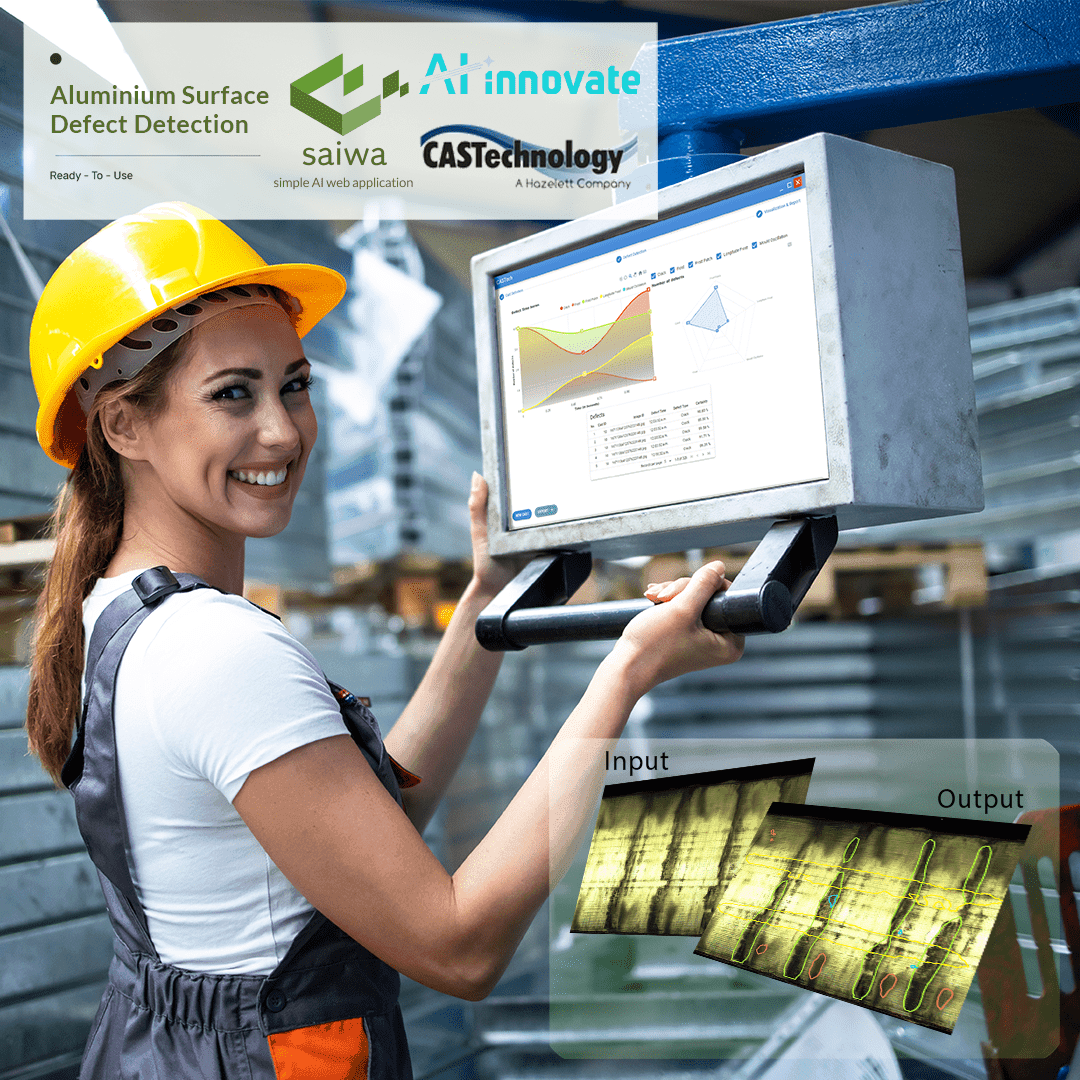
We at Saiwa Inc. are pleased to announce that we have successfully completed an aluminium surface defect detection project in collaboration with AI-innovate Company for CastTechnology in Canada.
In this project, using machine learning techniques and the networks we provide in our Anomaly Detection service, we detect and localize the location of micro and macro defects on a casting line, including: crack, frost, frost patch, longitude frost and mold oscillation. This service is delivered via a simple user interface where users can run the defect detection APIs.
Read More

This is a corrective exercise mobile application which is developed for Android platform. Corrective Exercise is a technique that leverages an understanding of anatomy, kinesiology, and biomechanics to address and fix movement compensations and imbalances to improve the overall quality of movement during workouts and in everyday life. This technique is used to help assess and determine the root cause of imbalances and faulty movement patterns that lead to issues with posture, balance, and total body coordination.
Read More

RFDs are DNA sequences that induce a cleavage (cutting) reaction in a substrate strand in response to the presence of a target. In this project, we at saiwa team segmented and measured regions of interest (the dots that constitute the microarray) relative to the background in printed RFD images. Printed microarrays can be used to test for the presence of specific targets (i.e., bacteria). We used around 100 RFD images that were provided by Didar Lab., McMaster uni.
Read More

For a long time, product quality control relies on manual examination in the manufacturing field. In the past several decades, automated surface inspection (ASI) have become more widespread as hardware and software technologies have developed rapidly. To lower labor costs and enhance examination efficiency, more factories start to employ embedded machines for product inspection. ASI platforms use special light sources and industrial cameras to capture the images of the product surface, and machine/computer vision technologies to filter out defective products, which can reduce labor greatly. High-performance cross-product ASI algorithms are urgently needed in manufacturing.
Read More