According to Grand View Research, the global drone market size is projected to reach 163.60 billion by 2030. Traditional drone operations require constant human oversight, limiting their efficiency in time-sensitive missions and large-scale deployments. Manual piloting also increases operational costs and restricts coverage areas.
AI-powered drones are changing this landscape entirely. These intelligent systems can navigate autonomously, make real-time decisions, and adapt to dynamic environments without continuous human intervention. From precision agriculture to emergency response, AI transforms drones from remote-controlled devices into independent aerial platforms.
This article guides you on how AI enables drone autonomy, the technologies powering these systems, and their applications across industries. You'll learn about the benefits, challenges, and practical steps to implement AI-driven drone solutions using Saiwa's advanced platform.

What Is AI In Drone Technology
Drones equipped with machine learning algorithms and computer vision capabilities that enable autonomous operation. Unlike traditional drones that follow pre-programmed flight paths or require manual control, these systems can perceive their environment, make decisions, and learn from experience.
The integration of AI allows drones to process sensor data in real time, identifying objects, avoiding obstacles, and adjusting flight patterns based on mission objectives. This autonomy significantly expands their utility beyond simple aerial photography to complex industrial applications requiring precision and adaptability.
Inside the Process: How it Works
AI drone systems operate through a coordinated process that combines hardware sensors with intelligent software algorithms:
- Image and Data Capture: Onboard cameras, LiDAR, and sensors continuously collect environmental data during flight.
- Data Preprocessing: AI algorithms filter and enhance raw sensor inputs, removing noise and standardizing formats for analysis.
- AI Model Processing: Deep learning models analyze processed data to identify objects, assess terrain, and detect anomalies or patterns.
- Decision and Action: The system makes autonomous decisions about navigation, task execution, or alert generation based on analyzed data.
- Continuous Learning: Machine learning models improve performance over time by incorporating feedback from completed missions and environmental interactions.
This workflow enables drones to handle complex scenarios that would overwhelm manual operators, from tracking moving targets to inspecting infrastructure across vast areas.
Where AI Drones Across Industries Is Used
AI-powered drones deliver measurable value across diverse sectors by automating tasks that are dangerous, time-consuming, or require extensive coverage:
- Agriculture: Drones monitor crop health, detect pest infestations early, and enable precision spraying that reduces herbicide use by up to 40%. They provide farmers with actionable insights about soil conditions and yield predictions.
- Infrastructure Inspection: Automated visual inspections identify structural defects in bridges, pipelines, and power lines without requiring human workers to access dangerous locations. This preventive approach reduces maintenance costs by detecting issues before they escalate.
- Construction: AI drones create accurate 3D site maps, track project progress, and identify safety hazards. Real-time monitoring allows project managers to oversee multiple sites simultaneously, improving productivity by 25-30%.
- Emergency Response: During disasters, drones quickly assess damage, locate survivors using thermal imaging, and map safe evacuation routes. Their ability to operate in hazardous conditions protects first responders while accelerating rescue operations.
Top 5 Applications of Artificial Intelligence in Drones
Security and Surveillance
AI-powered drones are changing the face of surveillance by autonomously detecting and responding to potential threats. They can monitor borders, large crowds and critical infrastructure in real time, identifying unusual patterns or movements without the need for constant human supervision.
Precision Agriculture
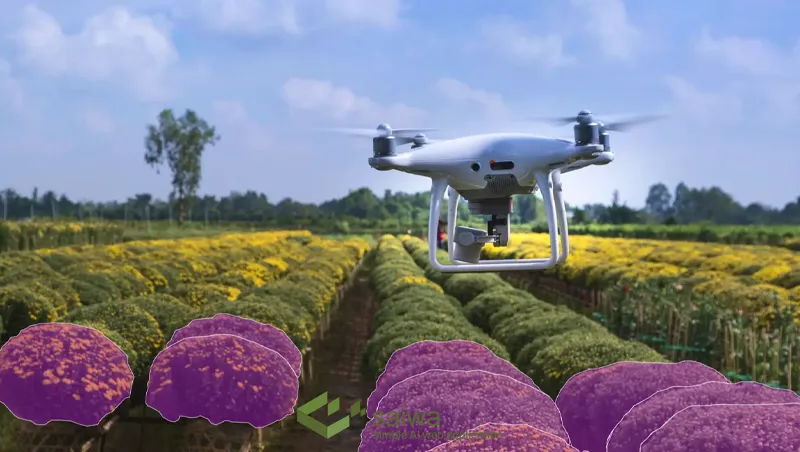
In agriculture, AI-equipped drones use advanced computer vision and multispectral imaging to monitor crop health, detect diseases and pests at an early stage, and optimise the use of irrigation and fertiliser. This provides farmers with valuable insights to help them make data-driven decisions that improve yields, reduce waste and promote sustainable, regenerative farming practices.
Wildfire Detection and Management
AI-driven drones play a vital part in identifying and managing wildfires before they can spread out of control. Equipped with thermal sensors and AI pattern recognition technology, these drones can detect changes in temperature, smoke patterns and levels of vegetation stress. This data allows firefighters to identify high-risk areas, track the progression of fires in real time and coordinate containment efforts more safely and effectively.
Package Delivery and Logistics
AI lies at the heart of the next generation of delivery systems. Autonomous drones use machine learning algorithms and real-time environmental data to navigate complex urban environments, avoid hazards and maximise the efficiency of delivery routes.
Read Also: AI and Natural Disaster Prediction
Technologies that make AI Drones function
Several core technologies enable intelligent drone operations:
- Computer Vision: Convolutional neural networks process visual data to identify objects, measure distances, and recognize patterns in real-time footage.
- Deep Learning Architectures: Models like YOLO and R-CNN enable object detection at speeds exceeding 30 frames per second, essential for dynamic obstacle avoidance.
- Sensor Fusion: AI algorithms combine data from multiple sensors (cameras, LiDAR, GPS, IMU) to create comprehensive environmental models that improve navigation accuracy.
- Reinforcement Learning: Drones learn optimal flight strategies through trial and error, adapting to wind patterns, obstacle configurations, and mission-specific requirements.
- Edge Computing: Onboard processors execute AI models directly on the drone, eliminating latency from cloud transmission and enabling split-second decision-making.
- Natural Language Processing: Advanced systems interpret verbal commands, allowing operators to direct missions using conversational language rather than technical controls.
Read Also : Leveraging Drones in Agriculture for Smarter Farming
Upsides and Downsides
While AI drones offer impressive efficiency and coverage for large areas, they also face some downsides on the other hand.
Downsides
Organizations adopting AI drone technology must address several considerations:
Data Requirements: Training accurate AI models demands extensive labeled datasets specific to each application, which can be time-consuming to collect and annotate.
Regulatory Compliance: Aviation authorities impose restrictions on autonomous flight, requiring organizations to navigate complex permitting processes before deployment.
Integration Complexity: Connecting drone systems with existing software platforms, databases, and workflows often requires custom development and IT expertise.
Initial Investment: High-quality AI-capable drones and supporting infrastructure represent significant upfront costs, though ROI typically materializes within 12-18 months.
Cybersecurity Risks: Connected drones face potential hacking threats, requiring robust encryption and access controls to protect sensitive data and prevent unauthorized access.
Upsides
AI-powered drones deliver substantial operational improvements across metrics that matter to businesses:
Complete Area Coverage: Autonomous flight patterns ensure systematic inspection of large areas without gaps, achieving coverage rates impossible for manual operations.
Enhanced Accuracy: AI detection systems identify defects, anomalies, or objects with precision exceeding 95%, reducing false positives that waste inspection resources.
Cost Reduction: Automated operations eliminate the need for human pilots on routine missions, cutting labor costs by 50-70% while extending operational hours.
Real-Time Intelligence: Instant data processing provides actionable insights during flight, enabling immediate response to detected issues rather than waiting for post-mission analysis.
Safety Improvement: Drones eliminate human exposure to hazardous environments like toxic sites, high-voltage equipment, or unstable structures.
Where to Begin?
Implementing AI drone systems requires a structured approach that aligns technology with business objectives:
- Define Mission Requirements: Identify specific tasks the drone must perform, the environment it will operate in, and the success metrics for your application. Clear objectives guide hardware selection and model training priorities.
- Select Appropriate Hardware: Choose drone platforms with sensors, processing power, and flight characteristics matched to your use case. Agricultural monitoring requires different capabilities than infrastructure inspection.
- Collect Training Data: Gather representative images and sensor data from your operational environment. Quality and diversity of training data directly impact AI model accuracy.
- Monitor and Refine: Track performance metrics, analyze mission results, and continuously update AI models based on real-world feedback. Regular refinement improves accuracy and adapts to changing conditions.
Conclusion
AI transforms drones from remotely piloted tools into intelligent systems capable of independent operation, complex analysis, and adaptive learning. The convergence of computer vision, deep learning, and edge computing enables applications that improve safety, reduce costs, and deliver insights impossible through traditional methods.
Developing AI systems for autonomous platforms, successful drone implementation depends less on acquiring the most advanced hardware and more on matching capabilities to specific operational needs. Organizations that start with clearly defined problems and incrementally expand their systems achieve better results than those pursuing technology for its own sake.
From our experience at Saiwa, real autonomy in drone systems requires more than object detection — it demands robust edge processing, adaptable AI models, and mission-specific learning pipelines. Our Sairone platform enables online/offline operation, continuous model improvement, and high-precision analysis of orthophotos and live UAV video streams, making AI-driven decisions reliable even in remote agricultural and environmental scenarios.
Note: Some visuals on this blog post were generated using AI tools.