



Vegetation Management Services in Agriculture: Enhancing Crop Health and Productivity
Enhance vegetation management in agriculture by identifying weed growth, monitoring crops, and optimizing land use efficiently.
Written by Amirhossein
Reviewed by Boshra
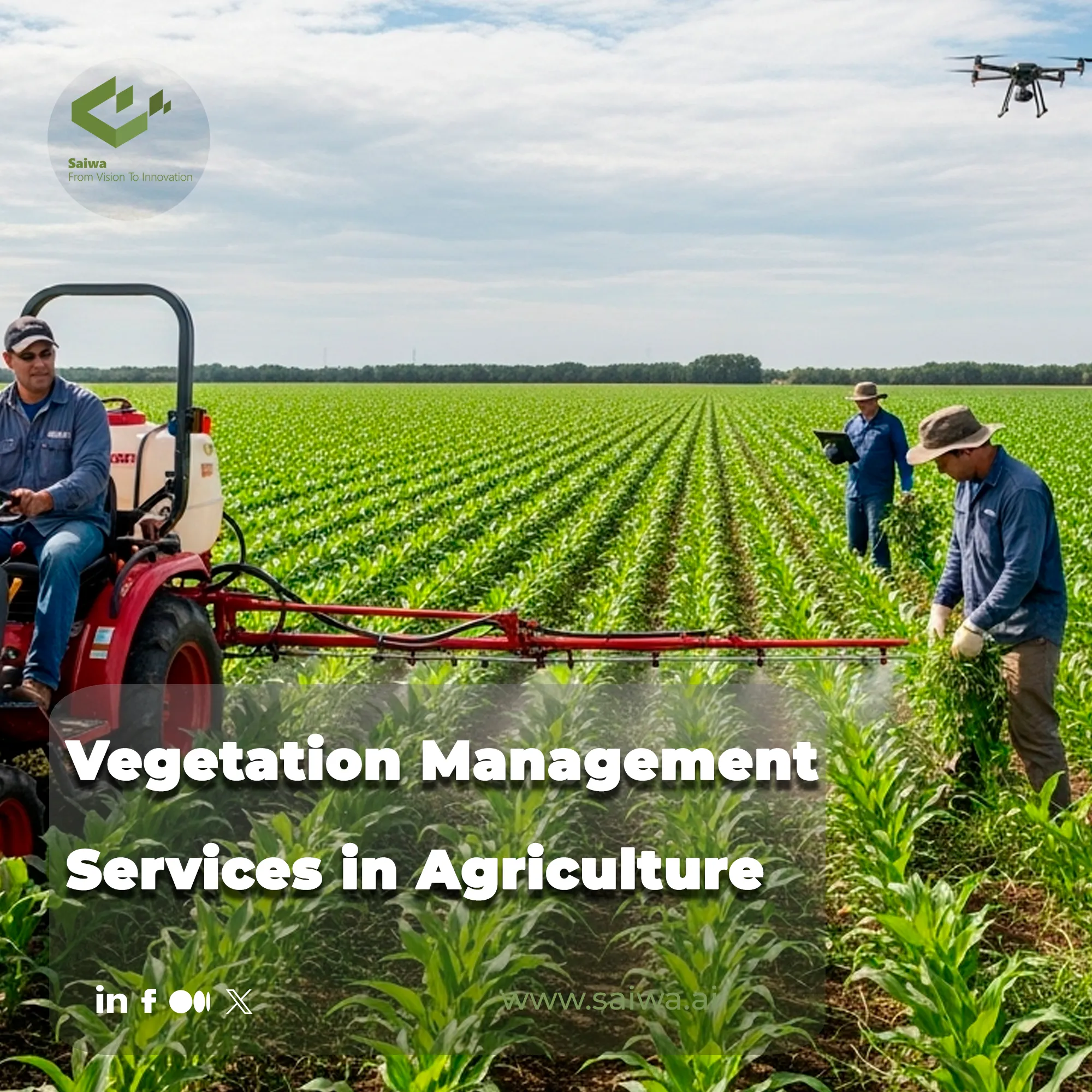
Modern farming faces a constant struggle with unwanted vegetation, which directly impacts crop vitality and profitability. At Saiwa, we use advanced AI to transform complex agricultural data into actionable insights for growers. Effective Vegetation management services are no longer just about manual labor; they are about leveraging technology for smarter, data-driven decisions. This article explores why these services are critical for modern agriculture and how our technology is revolutionizing this essential practice, ensuring you can enhance both crop health and productivity.

Why Vegetation Management is important
Effective vegetation control is about more than just clearing fields; it is a foundational strategy for sustainable agriculture. Its core benefits for any modern farm are clear and direct.
Maintaining Crop Health: Unwanted plants directly compete for essential resources like water, sunlight, and soil nutrients. By controlling them, you reduce this environmental stress, which leads to healthier and more resilient crops.
Protecting Soil and Resources: Proper management practices, such as the use of cover crops, prevent soil erosion. This protects the valuable topsoil, preserves its structure, and helps retain vital moisture.
Optimizing Yield: Reducing weed competition is a primary driver of increased output. Precision farming techniques can significantly boost performance, with some reports showing yield increases of up to 5%, a substantial gain in agriculture.
Key Vegetation management services
Achieving these benefits requires a multi-faceted and strategic approach. Several key Vegetation management services form the backbone of a successful agricultural operation, and understanding them is crucial. Here are the essential practices that modern growers rely on.
Weed control
This core service involves targeted strategies designed to identify and remove invasive species efficiently. Modern methods move beyond broad application, focusing instead on precision to minimize any potential damage to the main crops and their surrounding ecosystems.
Intercrop management
Planting secondary or "cover" crops between the primary harvest cycles is a vital technique for protecting the soil. This practice not only helps suppress the growth of weeds naturally but also plays a significant role in enriching the overall soil structure.
Buffer zone maintenance
Well-maintained, vegetation-free buffer zones around cultivated fields are critically important. These zones act as a protective barrier, preventing weed encroachment from surrounding areas and helping to protect local water sources from agricultural runoff.

Technology in Vegetation management
The future of productive farming is fundamentally driven by data. For efficient and scalable operations, technology is no longer an option but a core necessity. Two key innovations, in particular, stand out in revolutionizing modern vegetation control.
Drones for monitoring
Unmanned aerial vehicles (UAVs), commonly known as drones, provide an invaluable bird's-eye view of agricultural land. When equipped with advanced multispectral sensors, they can survey vast and often inaccessible areas quickly, accurately, and without disturbing the fields.
AI powered Analysis
Artificial intelligence is the engine that turns raw aerial data into powerful intelligence. Our AI algorithms process and analyze drone imagery, identifying subtle patterns of stress or growth that are often completely imperceptible to the human eye.
From Vegetation Data to Field Action
Effective vegetation management is strongest when prevention, detection, and targeted intervention work together instead of relying on a single weed-control pass.
FAO identifies soil cover as a core principle of conservation agriculture because it helps protect soil, recycle nutrients, improve structure, and reduce the pressure from weeds and pests.
Why integrated vegetation management performs better
For professional growers, vegetation management should be treated as a season-long system rather than a one-time operation.
That system usually combines three layers: maintaining protective ground cover where appropriate, detecting emerging weed pressure early, and applying inputs only where the agronomic threshold justifies treatment.
A practical framework looks like this:
Use cover crops or residue cover to reduce bare-soil exposure and suppress early weed establishment.
Monitor fields with UAV imagery to detect uneven vegetation patterns and identify hotspots faster than manual scouting alone.
Validate high-risk zones on the ground, then target control measures where competition is most likely to reduce crop performance.
Where cover crops add measurable value
Cover crops are not only a soil-health tool; they also support vegetation management by reducing erosion, improving infiltration, and limiting open space where unwanted plants establish easily.
In a field study from central Spain, erosion under traditional tillage reached 5.88 t/ha/yr, compared with 0.78 t/ha/yr under Brachypodium distachyon cover and 1.27 t/ha/yr under Secale cereale cover.
The same study reported that steady-state infiltration in vegetated plots was 45% greater than under tillage.
Management goal | What the evidence shows |
Reduce erosion | Vegetation cover lowered erosion substantially compared with traditional tillage in a multi-year vineyard study. |
Improve soil function | FAO reports that cover crops can improve soil structure, recycle nutrients, and help break compacted layers. |
Support water movement | Vegetated treatments showed higher infiltration, which can improve rainfall use efficiency. |
Manage trade-offs | A FAO AGRIS review notes that cover crops can also use soil water, so fit depends on rainfall pattern, region, and termination timing. |
This is the key management point: cover crops are highly valuable, but they should be selected according to climate, rotation, and water availability rather than adopted as a blanket practice.
Why drone-based weed mapping improves decisions
Drone imagery strengthens vegetation management because it turns scattered observations into full-field spatial evidence.
A systematic review covering 600 papers found that UAV-based multispectral imagery combined with machine learning is a promising rapid and cost-effective approach for weed detection across agricultural fields.
A separate 2025 review also highlights the growing role of RGB, multispectral, and hyperspectral sensors combined with deep learning for weed identification in precision agriculture.
For growers and ag-service providers, the real value is not the map alone.
The value is using that map to rank infestation zones, separate crop signal from weed signal, and act before weed competition affects yield, spray efficiency, or harvest uniformity.
How Sairone can help you Optimizing Agricultural Vegetation Monitoring and Management
This is where our Sairone platform provides a significant advantage. We combine high-resolution drone imagery and powerful AI to automate and improve your agricultural monitoring capabilities.
Sairone is an integrated toolkit designed to help you make data-driven decisions with complete confidence. Our platform offers tangible solutions to the complex problems growers face every day. For instance, our system excels at precise Weed detection, identifying invasive species with incredible accuracy before they spread.
Moreover, Sairone empowers proactive Plant Health Monitoring by spotting the earliest signs of disease or nutrient deficiency, allowing for timely interventions that can save a harvest.
This technology also provides reliable Crop Yield Estimation, giving you the critical foresight needed for better financial planning and resource management. We transform complex data into clear, field-level insights, making effective Vegetation management services more accessible and powerful than ever before.
Note: Some visuals on this blog post were generated using AI tools.
Comments
Be the first to share your thoughts
No comments yet
Start the conversation by sharing your thoughts
Table of Contents
No headings were found on this page.