



Blossom Counting - Boost Yield Planning in Smart Farms
Blossom Counting improves yield forecasts, enables smarter orchard decisions, and powers precision agriculture with AI-driven insights from early bloom data.
Written by Amirhossein
Reviewed by Boshra
Why Blossom Counting is a Cornerstone of Modern Precision Agriculture?
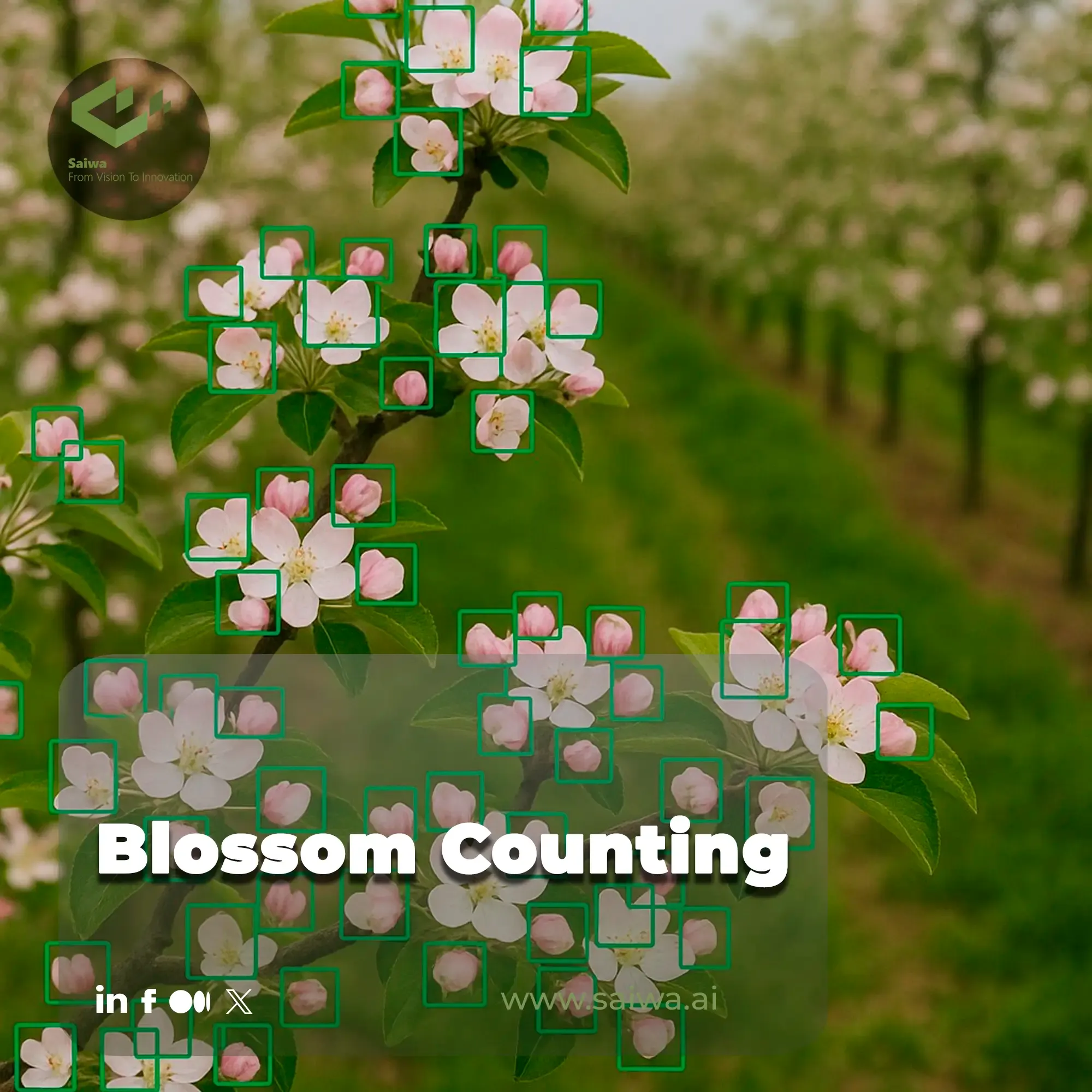
Forecasting agricultural output has long been a challenge, with growers historically relying on a mix of experience and historical data. However, as the scale of production grows, so does the need for greater accuracy. For fruit trees like apples and peaches, the density of flowers is a primary determinant of the final harvest size, making it a critical metric. Advanced Blossom Counting techniques provide a precise, early-season glimpse into a farm's potential, transforming orchard management from a reactive practice to a data-driven strategy. This shift toward precision delivers several crucial benefits:
Improving Yield Forecasts: An accurate flower count provides a reliable baseline for Crop yield estimation, enabling better planning for logistics, labor, and marketing months in advance.
Smarter Orchard Decisions: Data on blossom density informs critical interventions like targeted tree thinning, a process that improves fruit size and quality by reducing competition for resources.
Reducing Crop Loss: Optimizing inputs such as water and fertilizer based on a precise yield forecast prevent waste of recources and supports more sustainable farming practices.
Blossom Data in Smart Farming: In an integrated smart farm, blossom data serves as a vital input for AI models. Platforms like Sairone automate this data collection and analysis, offering a deeper understanding of the orchard's overall health and productivity.

Traditional Blossom Counting Methods
Before the advent of advanced technologies, assessing blossom density was a fundamentally manual, labor-intensive, and often subjective task. These foundational methods, while useful in their time, were inherently limited in scale and consistency, with error rates that could be significant. These manual techniques generally fell into a few main categories:
Visual Surveys: Relied on expert growers visually estimating blossom numbers, a method highly dependent on individual skill.
Sample Plot and Quadrat Sampling: Involved manually counting blossoms in a small, defined area (like on a few trees or in a quadrat) and extrapolating the result across the entire orchard.
Transect Counts: Required walking a predetermined path and counting flowers at specific intervals.
Mark–Recapture or Cluster Estimation: Focused on counting flower clusters rather than individual blossoms, especially for species like apples where this formation is common.
Advanced Blossom Counting Methods
The limitations of manual methods have paved the way for technological innovation. Modern approaches leverage automation and advanced imaging to deliver unparalleled accuracy and efficiency, revolutionizing how we perform blossom counting by capturing comprehensive data across entire orchards.
Image-Based Counting
This technique uses algorithms to process high-resolution still photographs, identifying and quantifying blossoms based on unique characteristics like color and shape.
Drone-Based Blossom Surveys
Unmanned aerial vehicles (UAVs) equipped with cameras can systematically photograph vast areas in a short time, ensuring consistent and objective data collection that is impossible to achieve manually.
AI-Powered Detection and Deep Learning
At the heart of modern systems, deep learning models, particularly Convolutional Neural Networks (CNNs), are trained to detect blossoms—even those that are partially obscured—with accuracy rates often exceeding 90%.
Multispectral and Hyperspectral Imaging
These advanced sensors capture light from outside the visible spectrum, allowing for a more reliable differentiation between blossoms, leaves, and branches, further enhancing analytical precision.
Turning Blossom Counts Into Orchard Decisions
Blossom counting is most valuable when it is treated as a management signal, not just a visual metric. The current article correctly explains that flower density provides an early baseline for crop yield estimation in fruit trees such as apples and peaches, and that this information supports smarter planning months before harvest.
For orchard managers, that early signal matters because blossom intensity shapes later decisions on thinning, irrigation, labor allocation, and market planning long before fruit numbers are final.
Why blossom density matters beyond simple forecasting
A high blossom count does not automatically mean the orchard should aim to keep every potential fruit. The article already notes that blossom-density data can guide targeted thinning, which improves fruit size and quality by reducing competition for resources.
Research in perennial fruit systems supports that logic. A comprehensive review of orchard yield prediction found that pre-harvest yield information is valuable not only for harvest and post-harvest planning, but also for management adjustment earlier in the season.
Related horticultural research on plum reported that flowering intensity and crop load are closely tied to yield and fruit-quality outcomes, showing why bloom-stage decisions can influence the commercial result later in the season.
Why spatial maps are better than block averages
Whole-orchard averages can hide large differences between rows, zones, or individual trees. A triennial apple-orchard study using UAV RGB imagery showed that tree-level flower intensity can be quantified from aerial data, and one flowering index achieved a strong correlation with field-recorded flower cluster counts.
That matters operationally because uniform thinning or uniform input planning can overcorrect one zone and undercorrect another. A blossom map is more useful than a simple orchard-wide estimate because it reveals where flower pressure is concentrated and where yield potential is weaker.
Orchard need | Why blossom counting helps |
Early yield planning | Provides an early-season production baseline for logistics, labor, and marketing. |
Thinning decisions | Helps identify high-bloom zones where fruit competition may later reduce size or quality. |
Zone-based management | Reveals tree-to-tree or row-to-row variability that block averages may miss. |
Smarter monitoring | Creates a repeatable reference point for comparing bloom, fruit set, and final yield. |
Build a bloom-to-yield workflow
In practice, blossom counting works best as the first stage of a seasonal workflow rather than a standalone event. UAV studies in orchard management have highlighted the broader role of aerial observation in supporting precision decisions across perennial systems, including bloom monitoring and spatial planning.
A practical workflow usually looks like this:
Capture bloom-stage imagery when flower visibility is high and canopy obstruction is still limited.
Convert images into blossom-density maps at the tree or zone level instead of relying on rough visual estimates.
Use those maps to prioritize thinning intensity, follow-up scouting, and early yield scenarios.
Compare blossom counts with later fruit set and harvest outcomes to improve future forecasting models.
Where Sairone fits
This is where Sairone adds practical value. The current article states that Sairone automates analysis of high-resolution drone imagery, delivers rapid flower counts, and produces blossom-density maps across the orchard rather than simple generalized estimates.
That makes the platform useful not only for counting flowers, but also for helping growers connect bloom-stage variability with field actions that influence final productivity.
For modern orchards, the real advantage of blossom counting is not just knowing how many flowers are present. It is using that early evidence to manage variability sooner, allocate resources more precisely, and build better yield forecasts from the first visible stage of the season.
Innovating Blossom Counting with Sairone Technology
Sairone, developed by Saiwa, translates the potential of these advanced methods into a practical, integrated solution. This platform automates the analysis of high-resolution drone imagery to deliver rapid and reliable flower counts. Its sophisticated AI/ML engine doesn't just stop at counting;
it creates a detailed map of blossom density across the entire orchard. By harnessing this technology, you can move beyond simple estimations to precisely manage every section of your land, optimizing interventions from Weed detection to plant health monitoring. Sairone turns complex visual data into a clear roadmap for maximizing productivity.
Conclusion
The evolution from tedious manual counts to automated analysis marks a significant leap in precision agriculture. Technologies like AI-driven drone surveillance are empowering growers with accurate, actionable insights for smarter orchard management. By providing a clear and early forecast of yield potential, these innovations help optimize resources, improve financial planning, and foster more sustainable and productive farming operations.
Note: Some visuals on this blog post were generated using AI tools.
Comments
No comments yet!
Table of Contents
No headings were found on this page.