Dec 18, 2025
Deep Learning Reveals How Fruit Flies Form, One Cell at a Time
AI predicts fruit fly cell behavior minute by minute, revealing how tissues and organs form.
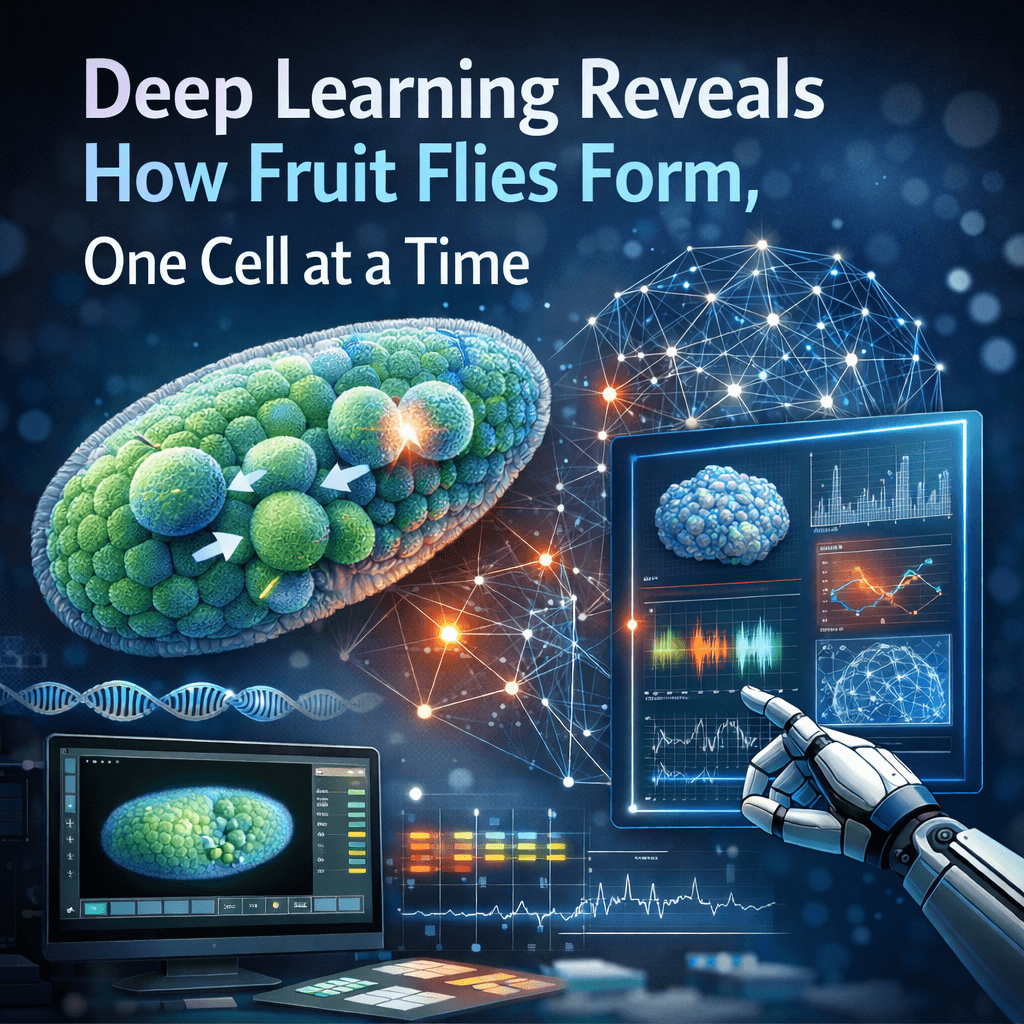
A team of engineers at MIT has developed a powerful new artificial intelligence model capable of predicting how individual cells move, fold, divide, and rearrange during the earliest stages of development. The model can forecast these changes minute by minute with up to 90% accuracy, offering new insights into how complex tissues and organs form.
The research, published in Nature Methods, focuses on the process of gastrulation, a critical one-hour phase in early development when thousands of cells rapidly reorganize. Using high-resolution videos of fruit fly embryos—each containing about 5,000 cells—the team trained a deep-learning model to track and predict the behavior of every single cell over time.
Unlike traditional approaches that model embryos either as moving points or as foam-like structures, the MIT researchers combined both methods into a single “dual-graph” framework. This approach captures not only the position of cells, but also their physical connections, shape changes, and interactions with neighboring cells.
“We can predict not just what will happen to a cell, but when it will happen,” said Ming Guo, associate professor of mechanical engineering at MIT and senior author of the study. “This allows us to understand how local cell interactions give rise to large-scale tissue structures.”
The model successfully predicted key cellular events—such as folding, division, and detachment from neighboring cells—minute by minute during early development. According to the researchers, the method could eventually be applied to more complex organisms, including zebrafish, mice, and even human tissues.
Beyond developmental biology, the technology may also help identify early signs of disease. Conditions like asthma and cancer are associated with subtle changes in cell dynamics long before symptoms appear. By detecting these early patterns, the model could support improved diagnostics and drug testing in the future.
“The biggest limitation right now isn’t the model—it’s the availability of high-quality data,” said Guo. “With the right imaging data, this approach could be widely applied across many biological systems.”
The study was supported in part by the U.S. National Institutes of Health.
Source : https://news.mit.edu/2025/deep-learning-model-predicts-how-fruit-flies-form-1215