
Pose Estimation in Sports: Athletic Performance Analysis Using AI
Nov 24, 2024
Aug 24, 2026
Written by: Maryam Rajaei
Reviewed by: Boshra Rajaei, PhD
Written by: Maryam Rajaei
Reviewed by: Boshra Rajaei, PhD
Athletic performance optimization traditionally relies on subjective visual assessments by coaches. Manual biomechanical analysis requires expensive laboratory equipment and specialized expertise, making comprehensive movement analysis inaccessible to most athletes.
Traditional coaching methods struggle to capture subtle biomechanical deficiencies that impact performance, while quantitative data remains confined to elite training facilities with motion capture systems. This gap between elite and amateur training resources constrains performance improvement across all competitive levels.
Pose estimation wih AI changed this landscape by providing accurate digital representations of athletes in action, mapping key body joints to create virtual skeletons that reveal biomechanical dynamics from standard video footage.
This article goes through how pose estimation technology works, the core algorithms enabling sports analysis, and applications across athletic disciplines.
Pose estimation is a computer vision technique that identifies critical body points such as elbows, knees, wrists, and ankles to create detailed skeletal representations of human movement. The technology analyzes images or video to locate these key joints, connecting them to form a biomechanical model that reflects posture and motion dynamics accurately.
This digital skeleton enables quantitative analysis of movement patterns, turning subjective coaching observations into measurable data. The versatility of pose estimation spans multiple sports, capturing everything from golf swing mechanics to swimming stroke efficiency.
Read Also: Skeleton detection online
Pose estimation in sports combines advanced AI and computer vision to convert ordinary video footage into precise biomechanical data. Here’s how the process works:
Joint Detection and Skeleton Mapping:
AI algorithms identify key body landmarks such as elbows, knees, hips, and ankles straight from video frames. These points are connected to form a digital skeleton that mirrors the athlete’s actual movement in real time.

Deep learning models like Spatiotemporal Transformers analyze both spatial (body position) and temporal (movement over time) data simultaneously. This enables accurate tracking of dynamic athletic actions such as swings, kicks, or jumps.
Temporal Convolutional Networks (TCNs) process frame sequences to capture how each joint moves across time, revealing subtle technique variations often missed by manual observation.
Using Graph Convolutional Networks (GCNs), the body is represented as a graph where joints are nodes and bones are edges. This structure helps the system understand complex joint interactions, even when some body parts are hidden or occluded.
Multiple camera views or deep neural estimation enable 3D reconstruction of the athlete’s motion, translating 2D images into fully dimensional biomechanical models for precise angle and posture analysis.
Pose estimation transforms multiple aspects of sports performance and athlete development:
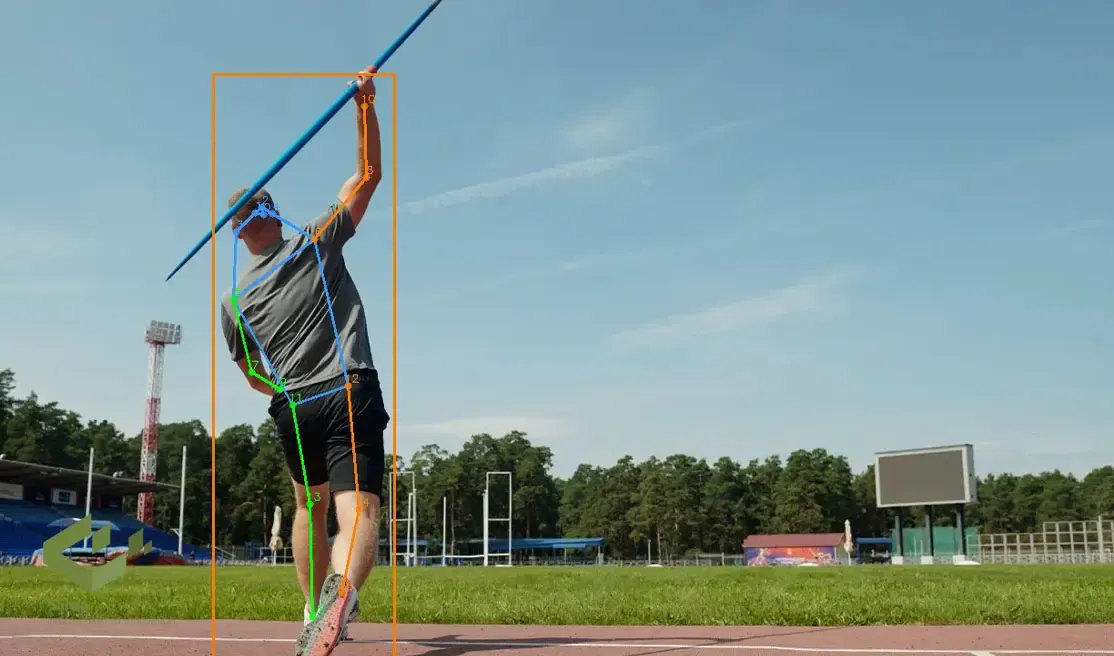
3D pose estimation is redefining how coaches and athletes refine their movement mechanics.
Every performance analysis system presents distinct strengths and challenges that organizations must evaluate when integrating technology into athletic training and competition environments.
Implementation challenges exist despite pose estimation's transformative potential:
AI-powered pose estimation provides substantial benefits for athletic development:
Fraime’s Pose Estimation service brings advanced biomechanical analysis directly to athletes, coaches, and performance specialists without the need for motion-capture labs or specialized hardware. By combining OpenPose, MediaPipe, and our recent ViTPose transformer-based models, Fraime delivers highly accurate multi-person keypoint detection from any standard video streams.
Users gain access to real-time kinematic tracking, automatic joint-angle measurement, movement-pattern comparison, and customizable analytics dashboards (upon request) tailored to their sport. Whether you aim to refine technique, prevent injury, or quantify performance progress, Fraime transforms raw footage into actionable insights, making elite-level biomechanics accessible to everyone.
Pose estimation technology fundamentally transforms athletic performance analysis by converting subjective visual assessments into objective, quantifiable data. Applications are technique refinement, injury prevention, personalized training development, and remote From a technical standpoint, what sets modern pose estimation apart is not only its precision and accuracy but its scalability across real-world sports environments.
With transformer-based models like ViTPose capturing global context and bottom-up systems like OpenPose excelling in multi-athlete scenes, we can now analyze movement in situations that were previously too dynamic, crowded, or unpredictable for traditional motion-capture methods.
In my experience, the true breakthrough lies in unifying these algorithms within platforms like Fraime—where raw joint detections are converted into meaningful metrics, comparative reports, and corrective feedback loops. This convergence of AI and sports science is redefining how athletes understand their bodies, enabling a level of technical refinement that was once possible only in elite biomechanics laboratories.
Note: Some visuals on this blog post were generated using AI tools.
