



Agricultural Data Management: Enhancing Efficiency in Farming
Explore the importance of agricultural data management, its role in improving farming practices, efficiency, and sustainable agricultural growth.
Written by Amirhossein
Reviewed by Boshra
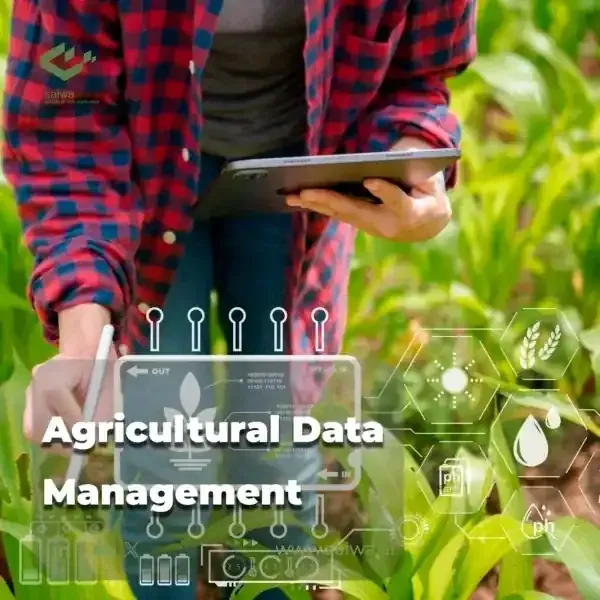
Agricultural operations generate enormous amounts of information through sensors, connected machinery, drones, and digital platforms, yet much of this data remains unused because it is rarely organized in a way that supports decision making.
When farms collect information without structure or context, the result is fragmented records that offer little guidance for planning or optimization. This gap matters because strong data practices are essential for improving yields, reducing waste, and operating more sustainably in a competitive agricultural environment.
By establishing clear data collection processes, reliable storage systems, and analytics tools, farm enterprises can turn raw information into meaningful insights.
This article explains practical methods for managing agricultural data and shows how farms can build a unified system that maximizes the value of digital agriculture investments.

Importance of Agricultural Data Management
Without proper data harvesting, storage, and governance practices established early on, gaps occur losing pivotal context that could improve future decision analytics.
Uncovering Correlative Insights
Experts can pinpoint influential correlations between isolated environmental factors and yields through statistical analysis of diverse aggregated data sources combined holistically.
Planning Operations Judiciously
Complete data histories fuel precise forecast modeling capabilities that allow farmers to determine ideal crop selection, planting locations, harvest windows, and cultivation amendments custom-tailored to their unique land characteristics season over season.

Types of Agricultural Data
Here are the main types of agricultural data management.
Farm Equipment Telemetry
Modern tractors, harvesters, and implements generate immense volumes of live usage statistics including engine load metrics, fluid levels, throttle application, hydraulic pressure, rotor speeds, and more. Location identifiers assign recordings to field zones.
Crop Analysis Feeds
Multispectral aerial imagery, drone footage, and scanner readings on crop health, maturity states, moisture stress, and growth phases build data pillars for predictive modeling.
Animal Biometrics
Ingestible health monitoring sensors, wearables on cattle, video tracking in hen houses, and milk output meters create information streams around livestock conditions optimizing welfare.
Read Also: A Guide to AI in Livestock Monitoring |Smart Farms
Weather Station Sensor Grids
Arrays of weather sensors distributed across acreages measuring hyperlocal variations in temperature, precipitation, dew point, soil temperature, and evapotranspiration rates at 5–15-minute sampling frequencies inform irrigation, fertilization, and harvest timing decisively.

Data Collection and Instrumentation
The starting point for leveraging agricultural data management begins with instrumenting equipment, vehicles, livestock, and environmental sensors measuring details occurring across farm operations. Data harvesting requires more than just capturing isolated siloed metrics in bulk but thoughtfully tying recordings to location and timing context.
As tractors pass through fields performing planting, spraying, and harvesting routines for example, IoT modules can encode geo-coordinates documenting exactly where machinery operates matched to runtime timestamps plus tied operational statistics like fluid levels and diesel consumption to link usage factors back to field zones.
Meanwhile, dense sensor grid layouts scattered across acreage measuring hyperlocal weather conditions every few minutes fueled by on-site solar power can feed into data pools providing microclimate insights impossible from relying on isolated broader regional weather reports alone.
Appending additional sensors onto livestock animals to assess movements, feed intake, and biometrics during grazing, transportation, and sheltering provides invaluable health monitoring indicators tied back to groups using edge data processing.
Structured data gathering requires intentional instrumentation using appropriate fieldbus protocols and APIs capable of handling agriculture working conditions and interfaces rather than just generic IT equipment. Ruggedized IoT devices survive prolonged outdoor placement across seasons while integrating adequately with existing equipment.

Data Storage Infrastructure
The mass-scale machine-generated recording volumes amassing daily from scattered agricultural data sources require planning sufficient backend infrastructure for securely aggregating and storing the continual flows for processing. A hybrid approach blending on-premise solutions with public cloud platforms balances affordability, scalability, and analytics readiness:
Locally managed data warehouses and servers offer inexpensive starting capacity for smaller operators to retain recent seasons of aggregated data if sized adequately. However backup power protection is essential to maintain uptime through grid outages to avoid gaps in data flows which would impede complete harvesting records.
As analytic needs develop, expanding into public cloud infrastructure delivers vastly greater storage capacity for developing more complete multi-year agricultural data lakes at reduced incremental costs. Cloud analytics engines input cleansed datasets while applying machine learning techniques against historical benchmarks pursuing advanced modeling. AWS, Google Cloud, and Azure provide services tailored for ag data workloads.
Based on growth expectations down the road, hybrid architectures maintain selective core data like sensor readings on local storage infrastructures while funneling processed derivative datasets into cloud repositories cost-effectively. This facilitates analyzing manageable recent data batches on-premise while offloading cold long-term archives externally.

Case Studies
Examining successful case studies provides insights into the real-world impact of agricultural data management. Farms that have embraced data-driven practices showcase tangible benefits, from increased productivity to improved resource efficiency. These examples serve as inspiration for others looking to adopt similar approaches.
Predictive Crop Planning with Satellite Data
By ingesting satellite imagery data documenting multiple prior growing years showing pivot irrigation patterns and subsequent yield results differentiated by crop varieties, AI models can optimally determine the highest value cultivation planting recommendations for each zone maximizing producer profits.
Earlier Harvesting from Maturity Monitoring
Ingesting regular aerial NDVI crop scans tracking maturation phases across mid-season growth followed by geo-tagged early harvester route completion rates layered over yield accuracy logging enables tighter protocols for dispatching autonomous picking fleet routes daily based on crops reaching maximal ripeness first.
Variable Rate Amendment Adjustments
After clustering soil composition scans, drainage profiles, and yield results logged geo-spatially over years, prescription map layers get generated indicating optimal variable application rates for irrigation, fertilizers, pesticides, and liming tuned at a sub-acre level personalized to each zone’s potential.
The Future of Agriculture Data Management
The landscape of agriculture data management is rapidly evolving. While collecting and storing data is foundational, the true value lies in seamless integration, security, and actionable insights. Key future trends shaping this domain include:
Data Interoperability and Standardization
Breaking down data silos is crucial. The future points towards greater adoption of industry standards allowing data from diverse equipment, sensors, and software to communicate effortlessly. This creates a unified data ecosystem for holistic farm management.
Cybersecurity in Connected Agriculture
With increasing connectivity comes vulnerability. Protecting sensitive farm data and automated systems from cyber threats like ransomware or breaches will become paramount. Expect a stronger focus on secure protocols, regular security audits, and farmer education on cybersecurity best practices.
Edge Computing
Processing data closer to the source—on tractors, sensors, or local gateways—is gaining traction. Edge computing enables faster, real-time analysis for immediate adjustments in the field (like variable rate applications) without relying solely on cloud connectivity, boosting responsiveness.
Skills Gap and User Experience (UX)
Sophisticated tools require skilled users. The future involves bridging the data literacy gap through training and, importantly, developing more intuitive, user-friendly interfaces. Simplifying complex data analysis will empower more farmers and advisors to harness its potential effectively.
Sustainability Reporting and Traceability
Data will increasingly be used to validate practices. Future ADM systems will facilitate easier collection and reporting of metrics for sustainability verification demanded by consumers and regulators. This also enhances farm-to-fork traceability, potentially integrating technologies like blockchain for immutable records.
Conclusion
Effective agricultural data management strengthens the foundation of modern precision farming by transforming scattered measurements into meaningful operational intelligence. When farms intentionally capture clean data, store it securely, and apply analytics tools, they gain clearer visibility into crop performance, livestock conditions, field variability, and long term resource trends. This level of insight supports smarter planning, early issue detection, and more consistent profitability.
From an expert perspective, success in data driven agriculture depends not only on advanced tools but also on disciplined workflows that match the realities of farming. High quality data, interoperability across systems, and a practical understanding of what information is most relevant are essential. As digital agriculture continues to evolve, farms that invest early in strong data practices will be better equipped to adapt, innovate, and operate efficiently in an increasingly complex agricultural landscape.
Note: Some visuals on this blog post were generated using AI tools.
References (4)
Comments
No comments yet!
Table of Contents
No headings were found on this page.