


Advanced Pest Control in Ontario: How AI is Transforming Crop Management
Optimize pest control in Ontario with AI. Detect pests early, map weeds precisely, and improve greenhouse and field decisions using Sairone's machine vision.
Written by Amirhossein
Reviewed by Boshra
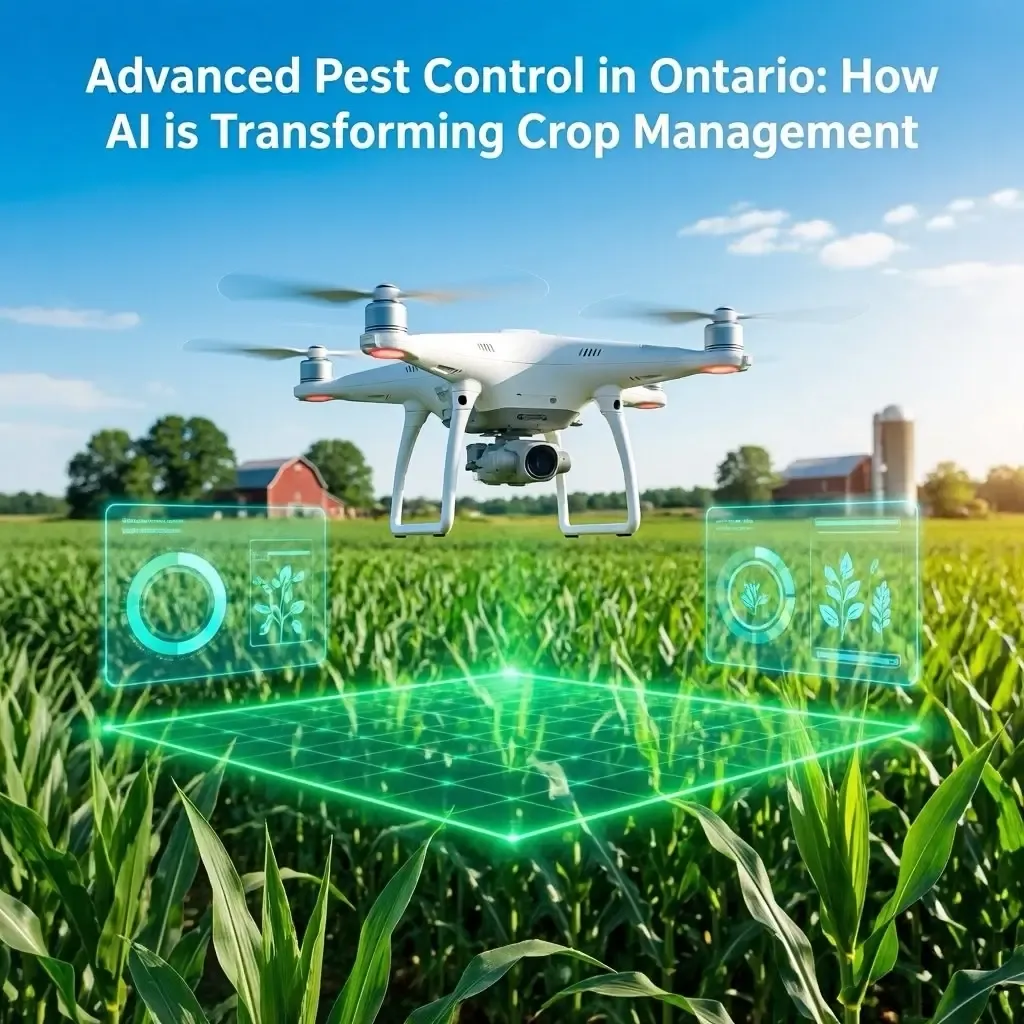
Ontario growers, greenhouse operators, and commercial land managers face a mounting challenge: pest and weed pressures are becoming harder to predict and significantly more expensive to manage using broad, reactive methods. While manual scouting remains important, it often misses early infestations, patchy weed emergence, and fast-moving hotspots that can devastate yields and inflate chemical costs.
This is where Sairone—Saiwa’s dedicated agricultural AI platform—steps in. By processing high-resolution drone imagery, orthophotos, and live feeds from greenhouse cameras, Sairone transforms pest and weed management into a precise, data-driven science. Our deep learning models automate pest population counting, map weed distribution at the pixel level, and generate variable-rate prescription files for targeted intervention.
This article explores how AI-powered monitoring is revolutionizing decision-making across Ontario’s agriculture and greenhouse systems, offering measurable operational value from early detection to cloud-based intervention planning.
Pest Control Ontario Canada: Why It Matters
In Ontario, pest management is no longer just a seasonal maintenance task; it is a strategic pillar of crop protection, profitability, and environmental compliance. Whether you operate a high-tech greenhouse near Toronto, a sprawling field crop business in southern Ontario, or a commercial landscape portfolio, timely detection and targeted action matter more than ever.
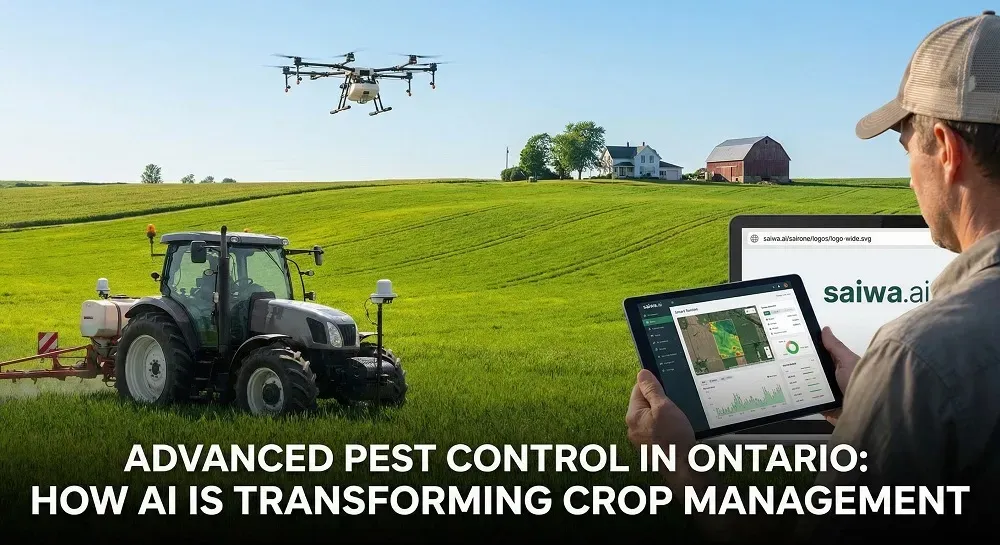
Pest control in Ontario for farms, greenhouses, and commercial properties
Pest control in Ontario spans vastly different environments, yet the core operational challenge remains the same: detect the problem early, classify it accurately, and respond before the damage spreads.
- Farms: Pest pressure reduces stand quality, photosynthetic capacity, and final yield.
- Greenhouses: The financial risk is exponentially higher because insects and diseases multiply rapidly in warm, controlled environments.
- Commercial Properties: Managed landscapes face strict public safety expectations, requiring high visual quality with minimal chemical overuse.
A professional, modern pest control program must address early insect detection, effective weed suppression (to eliminate secondary pest habitats), and highly efficient labor allocation. AI bridges this gap by turning raw images into actionable operational intelligence, moving farm managers from broad assumptions to verified, location-based action.
Why pest pressure and weed pressure are rising across Ontario
Several compounding factors are making pest control in Ontario Canada increasingly difficult:
- Weather Variability: Warmer periods and irregular rainfall accelerate insect development and weed establishment.
- Production Intensity: Greenhouses run tight, high-density schedules with zero margin for missed scouting, while open-field farms are managing larger acreages that are impossible to inspect entirely by hand.
- Chemical Resistance: The historical over-reliance on uniform, calendar-based chemical applications has reduced the long-term effectiveness of traditional herbicides and pesticides.
- Weeds as Alternate Hosts: Weeds do more than compete for nutrients; they provide shelter and breeding grounds for destructive insects and pathogens.
Today, the critical question is no longer, "Do we have a pest problem?" It is, "Where exactly is the problem, how severe is it, and what is the most efficient targeted response?"
Pest Control in Key Ontario Cities and Growing Regions
Ontario's agricultural landscape is highly diverse. A solution that works for an open field may need adjustments for an urban greenhouse. Location-specific monitoring is crucial because local imagery, environmental conditions, and crop types dictate how fast a team must respond.
Pest control Toronto Ontario: greenhouse, urban agriculture, and field crop applications
Pest control in Toronto, Ontario often revolves around greenhouse production, urban agriculture, and peri-urban commercial properties. In these high-value settings, detecting pests early enough to prevent a rapid outbreak is the ultimate goal.
Greenhouses near the Greater Toronto Area (GTA) deal with dense plant canopies and overlapping growth stages. Traditional scouting is highly labor-intensive and prone to missing microscopic early hotspots. Sairone’s AI-powered imaging scans leaves, rows, and greenhouse benches to flag abnormalities automatically. For larger field crop operations on the city's outskirts, our drone-based orthophoto analysis provides broad coverage, enabling zone-specific treatment decisions across expansive acreages.
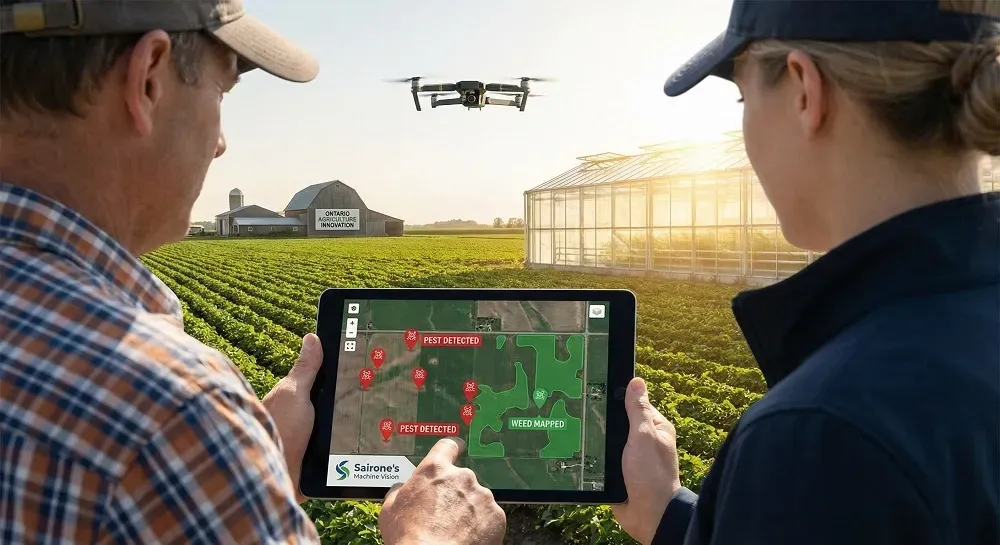
Pest control Hamilton, Brampton, Mississauga, and Scarborough Ontario: local crop pressures and AI solutions
Searches for pest control in Hamilton, Brampton, Mississauga, and Scarborough reflect a critical need for local relevance. While these peri-urban regions differ in land use, they share common operational bottlenecks: fragmented production sites, high labor costs, and time-sensitive intervention windows.
Sairone's AI approach is highly effective in these regions because it unifies both greenhouse and outdoor monitoring through a single cloud-based workflow, providing faster, more consistent evidence for agronomists.
| Ontario Region | Common Environments | Typical Pressure | AI-Supported Value |
|---|---|---|---|
| Toronto | Greenhouses, urban agriculture, peri-urban farms | Fast pest spread, high labor demand | Early hotspot detection and digital monitoring |
| Hamilton | Mixed horticulture, greenhouse, commercial landscapes | Variable weed patches and insect pressure | Targeted treatment planning and better documentation |
| Brampton | Nursery, landscape, urban-edge agriculture | Uneven site conditions and recurring outbreaks | Image-based surveillance across multiple properties |
| Mississauga | Commercial grounds, greenhouse supply chains | Quality-sensitive environments | Reduced unnecessary treatment through precise detection |
| Scarborough | Managed landscapes, urban agriculture pockets | Patchy weed pressure and localized pest hotspots | Zone-specific action supported by cloud mapping |
Weed Control Ontario as Part of Pest Management
Effective pest management in Ontario is inextricably linked to effective weed management. Treating weeds as a separate, secondary issue is an operational mistake. Weeds directly influence pest habitats, crop stress, and treatment efficiency.
Weed control Ontario and why it directly affects pest outbreaks
Weeds do much more than compete for water and light. A field margin with unmanaged weeds serves as a transition zone for insects migrating into the primary crop. In a greenhouse or nursery, weeds growing near pathways contribute to recurring pest cycles. By treating weed control in Ontario as a core component of pest defense, operations can eliminate alternate habitats, making insect infestations significantly easier and cheaper to manage.
Weed control in Ontario for field crops, orchards, and greenhouse systems
Weed management strategies vary heavily by production system:
- Field Crops: Weeds rarely emerge uniformly. Blanket herbicide treatments waste expensive chemicals on clean zones. Sairone’s drone and satellite analysis maps this variability, supporting highly precise spot-spraying.
- Orchards: Weeds interfere with irrigation and harvest access. Precision mapping provides season-long spatial records to improve understory management.
- Greenhouses: Weed control is tied to sanitation and floor management. AI helps teams identify recurring spatial patterns that manual inspectors might dismiss as isolated incidents.
Guide to weed control Ontario: prevention, detection, and targeted treatment
A modern, practical guide to weed control in Ontario relies on an integrated framework rather than chemistry alone:
- Prevention: Use strict sanitation, crop rotation, and edge management to block seed introduction.
- Detection: Capture weed presence early using Sairone’s drone imagery, video, or orthophoto analysis.
- Mapping: Convert raw images into digital spatial layers detailing weed density and expansion.
- Targeted Treatment: Apply variable-rate treatments or mechanical interventions only to the affected zones.
Verification: Reassess the site using AI to confirm the efficacy of the herbicide application.
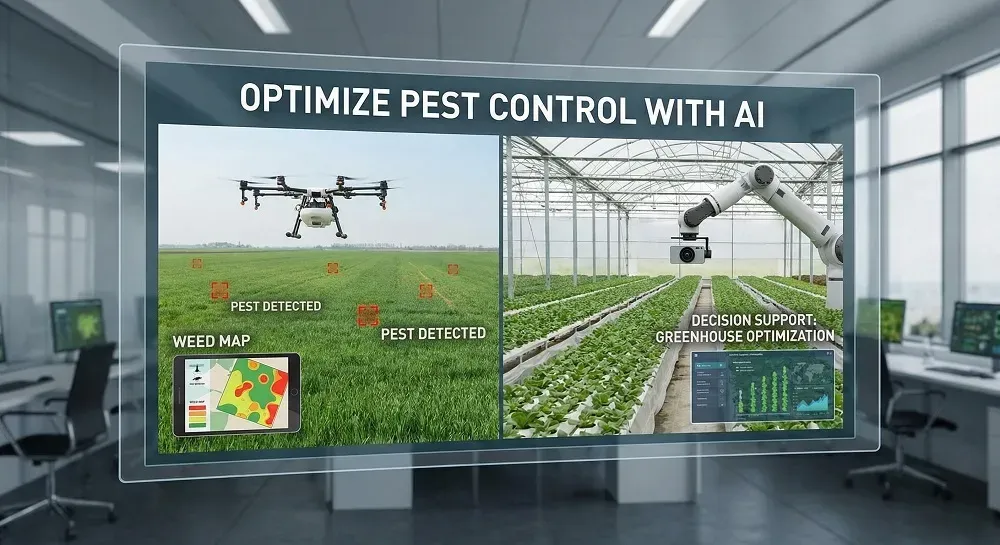
Sairone's Services for Pest Control and Weed Control in Ontario
Sairone, a specialized division of Saiwa, delivers enterprise-grade machine vision solutions tailored for Canadian agriculture. We make pest and weed management measurable, targeted, and infinitely scalable.
Machine Vision detection, segmentation, counting, and tracking for Ontario operations
Our platform supports agribusinesses, consultants, and service providers by delivering standardized, unbiased outputs. Whether you need to assess the severity of a localized infestation or trigger a threshold-based biological intervention, Sairone provides the exact spatial intelligence required.
Video and orthophoto analysis for greenhouse and field monitoring
We know operations do not want to completely overhaul their hardware. Sairone is sensor-agnostic. We process live video from greenhouse rails, stationary camera feeds, mobile phone captures, and drone-stitched orthophotos. Deliverables include hotspot maps, weed infestation layers, and time-series tracking visuals delivered straight to your dashboard.
Real-World Ontario Use Cases and Case Studies
AI is not a replacement for agronomic expertise; it is a powerful force multiplier. Here is how Sairone’s logic applies to real Ontario environments.
Case study: AI-based pest population counting in an Ontario greenhouse operation
A high-value vegetable greenhouse in Ontario faced recurring insect pressure. The problem wasn't a lack of scouting; it was that manual pest counts on sticky traps varied wildly depending on which staff member checked them. Intervention timing was based on fragmented, inconsistent notes.
By implementing Sairone’s image capture and AI population counting workflow, the greenhouse achieved standardized, objective counts. Management could instantly see whether pest pressure was stable, rising, or declining, allowing them to perfectly time the release of expensive biological predators.
Conclusion
The future of pest control in Ontario Canada is not about hiring more scouts or spraying more chemicals. It is about better timing, unparalleled visibility, and laser-focused targeting.
For decision-makers evaluating pest and weed control solutions in Ontario, the paradigm has shifted: crop protection is only fully optimized when detection, mapping, and action are unified in a single digital workflow. Sairone makes this a reality through advanced machine vision, deep learning, and cloud-based analytics. By combining early detection with traceable, targeted intervention, Ontario agribusinesses can drastically reduce input waste, protect their margins, and build resilient operations for the future.
Comments
No comments yet!
Table of Contents
No headings were found on this page.