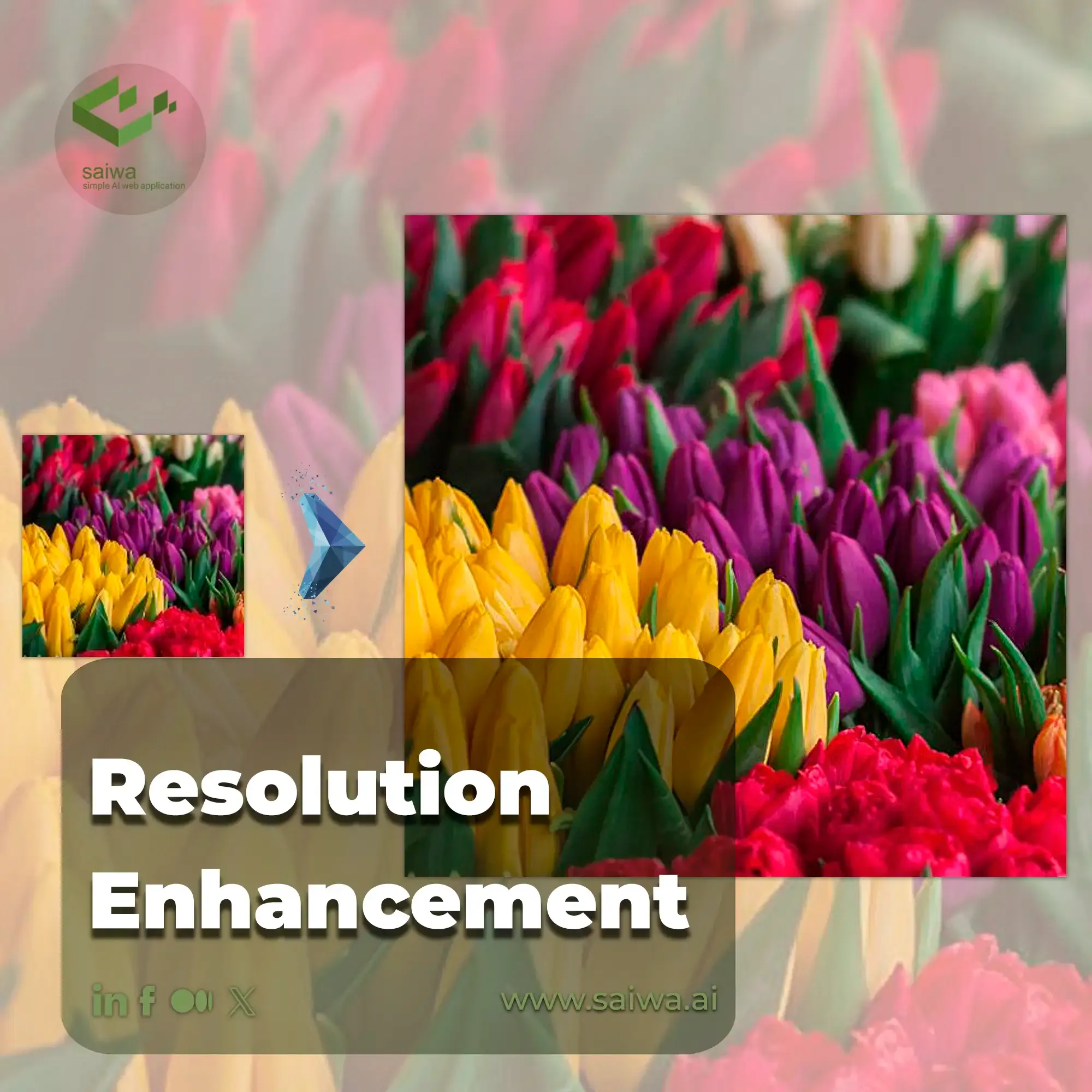
Resolution Enhancement
Feb 13, 2022
Aug 24, 2026
Written by: Amirhossein Komeili
Written by: Amirhossein Komeili
Resolution Enhancement refers to a group of techniques that are used in image processing or super-resolution microscopy for scaling up and improving low-resolution input images. Resolution enhancement has various applications, such as security and surveillance imaging, medical imaging, image generation, and satellite and astronomical imaging. There are both single and multiple image variants of resolution enhancement methods. saiwa provides two single image resolution enhancement methods using deep learning: Residual Dense Network (RDN) and Residual in Residual Dense Network (RRDN). They both use residual learning that has also been widely adopted to ease the training process, either in image-level or feature-level. For more details of the two methods and network architecture, please refer to the white paper. RDN networks weights are ready to use for scale-up with a factor of 2 and RRDN for scale-up with a factor of 4. For other scale-up factors, please fill-up the “Request for customization” form. saiwa resolution enhancement service benefits from following features:
https://cms.saiwa.ai/uploads/Resolution_Enhancement1080_Link1_800b113baf.m4v
Note: Some visuals on this blog post were generated using AI tools.

The aviation industry, a complex and dynamic sector, is engaged in an ongoing pursuit of innovative solutions to enhance efficiency, safety,

Blockchain technology and artificial intelligence together constitute two exponentially advancing domains that define modern software innova

Artificial Intelligence as a Service (AIaaS) is the third party offering of off-the-shelf AI tools. AIaaS allows individuals and companies t

The gaming industry has undergone a remarkable transformation in recent years, driven by advancements in artificial intelligence (AI) techno

We all know that Artificial Intelligence (AI) is changing how we live and work and transforming our world socially, economically, and politi

Machine vision has transcended simple object recognition; today’s deep learning models now perform nuanced quantitative analysis at an indus
Be the first to share your thoughts
Start the conversation by sharing your thoughts
Share this article
Help others discover this content
Get expert insights, product news, and industry trends delivered straight to your inbox.
No spam, unsubscribe anytime. We respect your privacy.