



Seedling Detection and Empty Cavity Counting
Status: Development (Started in Wed Apr 01 2026)
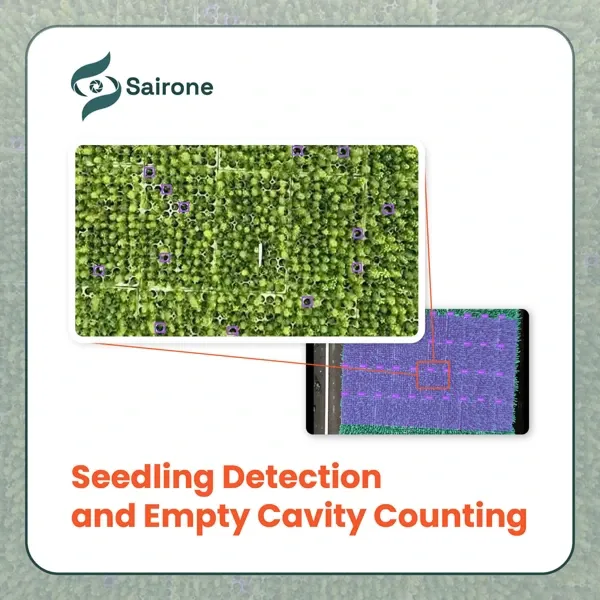
GreenTech Projects partnered with Saiwa to develop an AI-powered computer vision workflow for automated seedling tray analysis using drone imagery. The project focused on detecting and localizing seedling blocks, identifying empty cavities within propagation trays, and improving the speed and consistency of nursery monitoring operations. By combining aerial imagery with machine learning–based image analysis, the project demonstrated the potential of automated nursery assessment for large-scale propagation environments. The solution utilized RGB drone imagery collected over seedling fields and propagation areas. Saiwa developed and trained custom machine learning models capable of identifying tray structures and detecting empty cells across nursery blocks. The project was successfully completed and validated the feasibility of applying AI-based image processing to greenhouse and nursery production workflows

About Green Tech Projects
GreenTech Projects is a Canadian company specializing in controlled-environment agriculture, greenhouse technologies, and innovative horticultural production systems. The company focuses on improving operational efficiency, plant propagation workflows, and sustainable production practices through the integration of modern technologies and advanced agricultural methodologies.
Overview
Nursery and greenhouse propagation operations often rely on manual inspection methods to evaluate seedling trays, detect empty cavities, and monitor propagation quality. These workflows are labor-intensive, time-consuming, and difficult to scale consistently across large production environments.
To address these challenges, Saiwa collaborated with GreenTech to investigate the use of drone-based imagery and machine learning models for automated tray analysis. The project focused on two primary objectives:
- Detecting and localizing seedling blocks within aerial imagery
- Detecting and counting empty cavities within each block
Industry Challenge
Propagation facilities and nursery operations commonly face operational challenges related to tray inspection, seedling monitoring, and propagation quality assessment. In many commercial greenhouse and nursery environments, these tasks are still performed manually by staff who visually inspect thousands of trays to identify empty cavities, evaluate seedling emergence, and monitor overall tray uniformity. As production scale increases, manual counting and inspection workflows become increasingly time-consuming, labor-intensive, and difficult to standardize consistently across large propagation areas. Variability in lighting conditions, plant density, tray alignment, and human interpretation can also affect counting accuracy and reduce operational efficiency. These limitations create a strong need for scalable, data-driven monitoring solutions capable of providing faster and more consistent propagation analysis across large nursery operations.
Our Solution Approach
Saiwa developed a multi-stage AI-powered image analysis workflow specifically designed for propagation tray assessment and cavity detection.
The first stage focused on detecting and localizing seedling blocks within drone imagery. To train the detection models, Saiwa’s team annotated high-resolution images using the Fraime boundary annotation service. These annotated datasets were used to train machine learning models capable of identifying tray boundaries and propagation blocks across aerial imagery.
After tray localization, the second stage focused on identifying and counting empty cavities within each propagation block. For this step, we annotated images using Fraime bounding-box annotation service. The AI models were then trained to detect empty pots within trays.
Goals & Outcomes
The primary goal of the project was to automate nursery tray analysis using AI-powered computer vision models and drone imagery. Specific objectives included:
- Automating the identification of propagation blocks
- Detecting and counting empty cavities
- Reducing reliance on manual inspection workflows
- Improving scalability of nursery monitoring operations
The project successfully demonstrated promising results for both tray localization and empty cavity detection. Results generated on previously unseen imagery showed that the machine learning models were capable of accurately identifying propagation blocks and detecting empty cells across seedling trays.